Artwork
The Crucifixion [Center Panel]
![The Crucifixion [Center Panel], by John Baptist Jackson, ink, 1741](https://artifactworldgallery.com/img/john-baptist-jackson--the-crucifixion-center-panel--e1ad95a2187c7c85-w1024.webp)
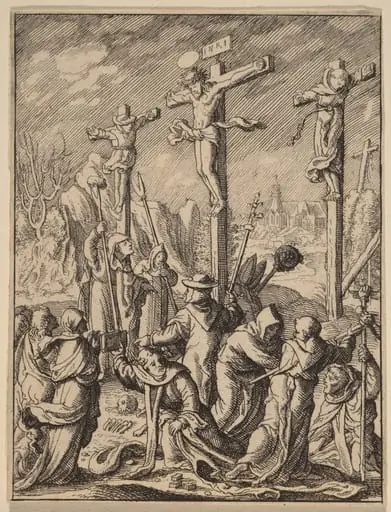
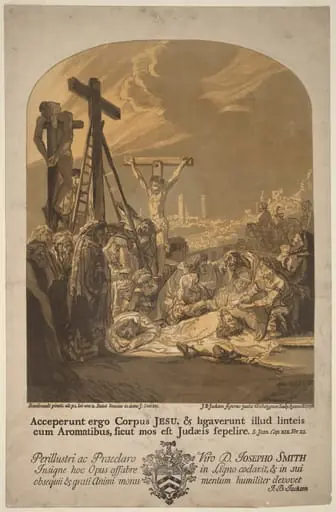
The Crucifixion [Center Panel] is an ink print by the Baroque artist John Baptist Jackson. It dates from 1741 and is held in the collection of the National Gallery of Art. Created in 1741, this chiaroscuro woodcut presents a dramatic interpretation of the crucifixion.
About this work
Overview
The composition centers on the nailed figure, surrounded by soldiers and a group of kneeling women, all set against a storm‑laden sky.
Created in 1741, this chiaroscuro woodcut presents a dramatic interpretation of the crucifixion. Printed on laid paper with four separate blocks, the image combines earthy hues—buff, light brown, gray, and red brown—to render a night‑time scene filled with tension and movement. The composition centers on the nailed figure, surrounded by soldiers and a group of kneeling women, all set against a storm‑laden sky.
Subject & Meaning
The work portrays the biblical moment of Christ’s execution, emphasizing the chaos of the surrounding crowd. Soldiers are shown forcing the cross upright and brandishing spears, while a cluster of women kneel in apparent shock or prayer. The stark lighting and turbulent sky amplify the sense of divine suffering and human turmoil inherent in the narrative.
Technique & Style
Jackson employed a chiaroscuro woodcut process, aligning four distinct woodblocks—each inked in a different earth tone—to build successive layers of color. Oil‑based inks allowed subtle overprinting, producing a richer palette than typical black‑and‑white woodcuts. The print also features embossing, a raised effect that adds tactile depth and highlights key figures within the scene.
History & Provenance
The print bears the printer’s name and a noble patron’s inscription at its base, a customary practice for high‑profile commissions in the eighteenth century. Though Jackson worked mainly in Paris and Venice, this piece reflects his broader European activity and the patronage networks that supported his innovative color printing.
Context
During the early 1700s, chiaroscuro woodcuts offered an alternative to oil paintings for reproducing complex, multicolored images. Jackson’s approach diverged from the ink‑and‑wash tradition, aiming instead to emulate the tonal richness of painted works. This print thus illustrates a transitional moment in printmaking, where technical experimentation expanded the medium’s expressive possibilities.
Artist & collection

Artist
John Baptist Jackson (1701–1780) was a British artist, a woodcut printmaker of the eighteenth century.

![The Marriage at Cana [left plate], by John Baptist Jackson](https://artifactworldgallery.com/img/john-baptist-jackson--the-marriage-at-cana-left-plate--22bae83d46cc40b5-w320.webp)