Artwork
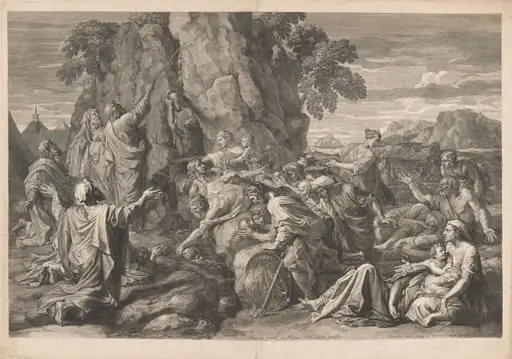
The Finding of Moses
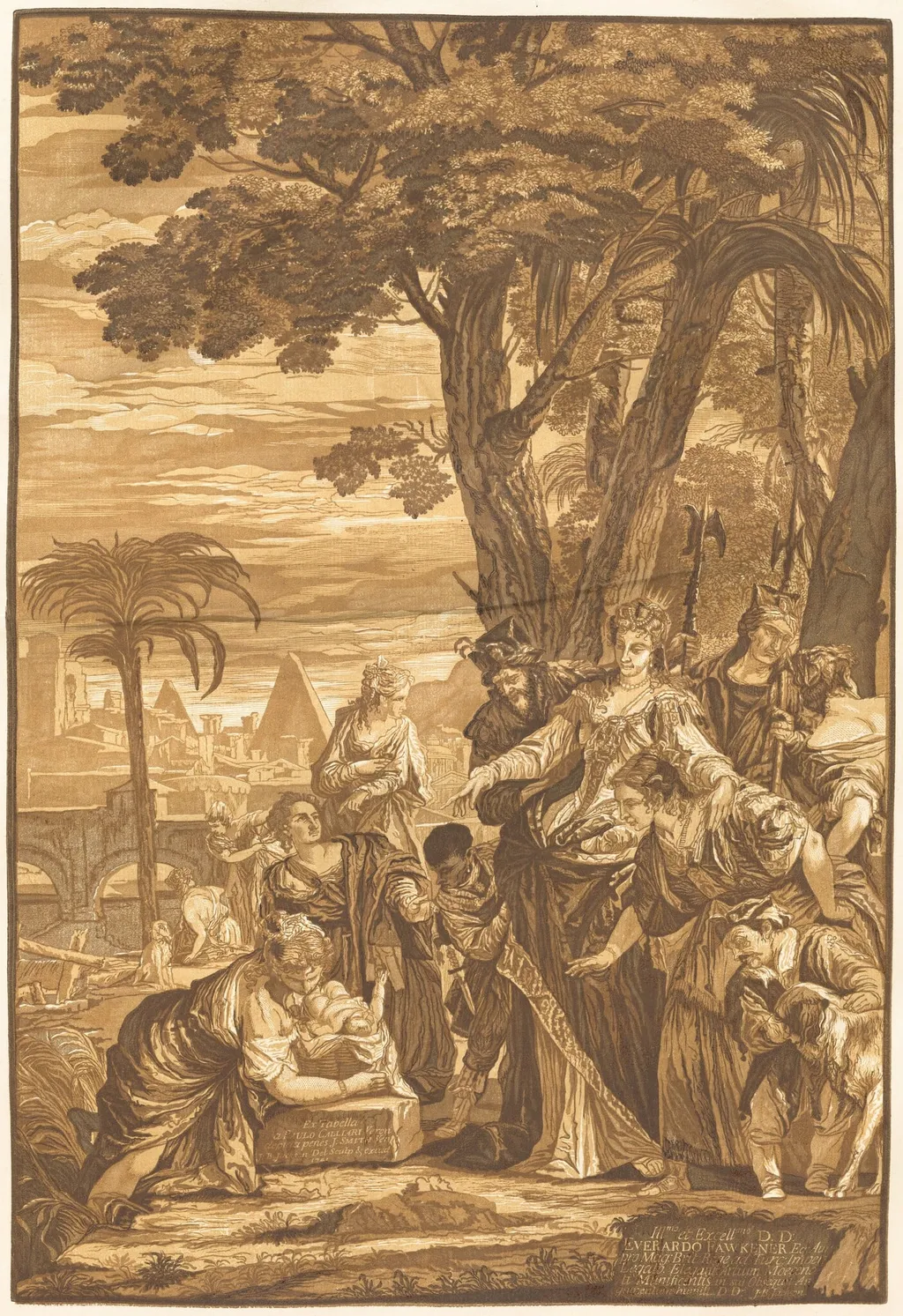
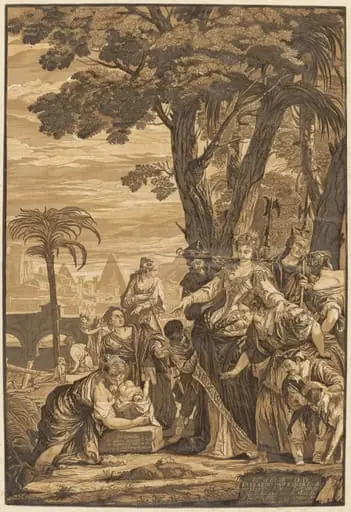
The Finding of Moses is an ink print by the Baroque artist John Baptist Jackson. It dates from 1741 and is held in the collection of the National Gallery of Art.
About this work
Overview
The print translates the drama of painted compositions into the medium’s distinct grain and tonal gradations.
Created in 1741 by British printmaker John Baptist Jackson, this chiaroscuro woodcut depicts the biblical moment when Pharaoh’s daughter discovers the infant Moses in the Nile. Executed in four muted tones—buff, light brown, violet gray, and dark gray—it exemplifies Jackson’s technical approach to color layering in woodcut, a method he refined during his time in Paris and Venice. The print translates the drama of painted compositions into the medium’s distinct grain and tonal gradations.
Subject & Meaning
The scene captures the instant of revelation: a woman kneels beside a woven basket, her hand extended toward the child, while others observe with varied expressions of surprise and caution. Palm trees and distant architecture frame the riverbank, anchoring the narrative in a familiar biblical landscape. The composition emphasizes quiet tension over grandeur, focusing on human reaction rather than divine intervention, aligning with 18th-century interpretations that favored psychological nuance.
Technique & Style
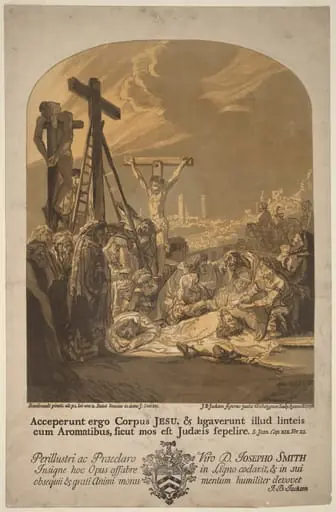
Jackson employed multiple woodblocks, each inked with a different tone, to build depth through overprinting. Subtle shifts in gray and brown create volume without line, while selective embossing enhances highlights on skin and fabric. The absence of black outlines and the use of atmospheric gradation reflect his adaptation of painterly chiaroscuro into woodcut, distinguishing his work from more linear contemporary prints and pushing the medium’s expressive limits.
History & Provenance
Jackson, active in the mid-18th century, produced this print during his years in continental Europe, where he studied and reproduced Italian and French paintings. Though little documented, his prints circulated among collectors and artists familiar with the chiaroscuro tradition. *The Finding of Moses* survives in a limited number of impressions, primarily in European institutional collections, reflecting its niche appeal and technical ambition.
Context
In the 1740s, chiaroscuro woodcuts were a revivalist endeavor, inspired by Renaissance models but adapted to contemporary tastes. Jackson’s work emerged amid growing interest in biblical narratives as subjects for printmaking, particularly in Britain and France. His use of oil-based inks and layered tones aligned with broader experiments in color printing, positioning him as a bridge between traditional craftsmanship and emerging print technologies.
Legacy
Jackson’s prints, including this one, contributed to the technical evolution of woodcut as a medium capable of tonal subtlety. Though not widely influential in his lifetime, his methods were noted by later printmakers seeking alternatives to etching and engraving. His work remains a reference point for scholars studying the intersection of painting and print in 18th-century Europe, particularly in the transmission of compositional ideas across media.
Artist & collection

Artist
John Baptist Jackson (1701–1780) was a British artist, a woodcut printmaker of the eighteenth century.

![The Marriage at Cana [left plate], by John Baptist Jackson](https://artifactworldgallery.com/img/john-baptist-jackson--the-marriage-at-cana-left-plate--22bae83d46cc40b5-w320.webp)