Artwork
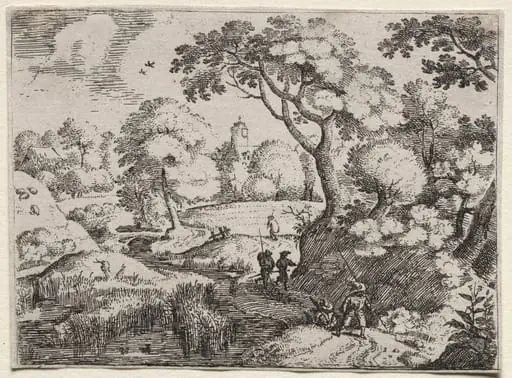
Landscape with Travelers Attacked by a Gang of Robbers
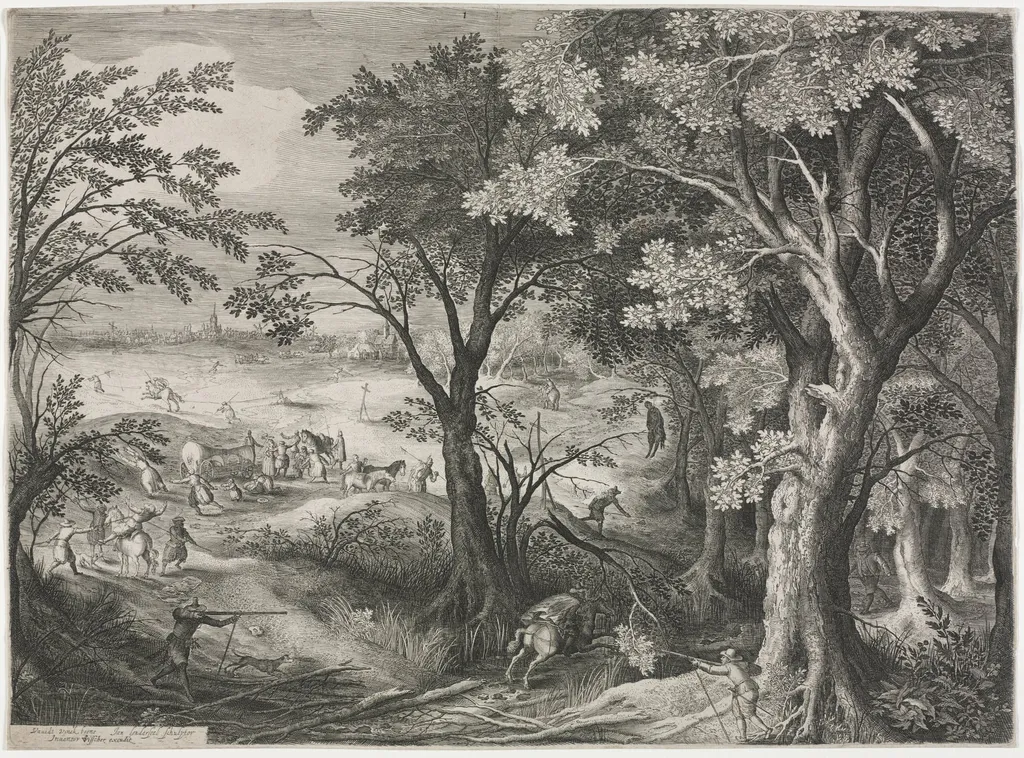
Landscape with Travelers Attacked by a Gang of Robbers is a print by the Baroque artist Jan van Londerseel. It dates from 1602 and is held in the collection of the Cleveland Museum of Art.
About this work
Overview
This engraving depicts a violent encounter between travelers and bandits in a dense forest, rendered as a print after a drawing by David Vinckboons.
This engraving depicts a violent encounter between travelers and bandits in a dense forest, rendered as a print after a drawing by David Vinckboons. Created around the turn of the 17th century, it reflects a recurring theme in Netherlandish art tied to the social unrest of the Eighty Years’ War. The composition captures multiple moments of chaos within a single frame, emphasizing danger and vulnerability on rural roads.
Subject & Meaning
The scene portrays displaced soldiers turned outlaws preying on civilians, a direct consequence of wartime instability. As families flee a overturned wagon and a mounted traveler attempts escape, the hanging corpse in the background serves as a grim deterrent. These images functioned not merely as spectacle but as warnings, grounding the viewer in the real risks faced by those traveling through lawless regions during prolonged conflict.
Technique & Style
Sharp, precise lines define the figures and foliage, enhancing the engraving’s dramatic tension. The dense shadows of the forest contrast with the illuminated figures, guiding the viewer’s eye through the unfolding violence. Details such as the wagons, weapons, and clothing are rendered with clarity, reflecting the printmaker’s reliance on Vinckboons’s detailed preparatory drawing and the medium’s capacity for narrative precision.
History & Provenance
David Vinckboons, originally from Antwerp, relocated to Amsterdam in 1586 following the Spanish siege of his native city. His move aligned with a broader migration of Flemish artists seeking safer artistic communities. This print, derived from his drawing, circulated widely in the Dutch Republic, where demand for scenes of contemporary peril remained high among a public acutely aware of war’s aftermath.
Context
The Eighty Years’ War disrupted rural economies and left many soldiers without livelihoods, leading some to form armed bands. These groups targeted travelers, especially along poorly policed forest roads. Artists responded by documenting such incidents, transforming real social trauma into visual narratives that resonated with urban audiences familiar with the instability of border regions and displaced populations.
Legacy
Vinckboons’s approach influenced later Northern European artists who explored similar themes of violence and isolation in nature. His integration of moral warning into landscape scenes prefigured the psychological depth found in works by contemporaries like Adam Elsheimer. Though not widely attributed today, these prints contributed to a visual language of danger that persisted in Northern art through the 17th century.
Own this work as a print
Artist & collection

 Saint Jerome in the Wilderness
 Cephalus and Procris
 March and April
 Landscape with a Milkmaid
 The Flight into Egypt: The Donkey Led to the River
 Euntes in Emaus (The Pilgrims to Emmaus)
 Landscape with the Temptation of Christ
 Pharaoh’s Daughter Finding Moses
 Untitled
 Woodland Scene with Two Hunters and a Dog to the Left
 Landscape
 Six Landscapes: Path Between Swamp and Wooded Bank