Artwork
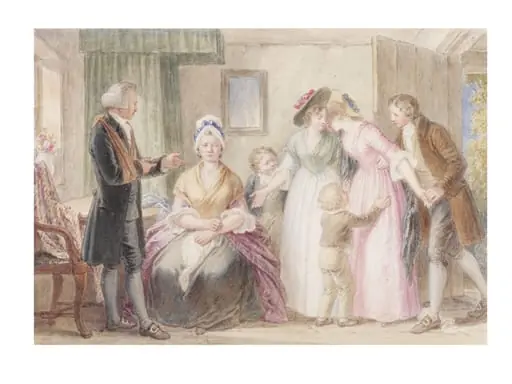
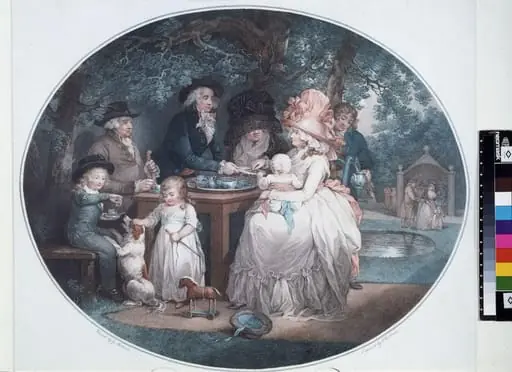
Young Thornhill introducing himself to the Primrose Family
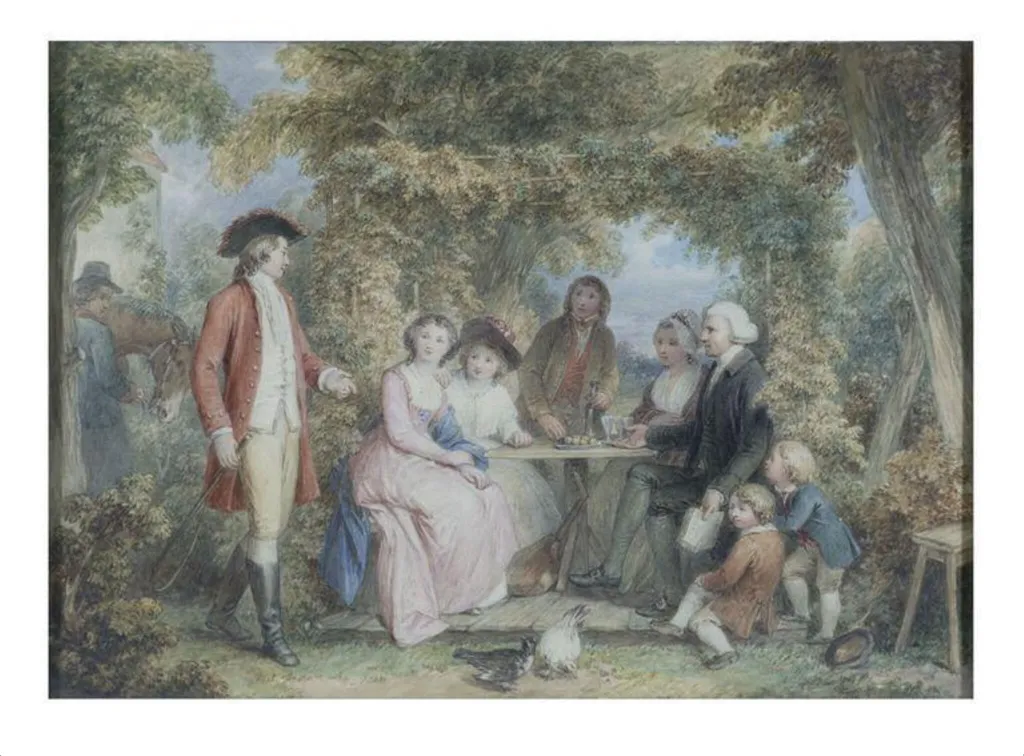
Young Thornhill introducing himself to the Primrose Family is a watercolor work on paper by John Masey Wright. It dates from 1850 and is held in the collection of the Victoria and Albert Museum.
About this work
Overview
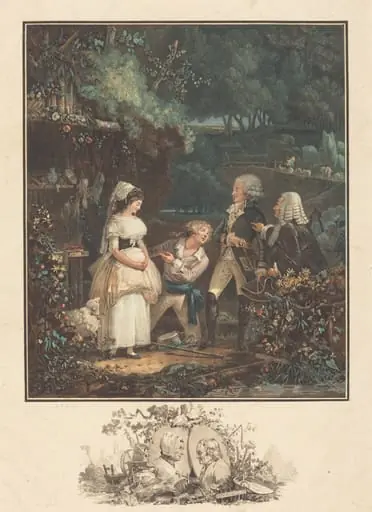
John Masey Wright’s watercolour presents a leisurely garden gathering drawn from chapter five of *The Vicar of Wakefield*. A young man in a red coat, hat in hand, stands before the Primrose family, who are seated or standing around a low table. The composition includes a woman in a pink dress with two children, a dog, a cat, and other figures engaged in casual conversation.
Subject & Meaning
The scene captures the moment when the character Young Thornhill makes his first introduction to the Primrose household, reflecting the novel’s themes of social interaction and courtship. By placing the newcomer slightly apart, Wright emphasizes the tentative nature of his entry into the family’s domestic space.
Technique & Style
Wright employs a muted palette of soft greens, pinks, and earth tones, applying loose brushstrokes that convey movement without excessive detail. The watercolour medium allows for delicate washes that suggest the dappled light of an outdoor setting, while the handling of figures remains suggestive rather than precise.
History & Provenance
The work belongs to a group of one hundred British watercolours bequeathed by the widow of Richard Ellison between 1860 and 1873. The donation was intended to help form the National Collection of Water Colour Paintings, a foundational effort to preserve the medium’s British heritage.
Context
Created in the early nineteenth century, the painting reflects the period’s interest in literary illustration, particularly scenes from popular novels. Wright, known for his narrative watercolours, frequently translated textual moments into visual episodes for a readership that prized both literary and artistic culture.
Artist & collection
Artist
John Masey Wright (1777–1866) was a British watercolourist. He was the son of an organ-builder and was apprenticed to the same business, but, as it proved distasteful to him, he was allowed to follow his natural…