Artwork
H Beard Print Collection
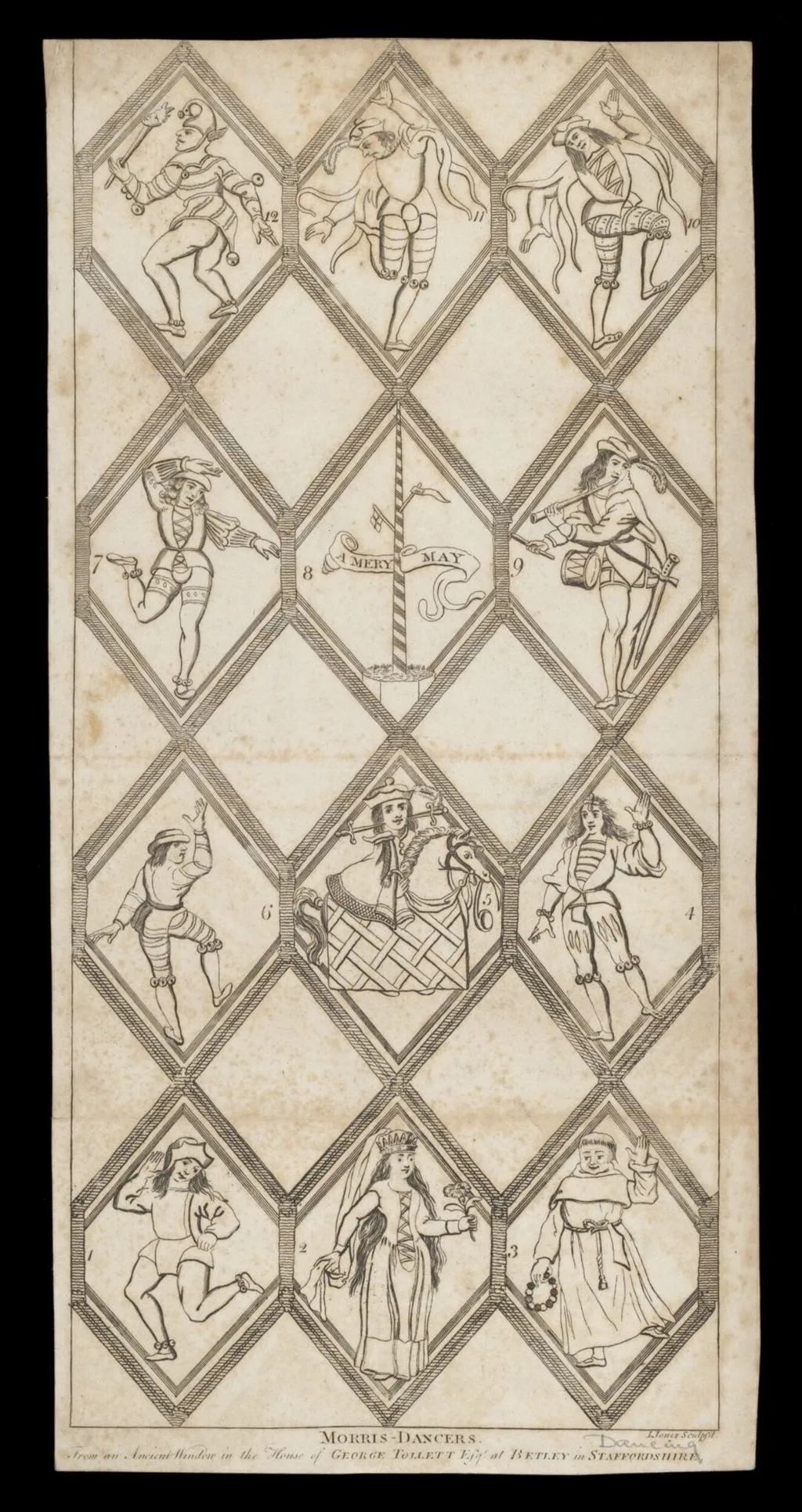
H Beard Print Collection is a print by Jones, I.. It dates from 1950 and is held in the collection of the Victoria and Albert Museum.
About this work
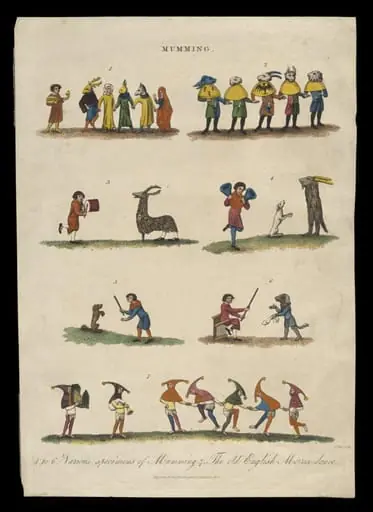
This print shows twelve Morris dancers in a row. It’s from an old window in a house in England. Created before 1900, it’s a print, not a painting.
The dancers wear bells on their legs. They hold hands and kick high in a line. The scene looks lively and full of motion.
Check out the Victoria and Albert Museum next.
Overview
Created prior to 1900, the image is not an original painting but a mechanical reproduction, likely intended for archival or decorative use.
A 19th-century print captures a sequence of twelve Morris dancers, reproduced from a stained-glass window once located in George Tollett’s home in Betley, Staffordshire. Created prior to 1900, the image is not an original painting but a mechanical reproduction, likely intended for archival or decorative use. The dancers are arranged in a single file, their movements rendered with rhythmic precision, suggesting a ceremonial procession.
Subject & Meaning
The dancers represent a traditional English folk performance, likely tied to seasonal festivals or May Day customs. Their linked hands and elevated kicks reflect a choreographed form of communal celebration. The presence of bells on their legs indicates an auditory component to the dance, reinforcing its role as a public, rhythmic ritual rather than a private display.
Technique & Style
The print employs fine line work to delineate each figure, with minimal shading to suggest volume. Clothing and bells are rendered with repetitive detail, emphasizing uniformity and pattern. The composition is linear and frontal, mirroring the architectural framing of the original window, which likely constrained the artist’s perspective to a flat, decorative arrangement.
History & Provenance
The source window belonged to George Tollett, a local landowner in Staffordshire, and was documented as an early example of folk imagery in domestic architecture. The print was made to preserve the design before potential deterioration. Its circulation among collectors suggests interest in regional traditions during the Victorian era’s antiquarian revival.
Context
Morris dancing was widely practiced in rural England through the 18th and 19th centuries, often associated with agricultural cycles and local identity. Though declining in some areas, it remained visible in preserved windows and illustrations. This print reflects a broader effort to record vanishing customs as industrialization reshaped rural life.
Legacy
The image contributes to the visual record of English folk performance, offering insight into how regional traditions were documented and disseminated before photography. It remains a reference for historians studying the material culture of rural celebrations and the role of domestic architecture in preserving communal rituals.
Artist & collection
Artist
I. Jones turned 19th-century London into a playground of hair and whiskers, cranking out prints so sharp you can count the curls on a poodle’s paw. They cranked out thousands, sticking them up like flyposters—cheap,…