Artwork
Holland Canal, near Rotterdam (Canal de Hollande, pres de Rotterdam (Hiver))
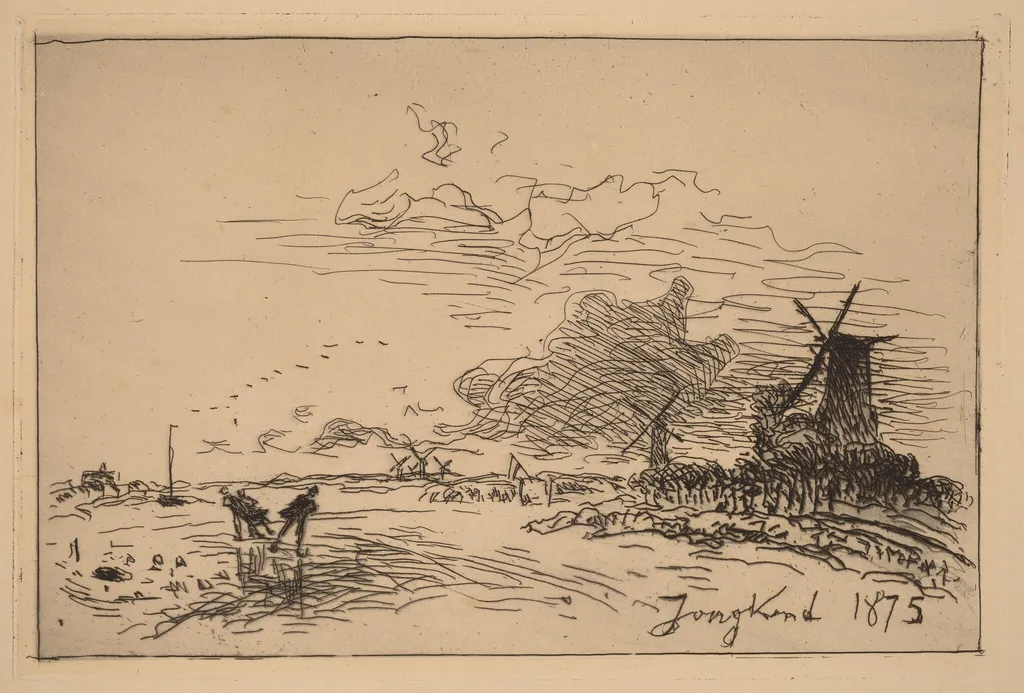
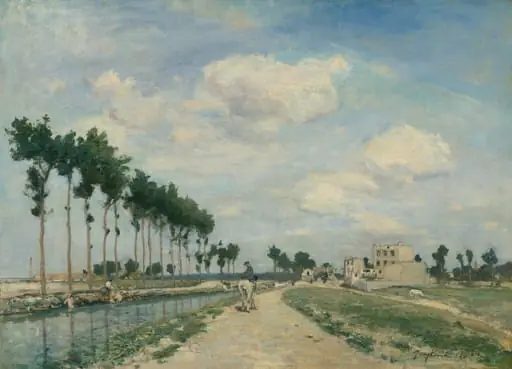
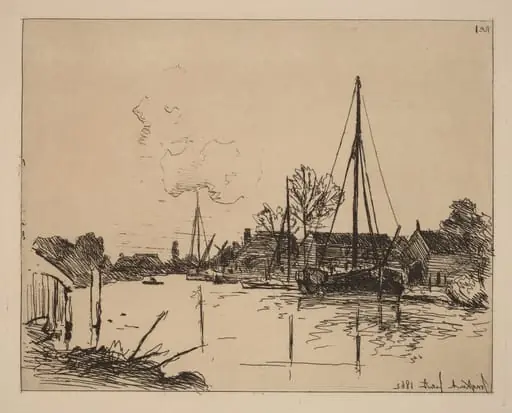
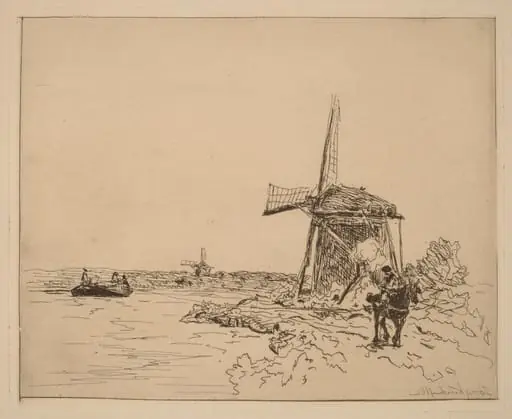
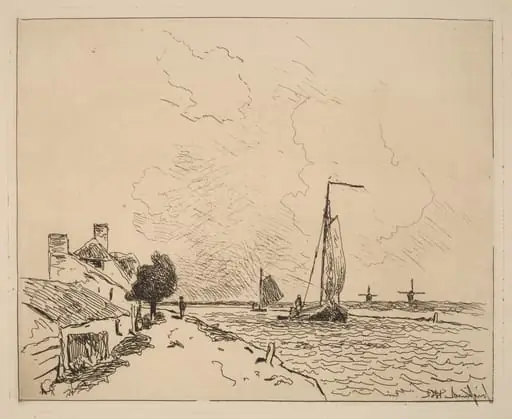
Holland Canal, near Rotterdam (Canal de Hollande, pres de Rotterdam (Hiver)) is an ink print by the Impressionist artist Johan Barthold Jongkind. It dates from 1875 and is held in the collection of the National Gallery of Art.
About this work
Overview
Created in 1875, this etching by Johan Barthold Jongkind captures a winter scene along a canal near Rotterdam. The work is part of a series of prints in which Jongkind explored Dutch landscapes with a spontaneous, observational approach. Its modest scale and quiet composition reflect a focus on everyday rural life rather than grand vistas, emphasizing atmosphere over detail.
Subject & Meaning
The scene depicts two small boats resting on still water, flanked by a low, snow-dusted bank and a distant windmill perched on a gentle rise.
The scene depicts two small boats resting on still water, flanked by a low, snow-dusted bank and a distant windmill perched on a gentle rise. The absence of figures and the muted tones suggest a moment of stillness, perhaps early morning or late afternoon in winter. The composition conveys a sense of solitude and seasonal quiet, characteristic of Jongkind’s interest in transient natural conditions.
Technique & Style
Jongkind employed etching to achieve a fluid, sketch-like quality. Lines are lightly incised into a metal plate, allowing ink to settle in grooves and transfer with minimal pressure to paper. The resulting marks are loose and uneven, mimicking the immediacy of a drawn sketch. The sky is rendered with faint, sparse strokes, and the windmill is suggested rather than detailed, reinforcing the work’s impressionistic character.
History & Provenance
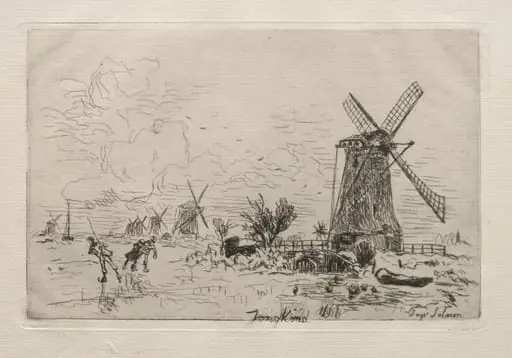
This print was made during Jongkind’s later years, when he was increasingly focused on printmaking after establishing himself as a painter. It belongs to a body of etchings he produced in the 1870s, often depicting Dutch waterways. While the exact provenance of this specific impression is not widely documented, it aligns with his broader output during a period of growing recognition among print collectors in Europe.
Context
Jongkind worked alongside early Impressionists and shared their interest in capturing light and atmosphere directly from nature. Though rooted in Dutch landscape traditions, his etchings broke from academic precision, favoring spontaneity. This work reflects a shift in 19th-century printmaking toward personal expression, where the artist’s hand and the medium’s inherent texture became central to the aesthetic.
Legacy
Jongkind’s etchings, including this one, influenced later generations of printmakers who valued directness and economy of line. His ability to convey mood with minimal marks helped redefine etching as a medium for personal observation rather than technical display. Though less celebrated than his paintings, these prints remain important for their role in bridging 19th-century realism and modernist simplicity.
Artist & collection