Artwork
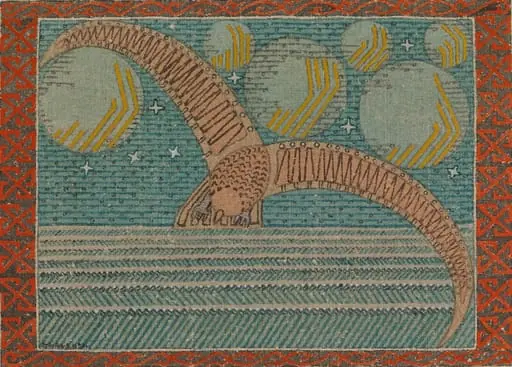
The Wild Duck and the Celestial Bodies
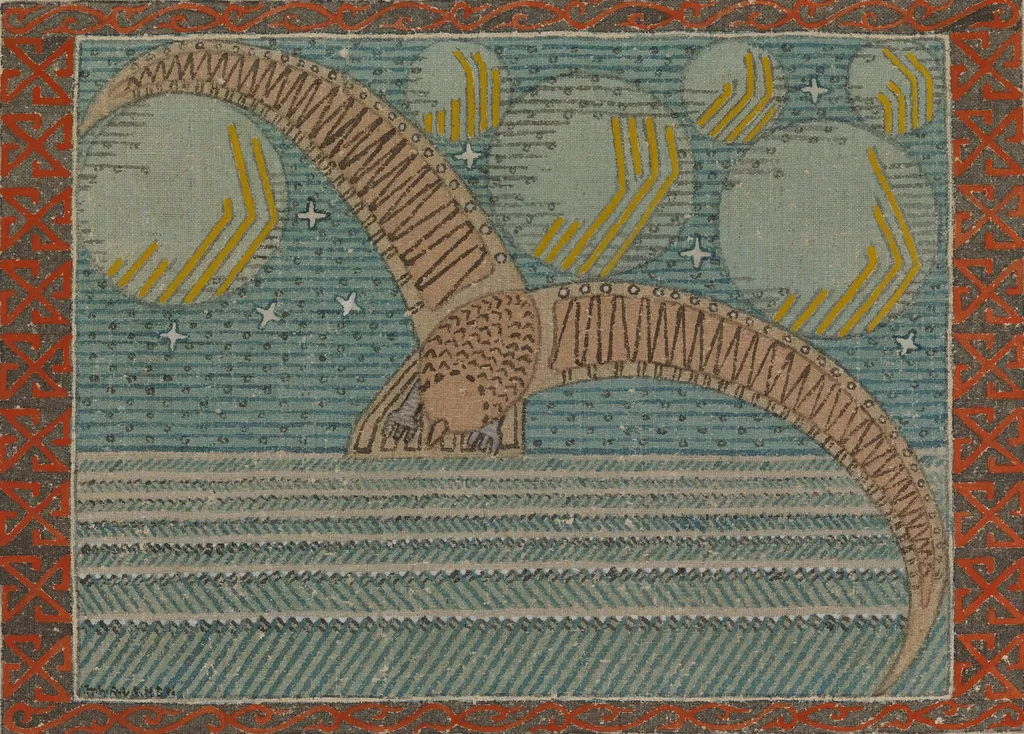
The Wild Duck and the Celestial Bodies is a tempera painting by the Art Nouveau artist Joseph Alanen. It dates from 1919 and is held in the collection of the Finnish National Gallery.
About this work
Overview
Created in 1919, this tempera work by Finnish artist Joseph Alanen is part of the Ateneum’s collection. The composition centers on a brown duck whose body is angled downward while its neck arches upward, surrounded by a field of blue punctuated with horizontal lines and scattered dots. A decorative border of red and gray geometric forms frames the scene, giving the piece a lively, kinetic feel.
Subject & Meaning
The central figure—a duck rendered with textured brown plumage—appears to be caught in a dynamic orbit with a series of circular motifs and star-like points that hover nearby. The juxtaposition of the terrestrial animal with abstract celestial symbols suggests a dialogue between the natural world and the cosmos, inviting viewers to contemplate motion, balance, and the interconnection of earthly and heavenly realms.
Technique & Style
Alanen employed tempera, a fast‑drying medium that allows for precise, layered coloration.
Alanen employed tempera, a fast‑drying medium that allows for precise, layered coloration. The duck’s feathers are built up with fine, stippled strokes that create a tactile surface, while the surrounding circles and stars are delineated with crisp outlines. The background’s blue wash, intersected by linear marks and dotted accents, contrasts with the bold, geometric border, reflecting an early 20th‑century interest in abstraction and decorative patterning.
History & Provenance
The painting entered the Ateneum’s holdings shortly after its completion, becoming part of the museum’s early 20th‑century Finnish art collection. Its acquisition reflects the institution’s commitment to preserving works by contemporary national artists, and the piece has remained on public display, offering insight into Alanen’s experimental phase during the post‑World War I period.
Context
Produced in the aftermath of the Finnish Civil War, the work aligns with a broader movement among Finnish artists to explore modernist forms while retaining references to local fauna and folklore. The integration of geometric borders and celestial motifs mirrors contemporary European trends toward abstraction, yet the subject—a familiar wild duck—grounds the composition in a distinctly Finnish visual vocabulary.
Artist & collection

 Sotka ja taivaankappaleita
 Tantric Manuscript "Sangrahani Sutra"
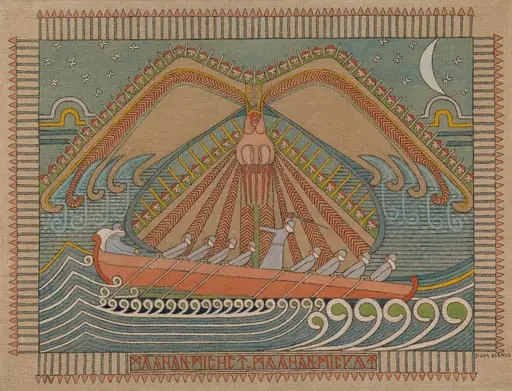 Sammon puolustus
 Pagan Deities
 God the Father. Design to the Stained-Glass Window for the Franciscan Church in Krakow
 The Hours
 The Pastorals of Virgil, Eclogue I: The Blasted Tree
 Tantric Manuscript "Sangrahani Sutra"
 Untitled
 Shepherd Chases away Wolf
 Untitled
 Birds in a tree