Artwork
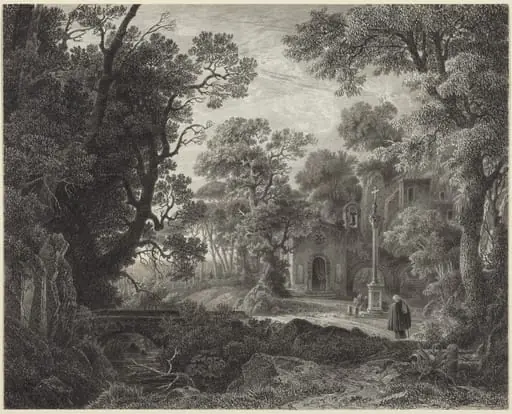
Gothic Church among Oaks
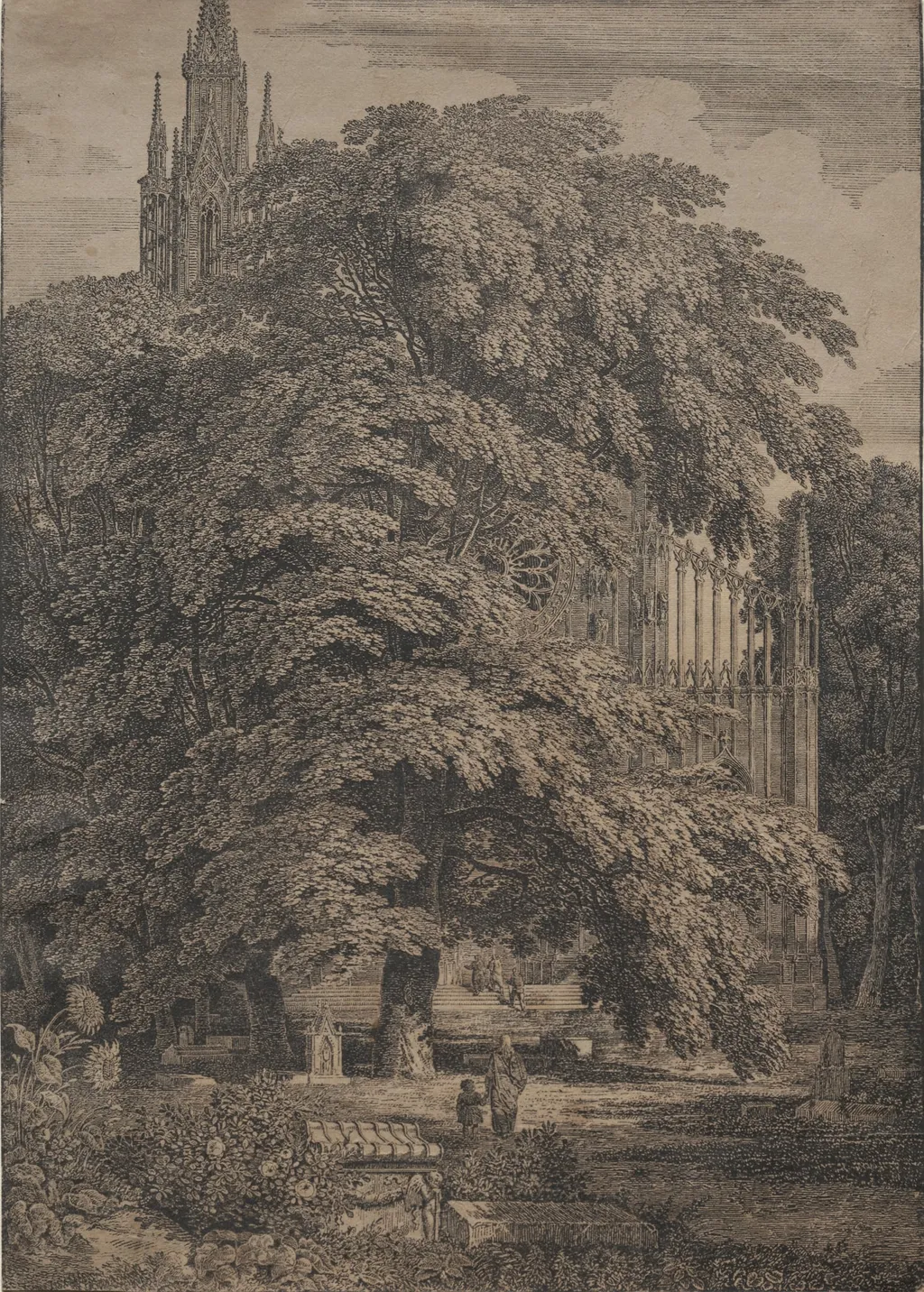
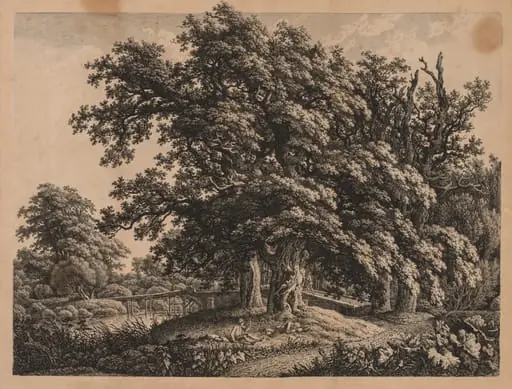
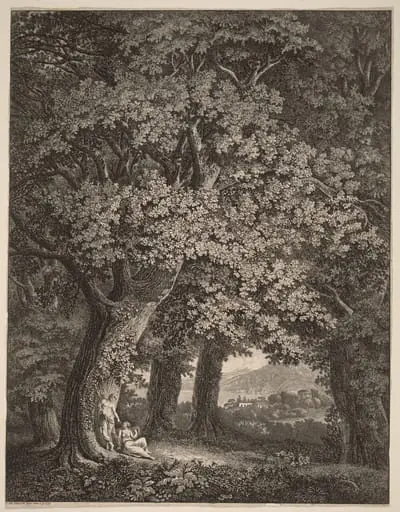
Gothic Church among Oaks is a print by the Romanticist artist Karl Friedrich Schinkel. It dates from 1810 and is held in the collection of the Cleveland Museum of Art.
About this work
Overview
It reflects his interest in merging built forms with natural landscapes to evoke spiritual and historical contemplation.
Karl Friedrich Schinkel, a leading Prussian architect of the early 19th century, also produced a body of graphic work exploring architecture’s emotional resonance. Gothic Church among Oaks is a lithograph that imagines a medieval cathedral emerging from a dense forest, not as a documented site but as a symbolic composition. It reflects his interest in merging built forms with natural landscapes to evoke spiritual and historical contemplation.
Subject & Meaning
The print presents a Gothic church bathed in moonlight, surrounded by towering oaks whose gnarled forms echo the ruinous architecture. A small child and a sunflower near gravestones suggest continuity amid decay—life persisting within the remnants of the past. The scene fuses Christian symbolism, reverence for nature, and medieval nostalgia, aligning with Romantic ideals that sought meaning in history’s echoes rather than in rational progress.
Technique & Style
Schinkel employed precise line work and tonal contrasts to render the church’s verticality against the dense, shadowed foliage. Moonlight glows softly on stone, while deep blacks pool at the base of trees and stones, heightening the sense of mystery. The composition avoids realism; instead, it assembles architectural elements—pointed arches, buttresses, spires—into an idealized vision, prioritizing mood over topographical accuracy.
History & Provenance
Created during Schinkel’s active years as a printmaker, this work emerged from his broader exploration of architectural fantasy. Though not tied to a specific location, it draws from his travels and studies of medieval structures across Europe. The print circulated among collectors and intellectuals, reinforcing his reputation beyond architecture into the realm of visual poetry and cultural memory.
Context
In early 19th-century Germany, Romanticism fostered a revival of interest in the Middle Ages as a source of national identity. Schinkel’s imagery responded to this cultural current, positioning Gothic architecture not merely as historical artifact but as a spiritual anchor. His juxtaposition of nature and ruin mirrored broader European trends, where landscapes became stages for collective memory and emotional reflection.
Legacy
Schinkel’s prints, including this one, influenced later generations of artists and architects who sought to imbue structures with symbolic weight. His fusion of nature and stone became a visual language for expressing the passage of time and the persistence of cultural ideals. Though his buildings shaped Berlin’s urban fabric, his graphic works offered quieter, more introspective visions of heritage and transcendence.
Artist & collection
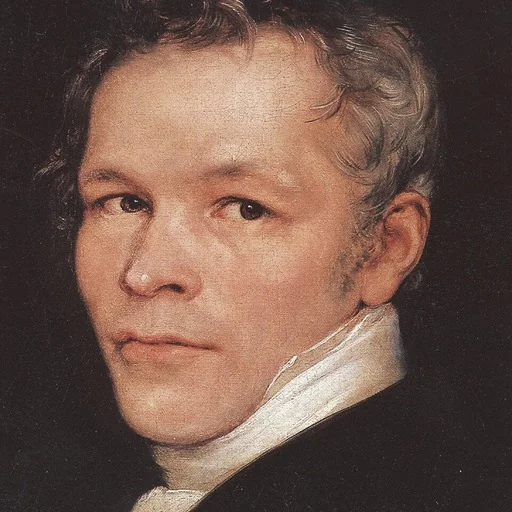
Artist
Karl Friedrich Schinkel (German pronunciation: ; 13 March 1781 – 9 October 1841) was a Prussian architect, city planner and painter who also designed furniture and stage sets.

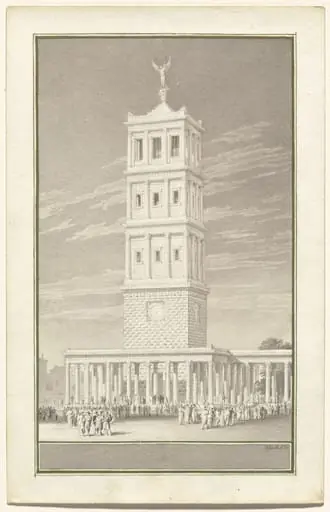 Campanile of a Cathedral for Berlin
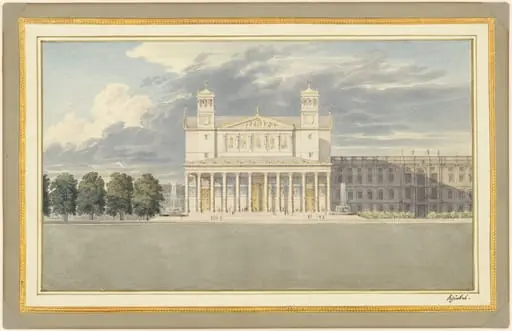 The Façade and Suroundings of a Cathedral for Berlin
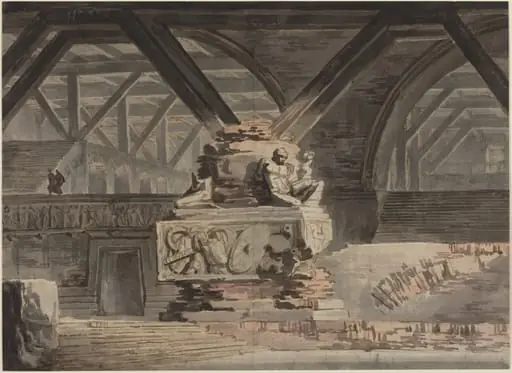 Stage Design: A Sepulchral Vault
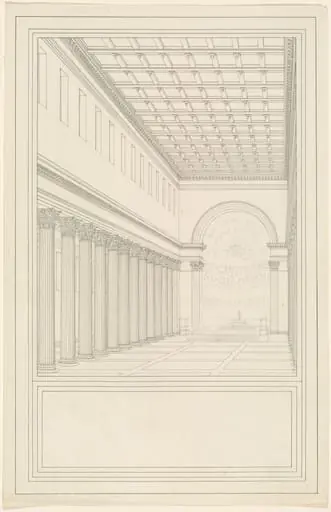 The Nave and Apse, without a Transept, of a Cathedral for Berlin
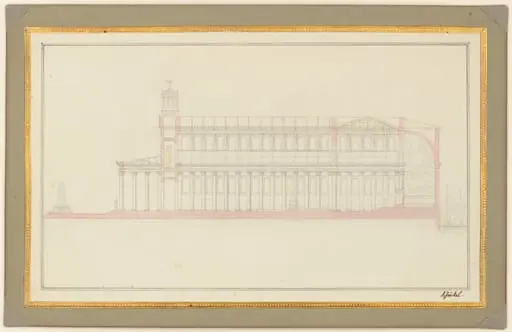 Longitudinal Section of a Cathedral for Berlin
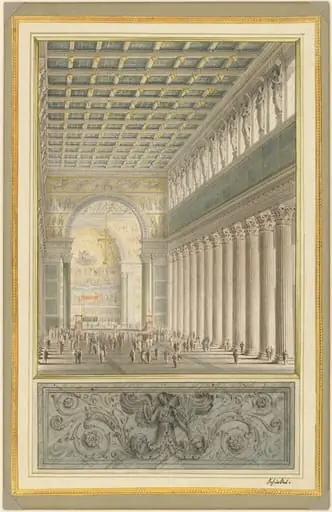 The Nave, Apse, and Crossing of a Cathedral for Berlin
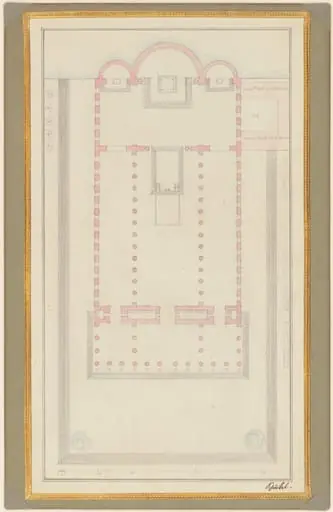 Ground Plan of a Cathedral for Berlin
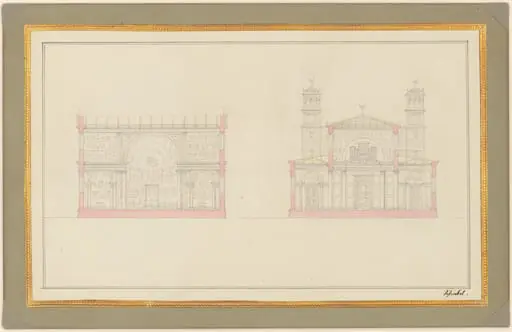 Section of the Crossing and the West End of a Cathedral for Berlin