Artwork
Adam bawgt die erden (Adam Ploughing)
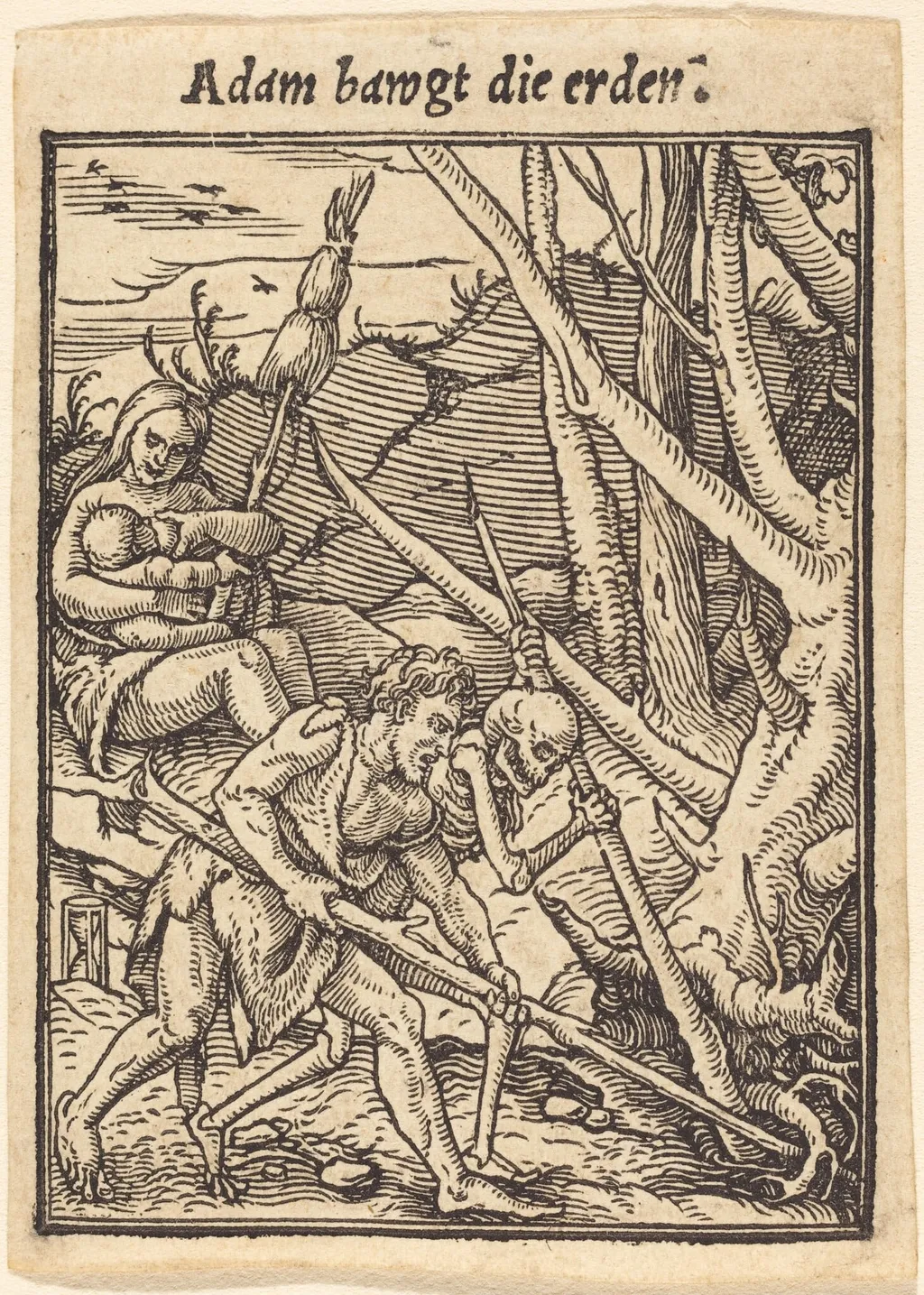
Adam bawgt die erden (Adam Ploughing) is an ink print by the Renaissance artist Hans Lützelburger. It dates from 1526 and is held in the collection of the National Gallery of Art. Created circa 1526, this German woodcut portrays the biblical figure Adam engaged in agricultural labor.
About this work
Overview
Created circa 1526, this German woodcut portrays the biblical figure Adam engaged in agricultural labor. The composition centers on a ploughing scene, populated by several figures attending to crops and tools, set against a modest landscape of trees and a simple dwelling. Rendered in stark black lines on a light paper, the image conveys a sense of bustling activity within a concise visual field.
Subject & Meaning
The work visualizes the scriptural episode in which the first man tills the earth, a motif that linked human industry with divine ordinance during the early sixteenth century. By situating Adam among a community of workers, the print underscores the theological notion that labor is an inherent, God‑ordained aspect of human existence, while also reflecting contemporary interest in everyday biblical narratives.
Technique & Style
The artist employs a relatively restrained yet dynamic line quality, suggesting movement through the positioning of oxen, plough, and surrounding figures.
Executed as a woodcut, the image relies on carved wooden blocks to produce bold, linear contrasts. The artist employs a relatively restrained yet dynamic line quality, suggesting movement through the positioning of oxen, plough, and surrounding figures. The limited tonal range typical of the medium is compensated by intricate detailing of foliage and architectural elements, characteristic of early Renaissance printmaking.
History & Provenance
The cutter, Hans Lützelburger, was active in Augsburg from about 1516 and is noted for his precise block‑cutting work, including contributions to Hans Holbein the Younger’s “Dance of Death” series. Lützelburger died in June 1526, shortly after completing this piece, which remained within the German print tradition and later entered museum collections documenting early modern graphic art.
Context
Produced during a period when religious subjects were frequently rendered in reproducible formats, the print reflects the growing demand for accessible visual narratives. Augsburg’s thriving print market provided both the technical infrastructure and the audience for such works, allowing biblical stories to reach a broader public beyond illuminated manuscripts.
Artist & collection

Artist
Hans Lützelburger (died June 1526), also known as Hans Franck, was a German blockcutter ("formschneider") for woodcuts, regarded as one of the finest of his day.