Artwork
Le Gué (The Ford)
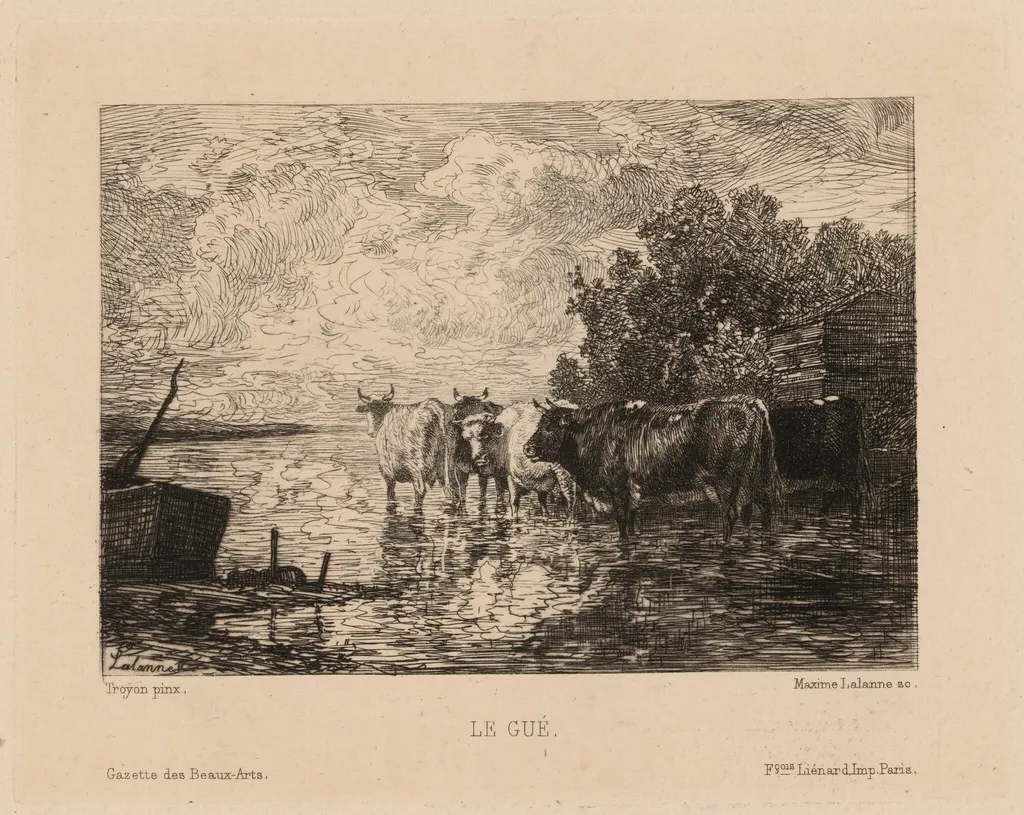
Le Gué (The Ford) is an ink print by the Impressionist artist Maxime Lalanne. It dates from 1873 and is held in the collection of the National Gallery of Art.
About this work
Overview
Le Gué (The Ford) is an 1873 etching on laid paper by French artist Maxime Lalanne, known for his expertise in printmaking and depictions of rural life.
Subject & Meaning
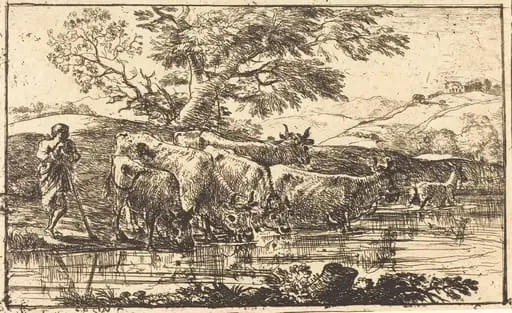
The print captures a serene rural moment: three cows wade through shallow, turbulent water at a ford, while a fourth cow stands by and a figure sits under a tree in the background, holding a long pole, evoking a sense of everyday pastoral activity.
Technique & Style
Lalanne utilized the etching technique, where ink is pressed into metal plate grooves, to achieve sharp details and textures, evident in the rendering of the cows, rough water, and swirling sky.
History & Provenance
Created in 1873, Le Gué (The Ford) is now part of the National Gallery of Art's collection in Washington.
Context
This work aligns with Lalanne's thematic focus on rural and pastoral subjects, characteristic of his printmaking oeuvre.
Legacy
As a representative of Lalanne's technical skill and thematic interests, Le Gué contributes to the broader body of late 19th-century French printmaking exploring everyday rural life.
Artist & collection
Artist
François Antoine Maxime Lalanne (November 27, 1827 – July 29, 1886) was a French artist known for his etchings and charcoal drawings (fusain).