Artwork
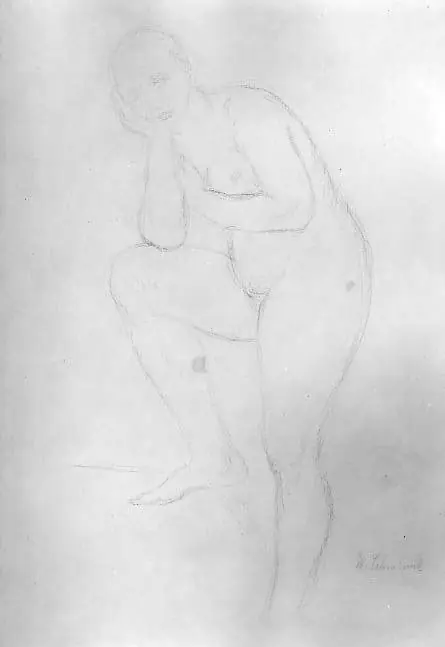
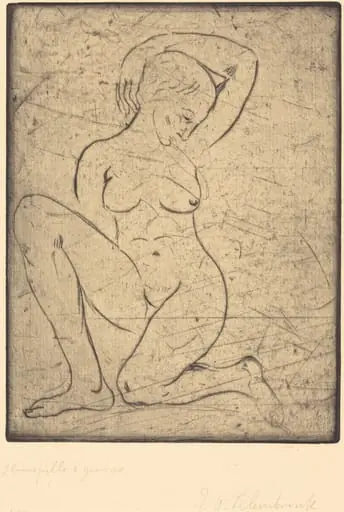
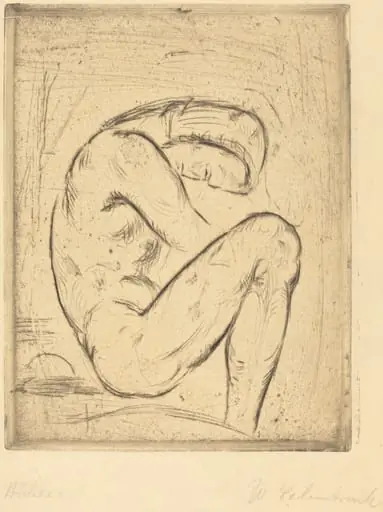
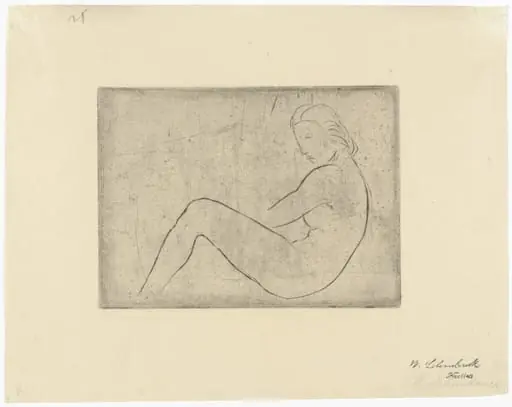
Badende mit Kopf auf Knie (Bather with Her Head on Her Knee)
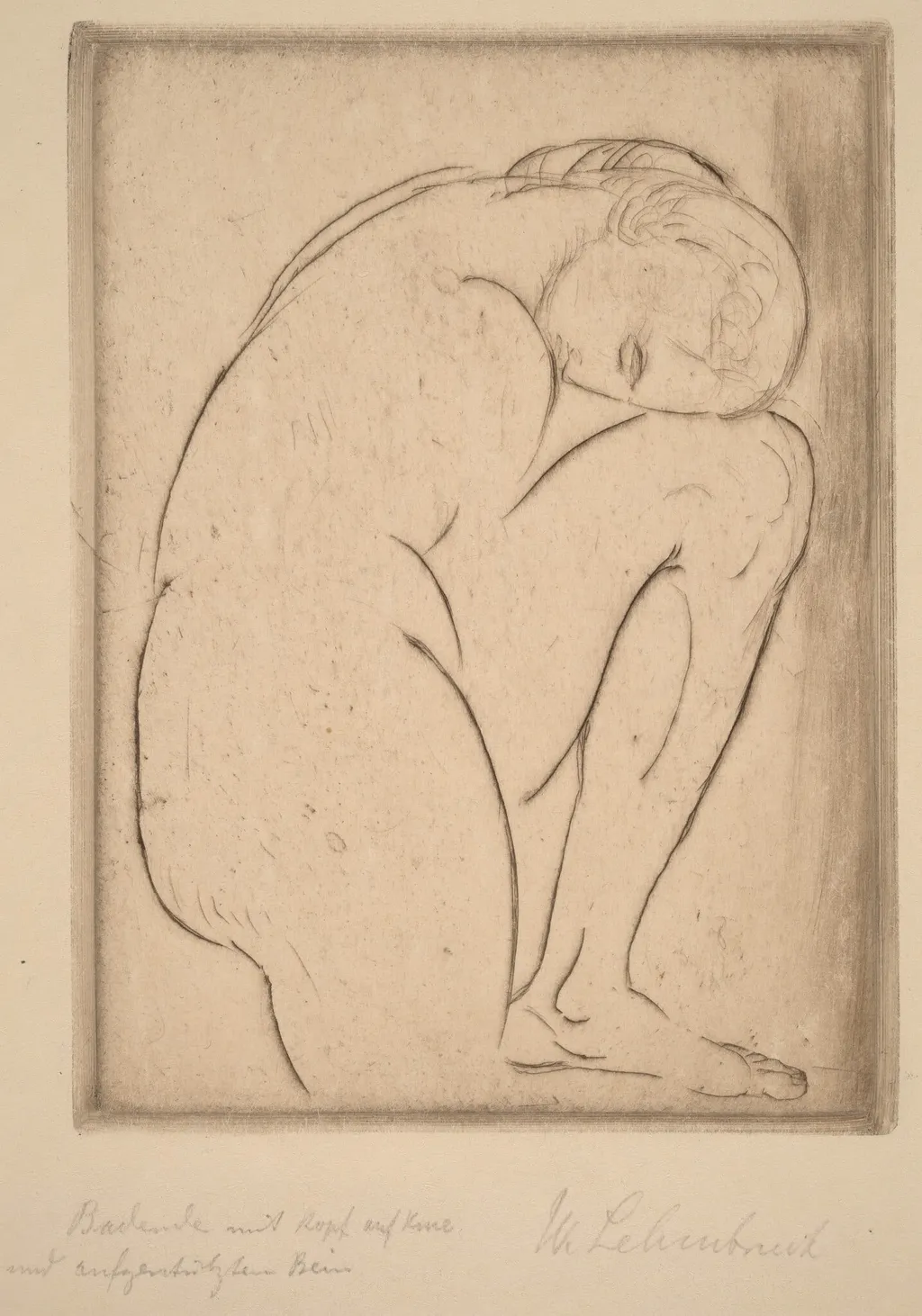
Badende mit Kopf auf Knie (Bather with Her Head on Her Knee) is an ink print by Wilhelm Lehmbruck. It dates from 1913 and is held in the collection of the National Gallery of Art.
About this work
Overview
Created in 1913, *Badende mit Kopf auf Knie* is a drypoint print by German artist Wilhelm Lehmbruck. Executed on heavy wove paper, the work captures a solitary female figure in a withdrawn, introspective posture. As a printmaker, Lehmbruck extended the emotional gravity of his sculptural practice into two dimensions, using the directness of drypoint to convey stillness and inner tension.
Subject & Meaning
The figure, seated with her head resting on her knees and arms limp at her sides, embodies solitude and quiet vulnerability. There is no narrative context—only the weight of presence. Lehmbruck’s focus on physical posture as an expression of psychological state aligns with early 20th-century explorations of inner life, stripping away ornament to emphasize emotional resonance over external detail.
Technique & Style
Drypoint technique involves scratching lines directly into a metal plate, creating a burr that holds ink and yields rich, velvety strokes. Lehmbruck used this method to render the figure with minimal, deliberate contours. The rough texture of the paper enhances the tactile quality of the lines, reinforcing the sense of fragility and intimacy without relying on shading or detail.
History & Provenance
This work remains part of the broader corpus of his graphic oeuvre, held in institutional collections focused on modern German art.
The print emerged during a period of intense artistic experimentation in Germany, shortly before World War I. Lehmbruck produced a series of intimate drawings and prints alongside his larger sculptures, often exploring similar themes of isolation and corporeal sensitivity. This work remains part of the broader corpus of his graphic oeuvre, held in institutional collections focused on modern German art.
Context
In the years leading to 1914, European artists increasingly turned inward, responding to industrialization and shifting social norms through depictions of solitude and bodily presence. Lehmbruck’s bather reflects this trend, resonating with contemporaries like Klimt and Munch who used the nude not as idealized form but as vessel for psychological states.
Legacy
Though less known than his sculptures, Lehmbruck’s prints like this one influenced later generations interested in expressive line and emotional economy. The work stands as a quiet testament to his belief that form could carry inner weight, bridging the gap between figurative tradition and modernist introspection without overt symbolism or drama.
Artist & collection
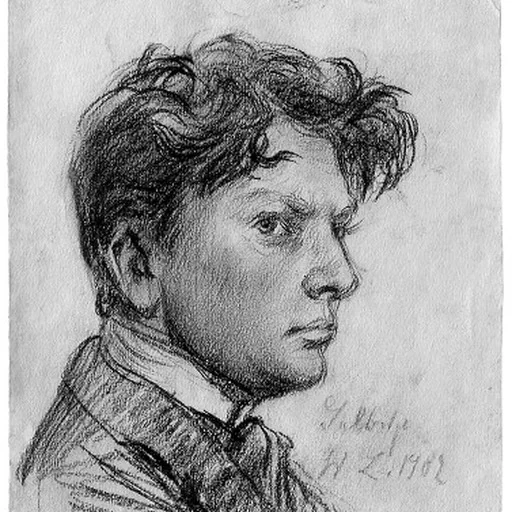
Artist
Wilhelm Lehmbruck (4 January 1881 – 25 March 1919) was a German sculptor. One of the most important of his generation, he was influenced by realism and expressionism.