Artwork
Femei la scăldat

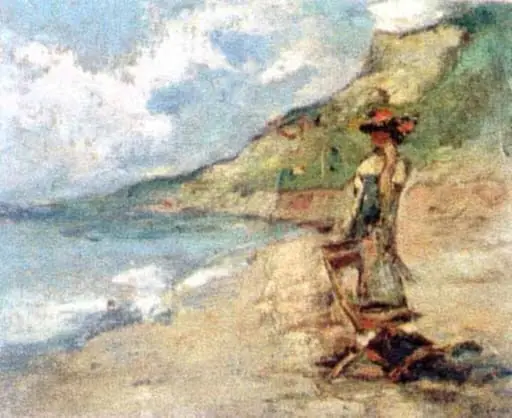
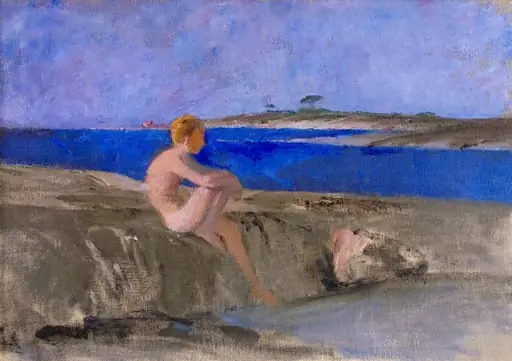
Femei la scăldat is an unspecified painting by Kimon Loghi. It is held in the collection of the Art Museum of Constanta. This painting depicts a solitary female figure on a coastal cliff, rendered with vigorous, textured brushwork.
About this work
Overview
The subject faces away from the viewer, one arm lifted, against a backdrop of sea, rocky terrain, and sparse vegetation.
This painting depicts a solitary female figure on a coastal cliff, rendered with vigorous, textured brushwork. The subject faces away from the viewer, one arm lifted, against a backdrop of sea, rocky terrain, and sparse vegetation. The surface is built with heavy, irregular strokes of paint, creating a tactile, non-idealized atmosphere. Light falls obliquely across her form, contrasting with the muted, earthy tones of the surroundings.
Subject & Meaning
The figure’s nudity and isolated position suggest a quiet, introspective moment rather than a mythological or narrative scene. Her turned back invites contemplation rather than engagement, emphasizing solitude and physical presence over symbolism. The setting—raw cliffs meeting the sea—reinforces a sense of natural endurance, aligning the human form with elemental landscapes without overt allegory.
Technique & Style
Thick, uneven applications of paint create a rough, tactile surface, characteristic of impasto. The brushwork is deliberate yet unrefined, avoiding smooth transitions in favor of visible texture. Color is restrained: cool blues and grays dominate the environment, while the figure’s skin catches warm, directional light, drawing attention without idealization. The tree’s branches are rendered with loose, sketchy strokes, adding rhythmic instability to the composition.
History & Provenance
The work’s origins are undocumented in public records, with no known exhibition history or collector lineage prior to its current attribution. It lacks signatures or inscriptions that might clarify its maker or date. Its informal style and lack of conventional finish suggest it may have been a study or personal exercise rather than a commissioned piece.
Context
Created during a period when artists increasingly turned to direct observation and expressive brushwork over academic polish, this piece aligns with late 19th-century trends favoring emotional resonance over narrative clarity. Similar approaches appear in the works of contemporaries exploring the human form in natural settings, though few combine such minimal composition with such tactile paint handling.
Legacy
Though not widely reproduced or studied, the painting contributes to a quieter lineage of modernist figure studies that prioritize materiality and mood over idealization. Its unpolished aesthetic anticipates later movements that valued process and raw expression, offering a subtle counterpoint to more celebrated depictions of the nude in art history.
Artist & collection
Artist
Kimon Loghi painted bright, sunlit scenes of people at leisure by the sea. In 1903 he showed “Balada” and later captured bathers in “Femei la scăldat,” set a beach near Concarneau in “Plajă la Beg - Meil,” and printed…