Artwork
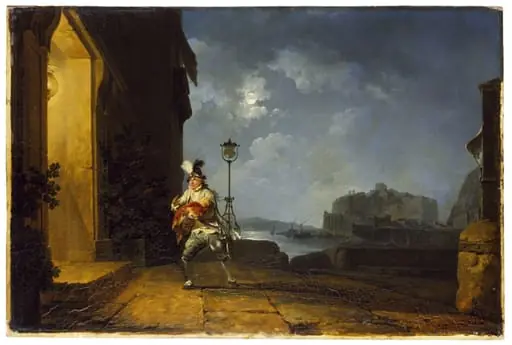
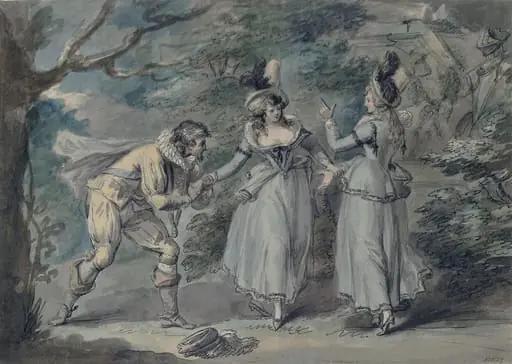
David Garrick as Don John in his adaptation of 'The Chances' by Beaumont and Fletcher, Act 1, Scene 2, with a view intended to be Naples in the background
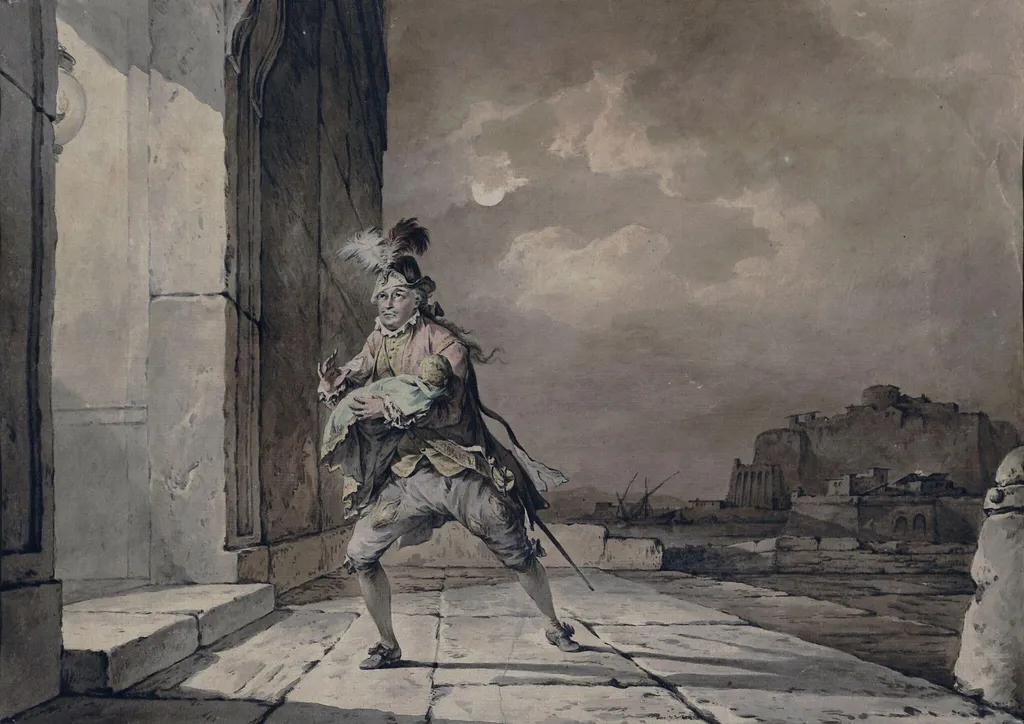
David Garrick as Don John in his adaptation of 'The Chances' by Beaumont and Fletcher, Act 1, Scene 2, with a view intended to be Naples in the background is a watercolor work on paper by the Rococo painting artist Philip James de Loutherbourg. It dates from 1774 and is held in the collection of the Victoria and Albert Museum.
About this work
Overview
This watercolour on Whatman paper portrays David Garrick as Don John in a scene from his revised version of Beaumont and Fletcher’s *The Chances*.
This watercolour on Whatman paper portrays David Garrick as Don John in a scene from his revised version of Beaumont and Fletcher’s *The Chances*. Executed with delicate brushwork, the piece functions as a preparatory study for a larger oil painting exhibited at the Royal Academy in 1774. The artist’s signature confirms authorship, and the composition captures Garrick mid-motion, suggesting theatrical movement. The background, though stylized, evokes a coastal Italian setting, reinforcing the scene’s imagined locale.
Subject & Meaning
Garrick portrays Don John, a character of ambiguous morality, caught in a moment of transition. His posture—stepping forward with a scroll in hand and hat held loosely—hints at impending action or decision. The setting, though labeled as Naples, is not a literal view but a theatrical construct, aligning with the play’s romantic intrigue. The image reflects Garrick’s reputation for embodying psychological nuance, transforming a stage role into a moment of quiet tension.
Technique & Style
The artist employs soft washes and subtle gradations of tone to model form and suggest depth within a shallow space. Chiaroscuro is used sparingly but effectively to define Garrick’s figure against the muted backdrop. The background architecture is rendered with loose, flattened brushwork, emphasizing its artificiality as a stage prop. The paper’s texture subtly enhances the watercolour’s transparency, reinforcing the work’s intimate, study-like character.
History & Provenance
Created as a preparatory study for the 1774 Royal Academy exhibition, the watercolour reflects the practice of theatrical portraiture in late 18th-century Britain. It was likely produced for private circulation or as a reference for the final painting. Its survival offers insight into the collaborative process between actor and artist, and the role of visual art in documenting and promoting stage performances during Garrick’s era.
Context
Garrick’s adaptation of *The Chances* was part of a broader trend of reworking Renaissance comedies for Georgian audiences. The choice of Naples as a backdrop aligns with contemporary tastes for exotic, romanticized settings in theatre. This watercolour situates Garrick within a cultural moment where acting was increasingly seen as a subject worthy of fine art, blurring boundaries between performance and visual representation.
Legacy
As a record of Garrick’s stage persona and the artistic methods of his time, the work contributes to the documentation of British theatrical history. It exemplifies how watercolour, often considered a minor medium, was used seriously by artists to capture ephemeral performances. The piece remains a testament to the intersection of drama and visual art in the 18th century, preserving a fleeting moment of theatrical life.
Artist & collection
Artist
Philip James de Loutherbourg painted dramatic stage scenes and sweeping landscapes in 18th-century England.