Artwork
Saint John on Patmos
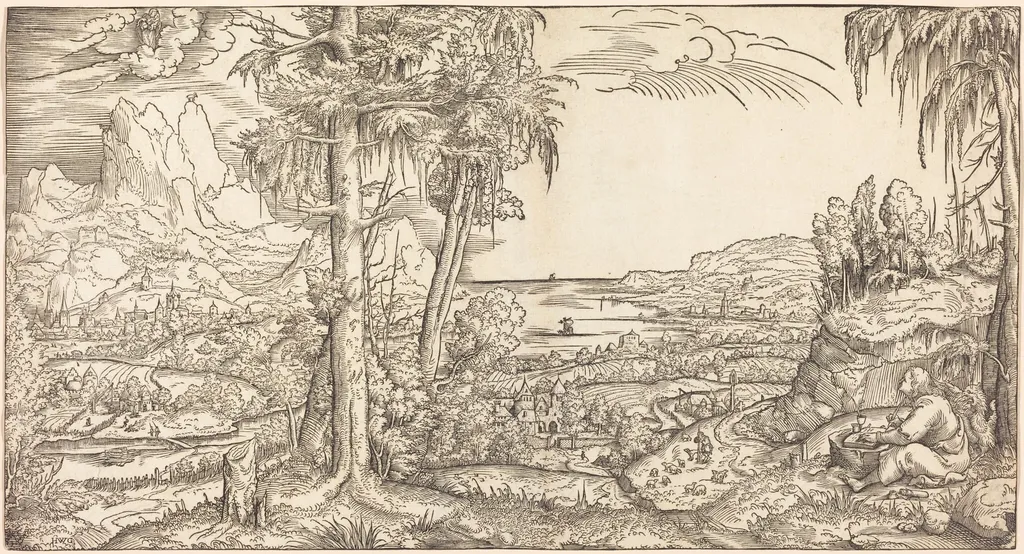
Saint John on Patmos is an ink print by the Renaissance artist Master H.W.G.. It dates from 1550 and is held in the collection of the National Gallery of Art. Created around 1550, this woodcut by Master H.
About this work
Overview
Created around 1550, this woodcut by Master H.W.G. depicts the biblical figure Saint John on the island of Patmos. Rendered in black ink on laid paper, the print captures a rugged coastal landscape with meticulous line work. The composition balances natural elements—cliffs, trees, and sea—with human structures, suggesting a quiet, contemplative atmosphere suited to the saint’s exile.
Subject & Meaning
The scene illustrates Saint John’s exile on Patmos, where, according to the Book of Revelation, he received divine visions. Though the saint himself is not prominently featured, the isolated setting and sparse human presence evoke solitude and spiritual revelation. The church near the shore hints at the enduring presence of faith amid desolation, reinforcing the narrative’s theological weight.
Technique & Style
The scale is deliberately skewed—towering cliffs and dense foliage dwarf the tiny figures—emphasizing nature’s dominance and the human condition’s fragility.
The artist employed fine, controlled incisions to carve the image into wood, producing a dense network of lines that model form and texture. Shading is achieved through cross-hatching rather than tone, giving the landscape a crisp, graphic quality. The scale is deliberately skewed—towering cliffs and dense foliage dwarf the tiny figures—emphasizing nature’s dominance and the human condition’s fragility.
History & Provenance
The print is attributed to Master H.W.G., a German artist active in the mid-16th century, though little is known of his life. The work likely circulated among religious audiences in Northern Europe, where woodcuts were widely used for devotional imagery. Its survival in good condition suggests it was carefully preserved, possibly in a private or ecclesiastical collection.
Context
Produced during the Reformation, this print reflects a period when religious imagery was both contested and reimagined. While Catholic traditions favored elaborate altarpieces, Protestant regions embraced simpler, accessible prints for private devotion. This woodcut’s quiet intensity aligns with emerging Protestant sensibilities, valuing introspection over spectacle.
Legacy
As an example of mid-16th-century German printmaking, the work demonstrates the technical sophistication achievable in woodcut before the rise of engraving. It contributes to a broader tradition of landscape-infused religious scenes, influencing later artists who sought to merge naturalism with spiritual narrative in printed form.
Artist & collection


 St. John on the Island of Patmos
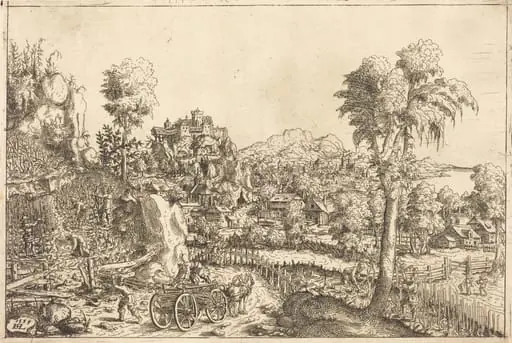 Landscape with a Vineyard
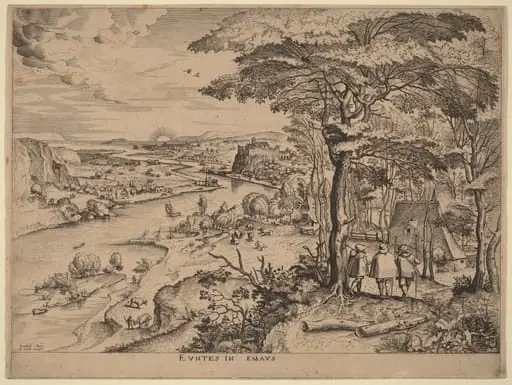 Euntes in Emaus (The Pilgrims to Emmaus)
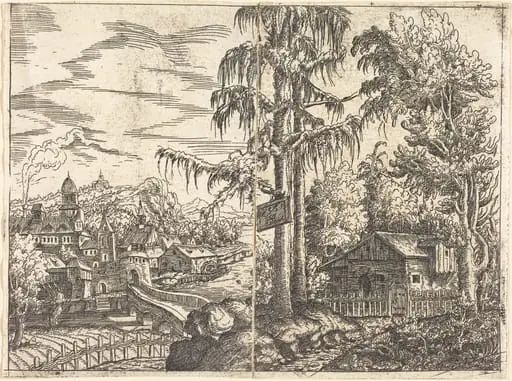 Landscape with View of a Farmer's Cottage and a Town near a River
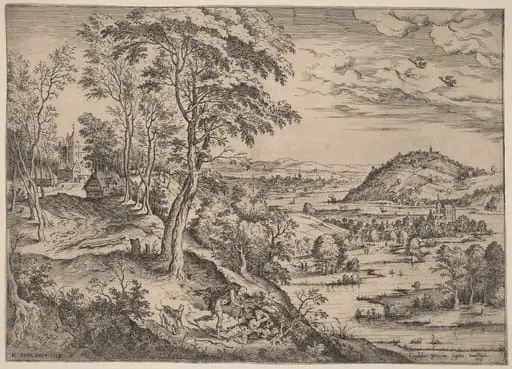 Cephalus and Procris
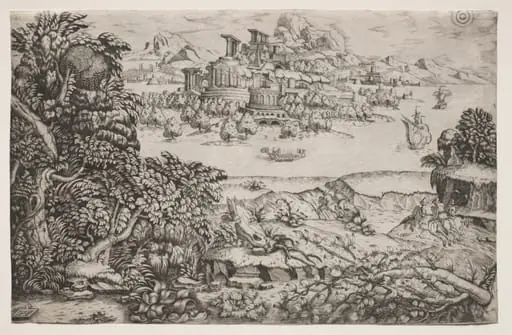 Landscape with a Temple above a Lake
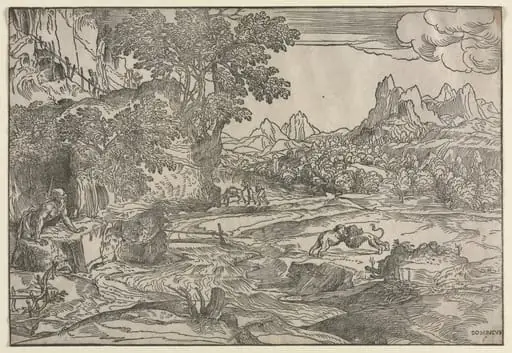 Landscape with Saint Jerome and Two Lions
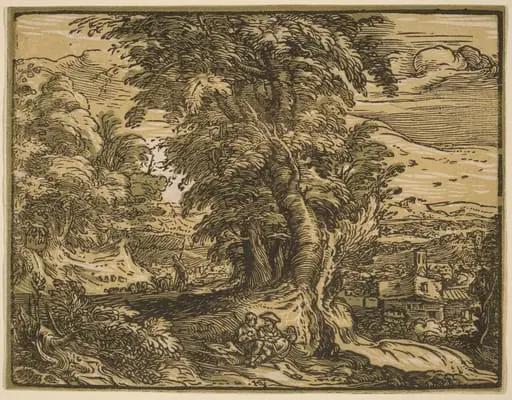 Landscape with a Shepherd Couple
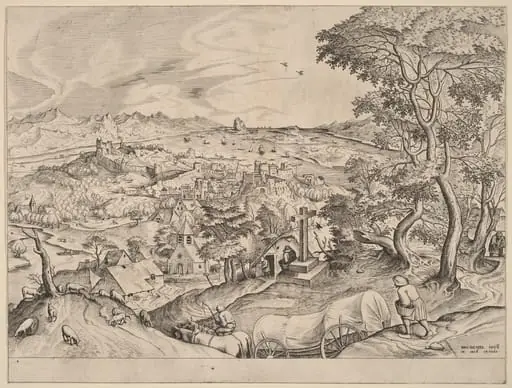 Plaustrum Belgicum (The Belgian Wagon)
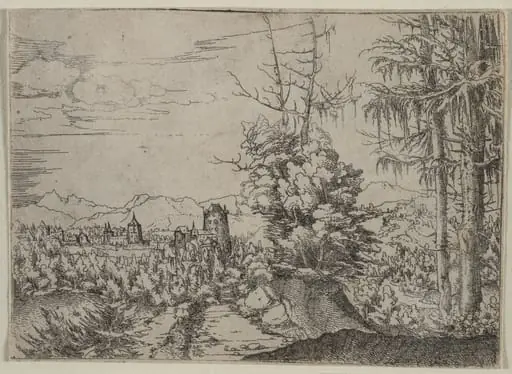 Landscape with Two Pines
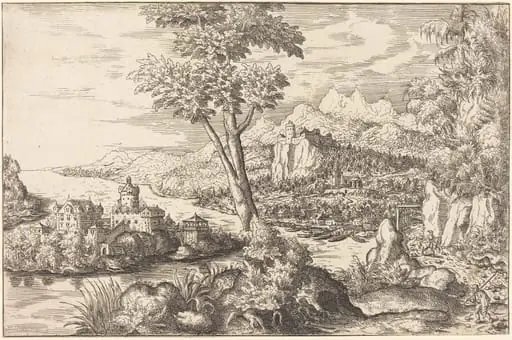 Landscape with Three Men
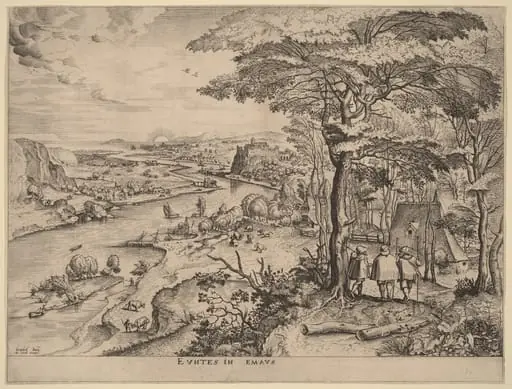 Euntes in Emaus (The Pilgrims to Emmaus)