Artwork
L'arche du Pont Notre-Dame, Paris (An Arch of the Notre-Dame Bridge, Paris)
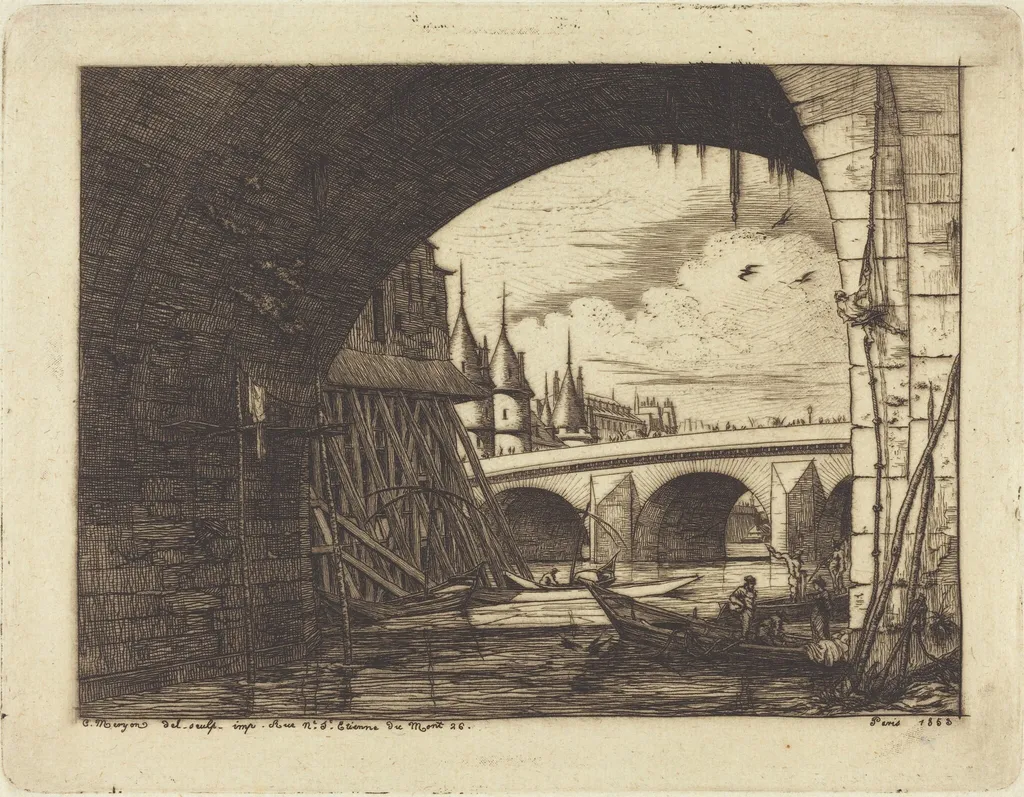
L'arche du Pont Notre-Dame, Paris (An Arch of the Notre-Dame Bridge, Paris) is an ink print by the Impressionist artist Charles Meryon. It dates from 1853 and is held in the collection of the National Gallery of Art.
About this work
Overview
Executed in etching and drypoint on green-toned laid paper, it belongs to a series of urban views that define his artistic legacy.
Created in 1853, this print by Charles Meryon captures a segment of the Notre-Dame Bridge in Paris. Executed in etching and drypoint on green-toned laid paper, it belongs to a series of urban views that define his artistic legacy. Meryon, who worked almost exclusively in black-and-white printmaking, used these techniques to convey texture, atmosphere, and structural weight without color, a choice influenced by his color vision deficiency.
Subject & Meaning
The composition centers on the bridge’s stone arches spanning a turbulent river, with boats navigating below. Behind, clustered buildings with spires suggest the dense medieval fabric of Paris. The dark sky and flying birds add a sense of quiet motion, emphasizing the bridge as both a functional passage and a monumental fixture in the city’s landscape. The image reflects Meryon’s fascination with architecture as a silent witness to urban life.
Technique & Style
Meryon employed fine, controlled etched lines and aggressive drypoint burrs to model light and shadow across stone and water. The choppy river is rendered with dense, intersecting strokes, while the arches gain depth through layered hatching. The green paper subtly enhances tonal contrasts, lending the scene a somber, atmospheric quality. His method prioritized texture and mood over precision, creating a sense of weight and timelessness in the architecture.
History & Provenance
The print was made during Meryon’s most productive period, when he was systematically documenting Paris’s older structures before modernization transformed them. It was likely part of a private collection soon after its creation, and later entered public holdings through institutional acquisitions. Meryon’s personal decline, marked by mental illness, began shortly after this work’s completion, and he spent his final years in an asylum, where he continued to draw until his death in 1868.
Context
In the mid-19th century, Paris underwent rapid urban renewal under Haussmann. Meryon’s prints, including this one, served as quiet records of neighborhoods and structures slated for demolition. His focus on bridges, alleys, and Gothic remnants contrasted with the prevailing interest in modernity, offering instead a melancholic meditation on decay and endurance within the changing city.
Legacy
Meryon’s etchings, once overlooked, gained recognition in the late 19th century for their emotional depth and technical rigor. *L'arche du Pont Notre-Dame* exemplifies his unique ability to merge architectural precision with psychological atmosphere. Today, his work is studied as a bridge between Romanticism and modern printmaking, influencing artists who seek to capture urban memory through monochrome detail.
Artist & collection
Artist
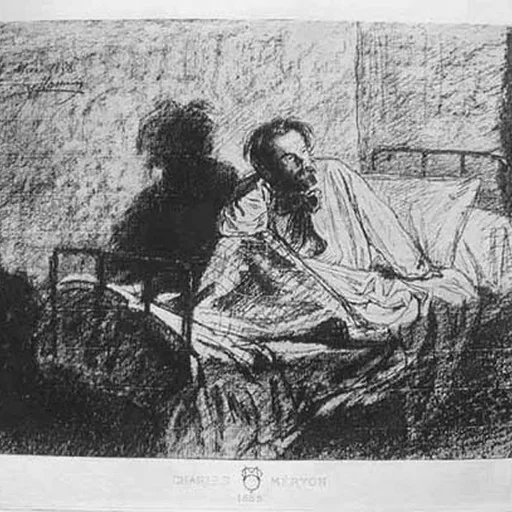
Charles Meryon (sometimes Méryon, 23 November 1821 – 14 February 1868) was a French artist who worked almost entirely in etching, as he had colour blindness.

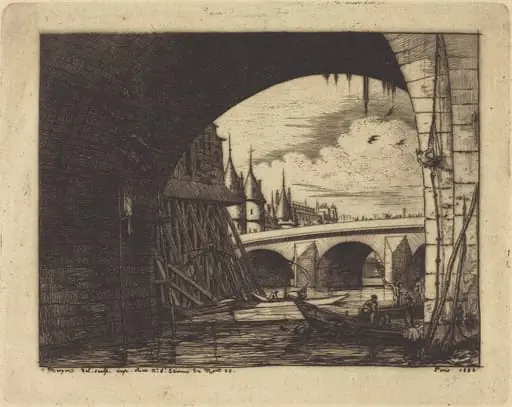 L'arche du Pont Notre-Dame, Paris (An Arch of the Notre-Dame Bridge, Paris)
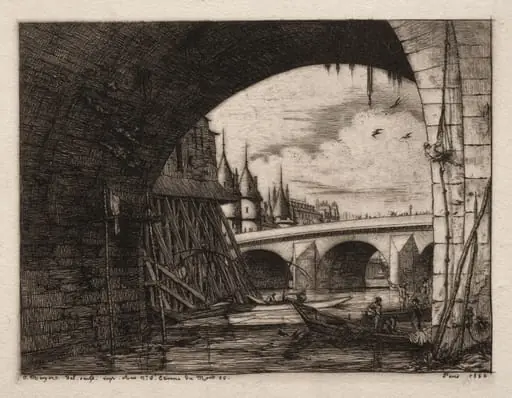 L'arch du Pont Notre Dame, Paris
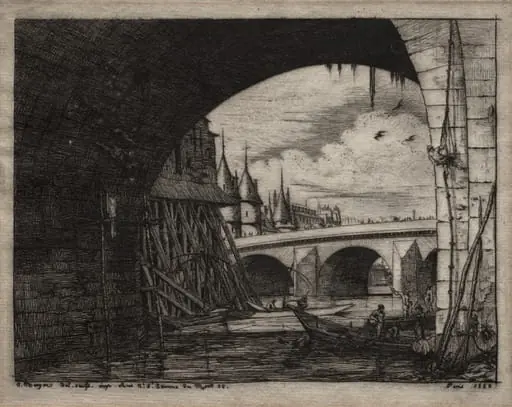 Etchings of Paris: An Arch of the Notre Dame Bridge
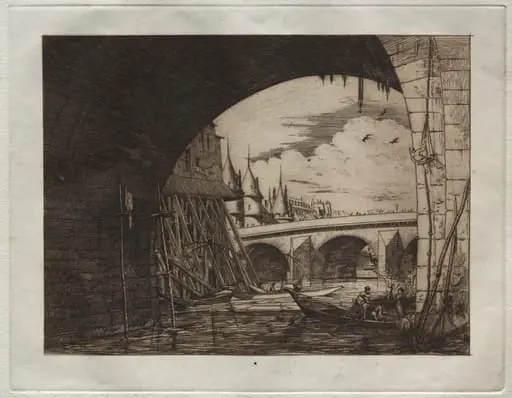 L'Arch du Pont Notre Dame
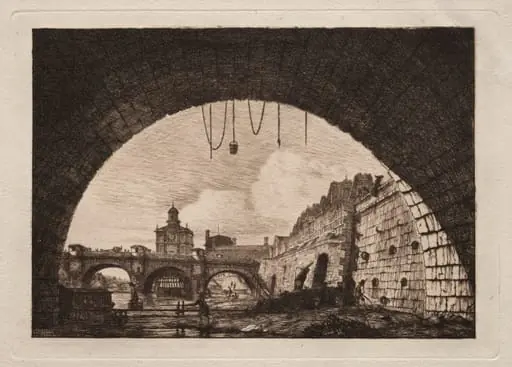 The New Bridge and the Samaritaine seen from under the First Arch of the Exchange Bridge, Paris
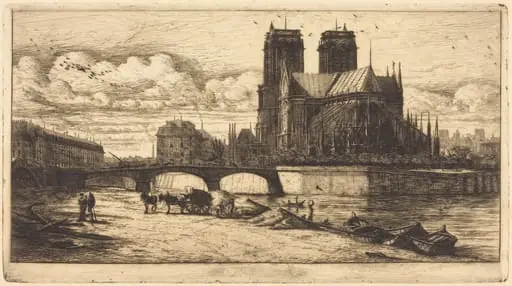 L'abside de Notre-Dame de Paris (The Apse of the Cathedral of Notre Dame, Paris)
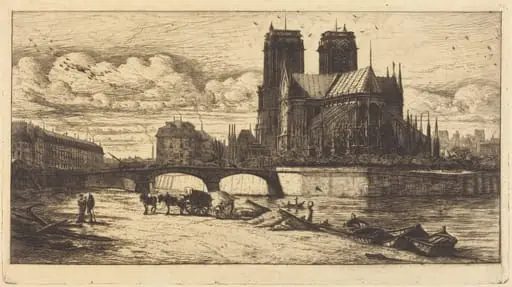 L'abside de Notre-Dame de Paris (The Apse of the Cathedral of Notre-Dame, Paris)