Artwork
La galerie Notre-Dame, Paris (The Gallery of Notre Dame, Paris)
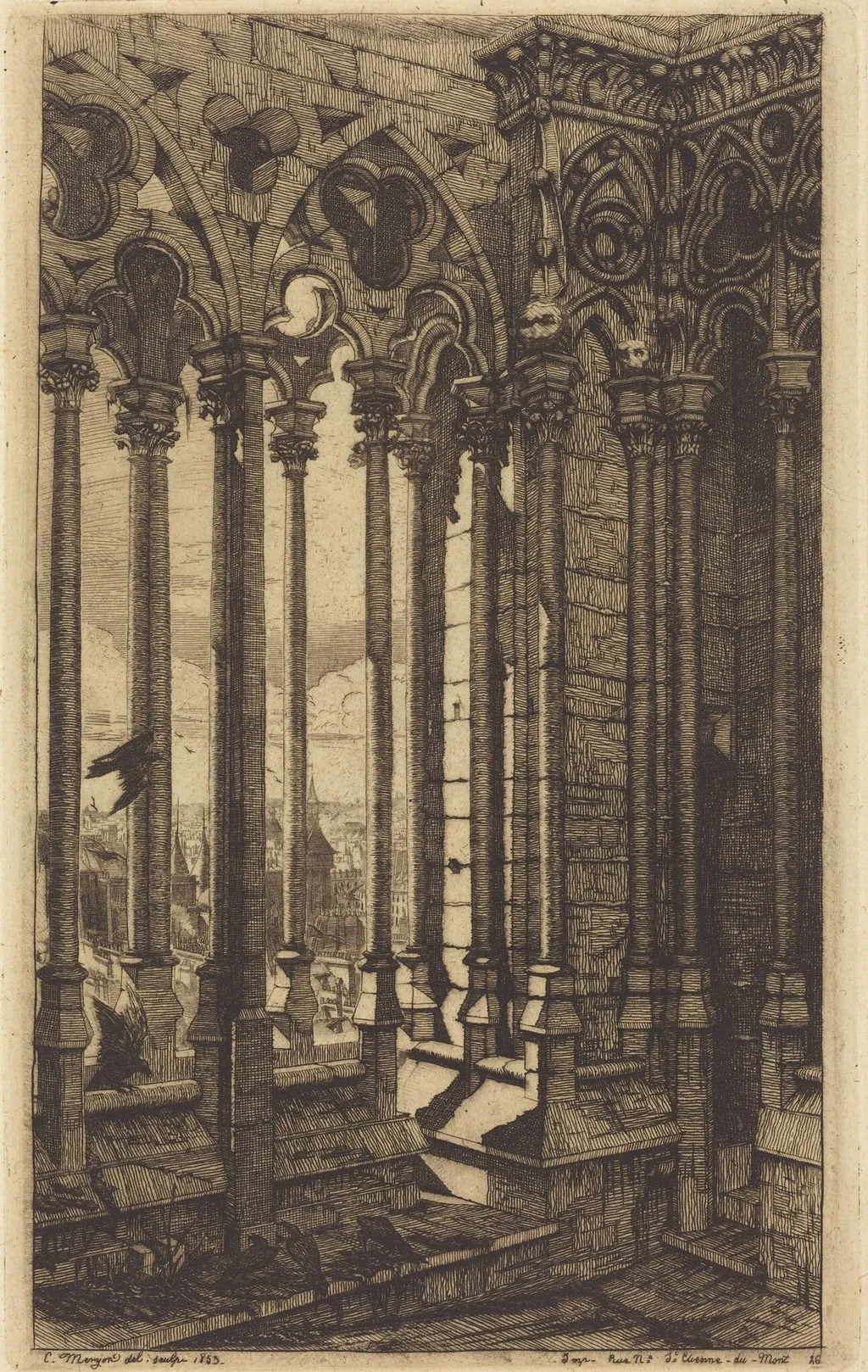
La galerie Notre-Dame, Paris (The Gallery of Notre Dame, Paris) is an ink print by the Impressionist artist Charles Meryon. It dates from 1853 and is held in the collection of the National Gallery of Art.
About this work
Overview
This work presents a narrow, vaulted passageway adjacent to Notre-Dame, rendered with meticulous line work that emphasizes depth and stillness.
Created in 1853, *La galerie Notre-Dame, Paris* is an etching on green laid paper by Charles Meryon, one of the few 19th-century French artists to focus almost entirely on the medium. Meryon, who could not perceive color, turned to the tonal precision of etching to capture the mood and structure of Paris. This work presents a narrow, vaulted passageway adjacent to Notre-Dame, rendered with meticulous line work that emphasizes depth and stillness.
Subject & Meaning
The print portrays a secluded arcade near Notre-Dame Cathedral, where slender columns rise toward a shadowed ceiling. The space feels abandoned, lit only by a faint glow at its far end, suggesting a quiet transition between the sacred and the urban. Meryon’s choice of this overlooked architectural detail transforms a utilitarian corridor into a contemplative space, evoking solitude and the passage of time within the city’s fabric.
Technique & Style
Meryon employed fine, controlled etching lines to model form and atmosphere, avoiding broad washes in favor of incremental tonal gradations. The intricate carvings on the columns and the textured surfaces of the walls are rendered with precision, creating a sense of lace-like ornamentation. The use of deep shadows and diminishing light enhances spatial depth, guiding the viewer’s eye into the receding corridor with a sense of quiet inevitability.
History & Provenance
Meryon produced this print during a period of intense focus on Parisian architecture, shortly after the city’s major renovations began under Haussmann. Though widely admired by contemporaries like Baudelaire, the work remained largely within private collections until the late 19th century. Its survival in original condition, on the distinctive green laid paper Meryon favored, is relatively rare among his oeuvre.
Context
In the 1850s, Paris was undergoing rapid transformation, yet Meryon turned away from the new boulevards to document the city’s medieval remnants. His etchings captured the lingering presence of Gothic structures amid modernization. *La galerie Notre-Dame* reflects a fascination with decay and endurance, offering a counter-narrative to the era’s progress-driven aesthetics by honoring the quiet dignity of forgotten spaces.
Legacy
Meryon’s etchings, including this one, established a new standard for urban topography in printmaking. His ability to convey emotional weight through architectural detail influenced later generations of printmakers and photographers drawn to the poetic potential of the city’s hidden corners. Though overshadowed in his lifetime, his work is now recognized as a foundational contribution to the artistic documentation of 19th-century Paris.
Artist & collection
Artist
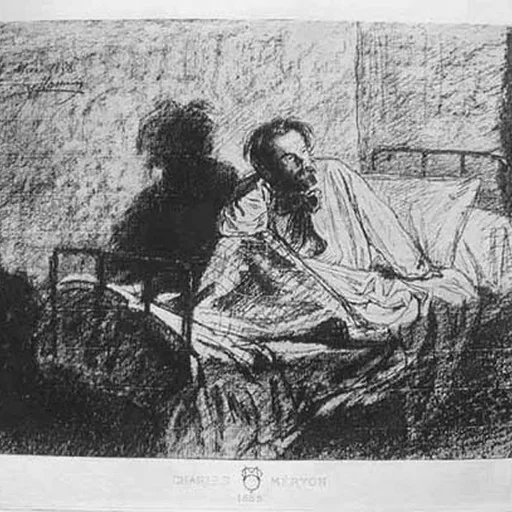
Charles Meryon (sometimes Méryon, 23 November 1821 – 14 February 1868) was a French artist who worked almost entirely in etching, as he had colour blindness.

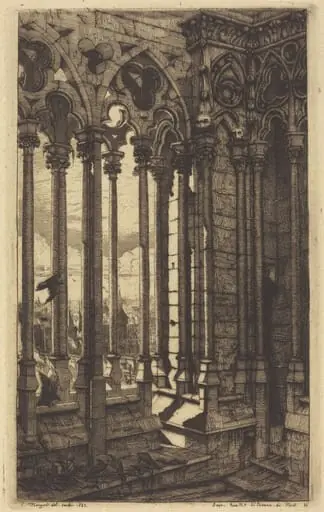 La galerie Notre-Dame, Paris (The Gallery of Notre Dame, Paris)
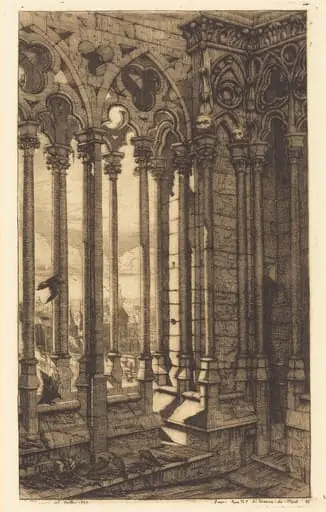 La galerie Notre-Dame, Paris (The Gallery of Notre Dame, Paris)
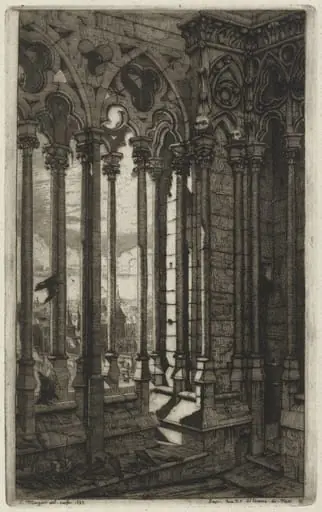 La galerie Notre-Dame, Paris (The Gallery of Notre Dame, Paris)
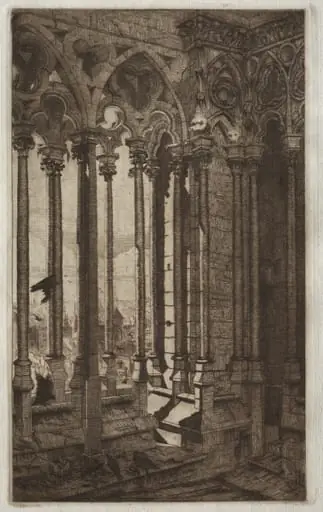 La Galerie Notre Dame
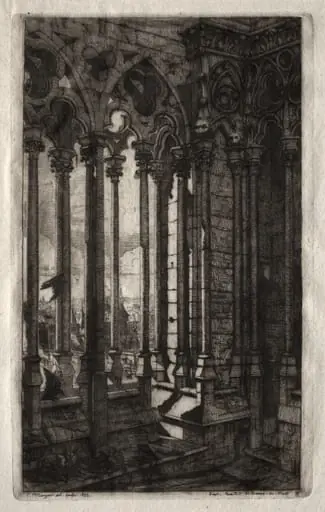 Etchings of Paris: The Gallery of Notre Dame
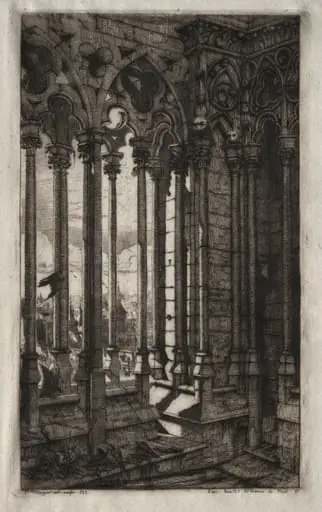 The Etchings of Paris: The Gallery of Notre Dame