Artwork
La Pompe Notre-Dame, Paris (The Notre-Dame Pump)
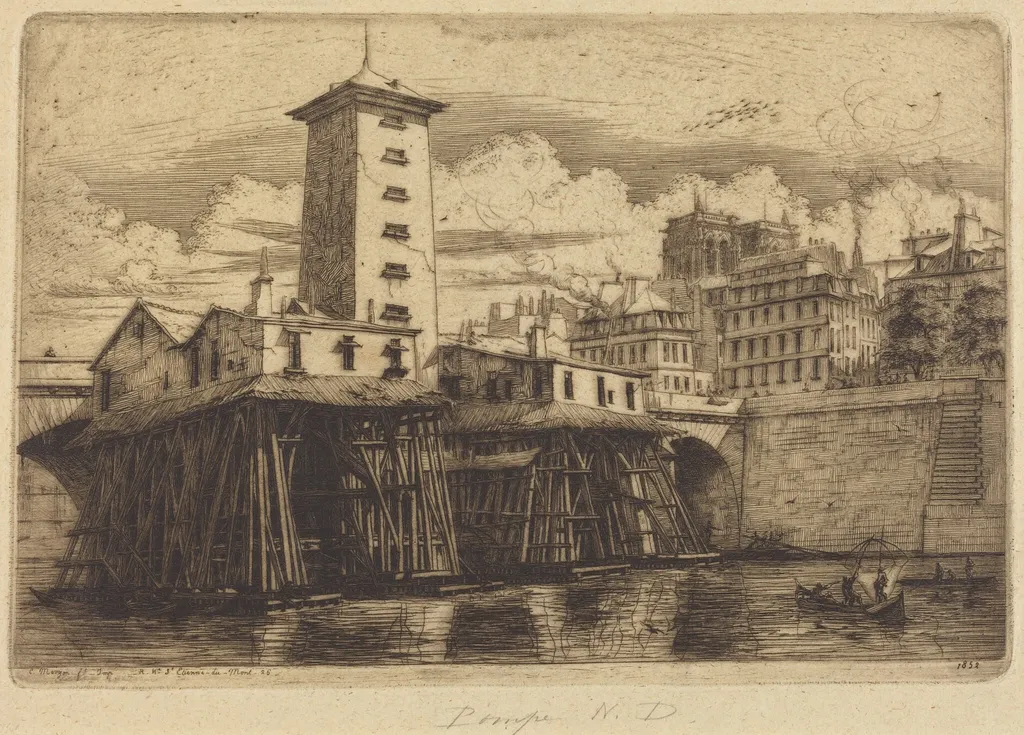
La Pompe Notre-Dame, Paris (The Notre-Dame Pump) is an ink print by the Impressionist artist Charles Meryon. It dates from 1852 and is held in the collection of the National Gallery of Art.
About this work
Overview
This piece is part of a larger series documenting the city’s infrastructure and skyline, capturing everyday life with precision and quiet intensity.
Created in 1852, *La Pompe Notre-Dame, Paris* is an etching and drypoint on green laid paper by Charles Meryon, a French artist renowned for his atmospheric depictions of Paris. Meryon, who worked exclusively in printmaking due to his color blindness, focused on architectural detail and urban mood. This piece is part of a larger series documenting the city’s infrastructure and skyline, capturing everyday life with precision and quiet intensity.
Subject & Meaning
The scene centers on a functional wooden pump near the Seine, surrounded by scaffolding and laborers, reflecting Paris’s evolving urban systems. Behind it, the silhouette of Notre-Dame’s tower rises amid clustered rooftops and chimneys, anchoring the composition in place and time. The inclusion of a small boat and distant spires suggests the river’s role as both artery and backdrop to daily routines, emphasizing the quiet coexistence of utility and monumentality in the city.
Technique & Style
Meryon employed etching and drypoint to achieve fine, expressive lines and rich tonal variation. The drypoint’s burr added soft, velvety shadows, enhancing the texture of wood, stone, and smoke. His meticulous line work renders scaffolding, thatch, and distant architecture with equal care, creating depth without perspective distortion. The green paper ground subtly unifies the scene, lending warmth to the gray urban fabric and reinforcing the work’s intimate, observational tone.
History & Provenance
The print was produced during Meryon’s most active period, when he was systematically documenting Paris’s medieval and early modern structures before modernization altered them. It was likely part of his *Eaux-Fortes sur Paris* series, circulated among collectors and artists. Though not widely exhibited in his lifetime, the work gained recognition posthumously as a key example of 19th-century French printmaking and urban documentation.
Context
In the 1850s, Paris was undergoing rapid transformation under Haussmann’s renovations. Meryon’s focus on older, functional structures like the Notre-Dame Pump reflected a concern for the city’s disappearing vernacular. His prints stood in contrast to the grand narratives of academic painting, offering instead a contemplative, almost archaeological view of ordinary urban life, valued later for its historical record and emotional resonance.
Legacy
Meryon’s *La Pompe Notre-Dame* contributed to the revival of etching as a serious artistic medium in France. His attention to architectural detail and atmospheric texture influenced later generations of printmakers and urban observers. Though little known during his lifetime, his body of work is now held in major collections as a vital record of pre-modern Paris, valued for its quiet fidelity to place and time.
Artist & collection
Artist
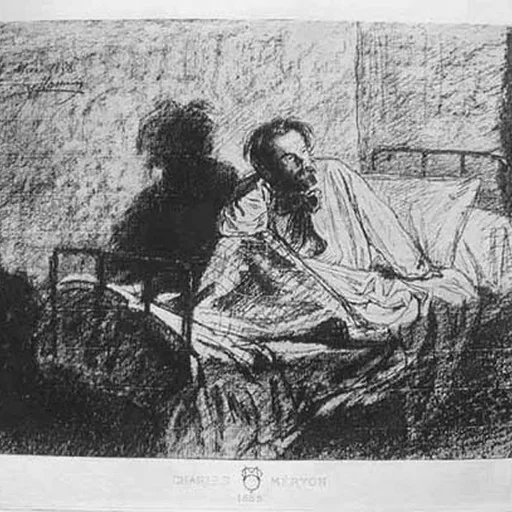
Charles Meryon (sometimes Méryon, 23 November 1821 – 14 February 1868) was a French artist who worked almost entirely in etching, as he had colour blindness.

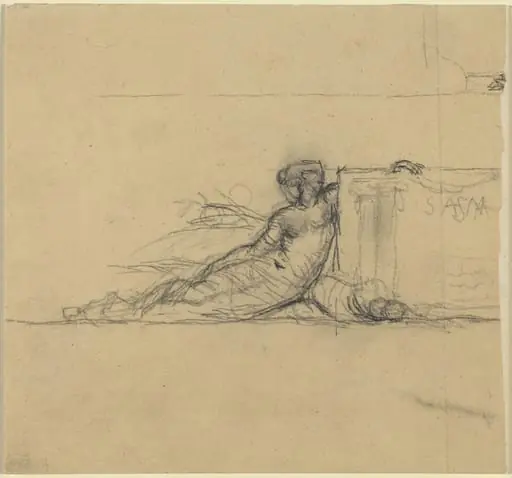
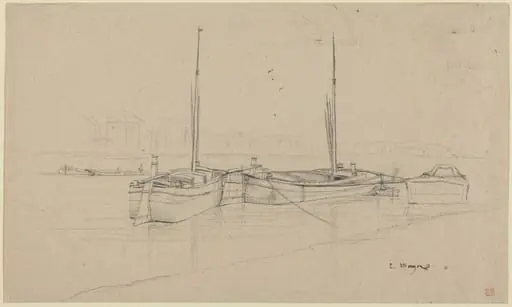
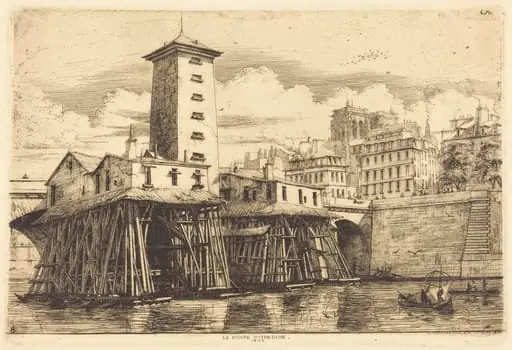 La Pompe Notre-Dame, Paris (The Notre-Dame Pump)
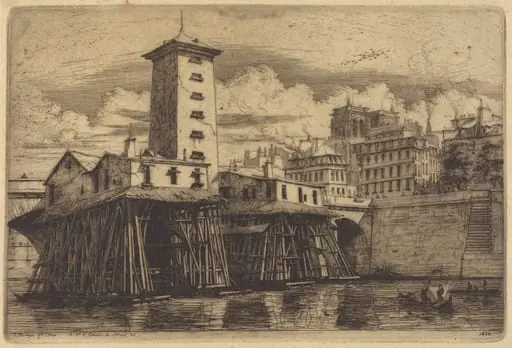 La Pompe Notre-Dame, Paris (The Notre-Dame Pump)
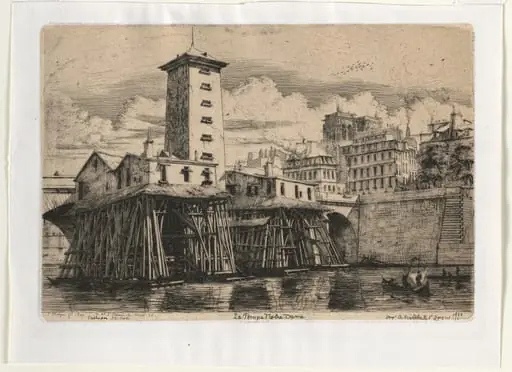 Notre Dame Pumphouse, Paris
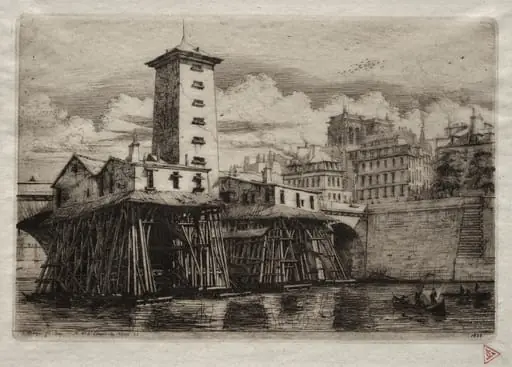 Etchings of Paris: The Notre Dame Pump
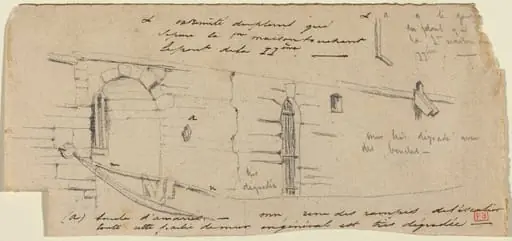
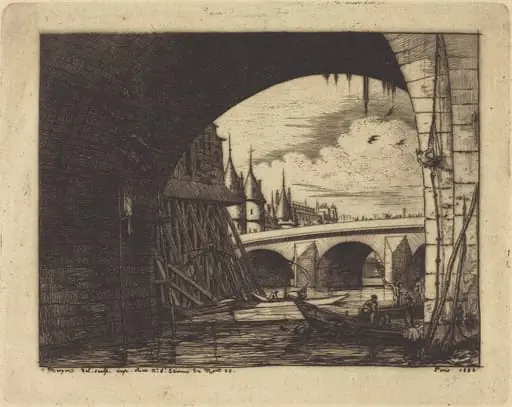 L'arche du Pont Notre-Dame, Paris (An Arch of the Notre-Dame Bridge, Paris)
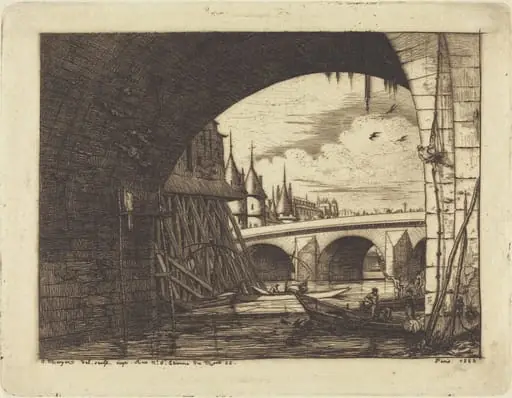 L'arche du Pont Notre-Dame, Paris (An Arch of the Notre-Dame Bridge, Paris)
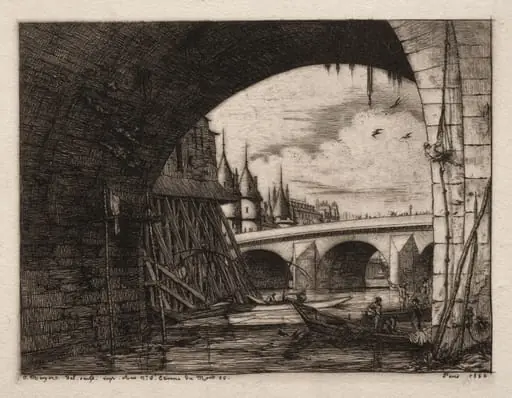 L'arch du Pont Notre Dame, Paris