Artwork
Le Pont-au-Change, Paris
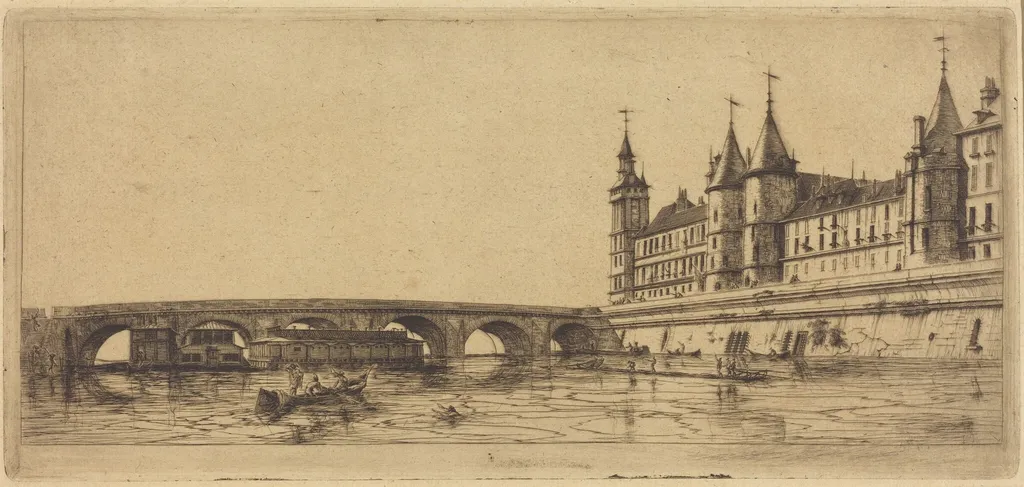
Le Pont-au-Change, Paris is an ink print by the Impressionist artist Charles Meryon. It dates from 1854 and is held in the collection of the National Gallery of Art. Created in 1854, *Le Pont‑au‑Change, Paris* is an etching executed on green laid paper.
About this work
Overview
Created in 1854, *Le Pont‑au‑Change, Paris* is an etching executed on green laid paper. The print depicts a segment of the Seine where a three‑arched stone bridge spans the water, flanked by a grand, spire‑topped building and a bustling riverbank populated with rowboats and pedestrians.
Subject & Meaning
The composition captures a typical Parisian riverscape, emphasizing the interplay between architecture and daily life. The towering façade with numerous windows suggests the city's historic grandeur, while the modest vessels and figures convey the ordinary rhythms of commerce and transport along the Seine.
Technique & Style
Meryon employed delicate, closely spaced lines to render architectural detail, water ripples, and human activity. This meticulous line work, characteristic of mid‑nineteenth‑century French etching, allows a high degree of texture and tonal variation despite the monochrome medium.
History & Provenance
The print belongs to Meryon’s celebrated series of Paris views, produced during a period when the artist, despite being color‑blind, focused on the city’s Gothic atmosphere. He continued to work until his institutionalization, dying in an asylum in 1868.
Context
Meryon’s work reflects a broader nineteenth‑century fascination with urban historicism, where artists documented the evolving face of Paris. His emphasis on stone structures and atmospheric detail aligns with contemporary interests in preserving the city’s medieval character amid rapid modernization.
Artist & collection
Artist
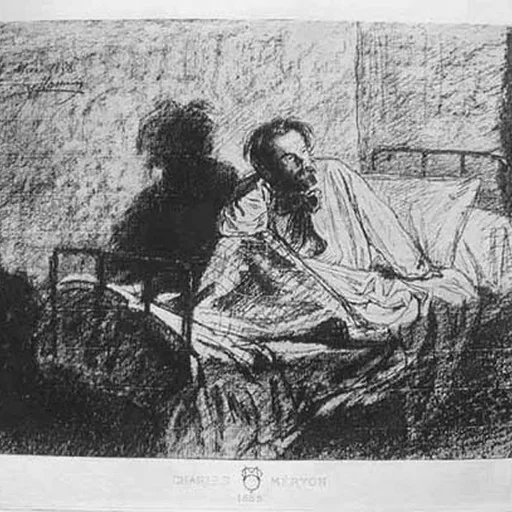
Charles Meryon (sometimes Méryon, 23 November 1821 – 14 February 1868) was a French artist who worked almost entirely in etching, as he had colour blindness.

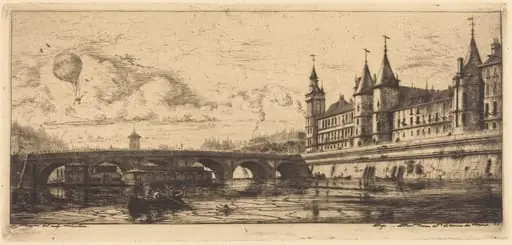 Le Pont-au-Change, Paris
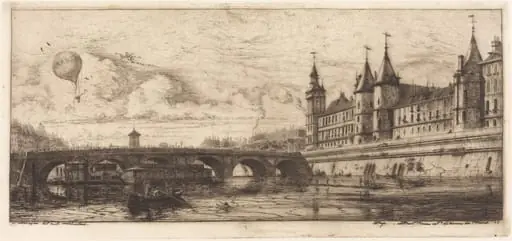 Le Pont-au-Change, Paris
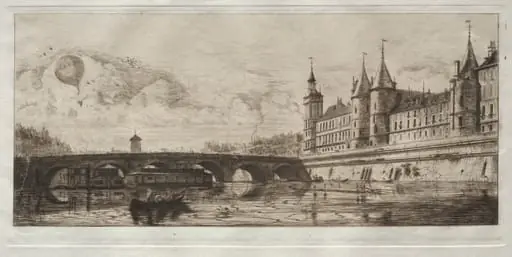 Le Pont-au-Change
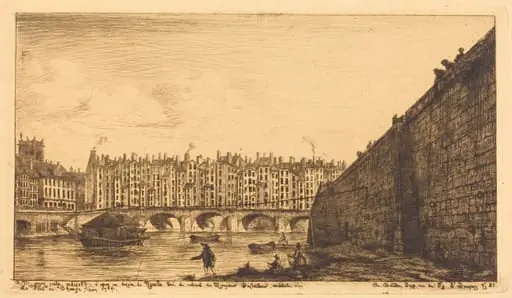 Le Pont-au-Change, Paris, vers 1784
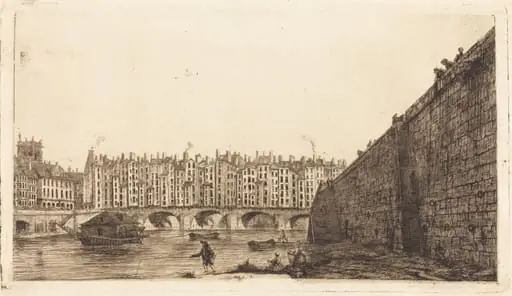 Le Pont-au-Change, Paris, vers 1784
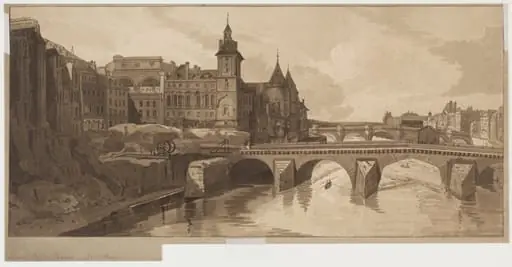 Selection of Twenty of the Most Picturesque Views in Paris:View of Pont au Change
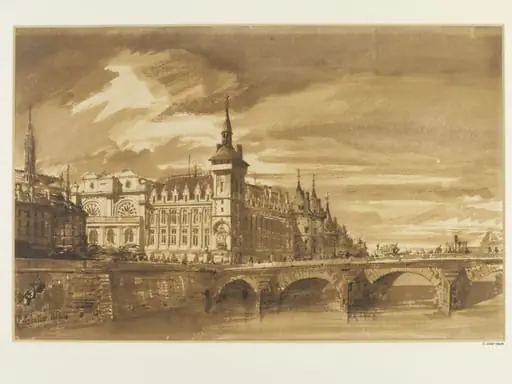 View of the Pont au Change and the Palais de Justice, Paris
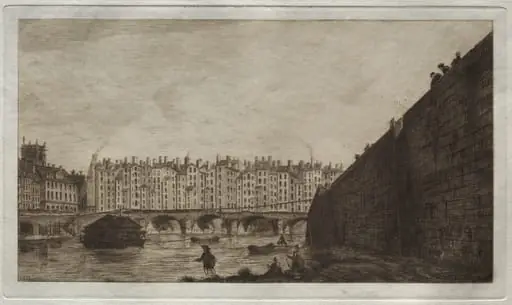 Le Pont-au-change, Paris, vers 1784
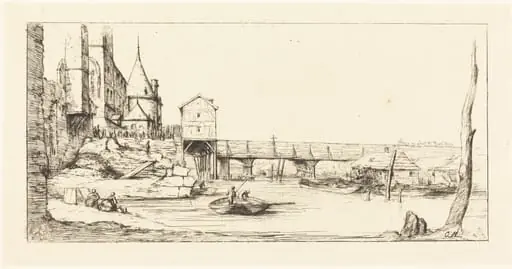 Passerelle du Pont-au-Change, Paris, après l'Incendie de 1621 (Footbridge Temporarily Replacing the Pont-au-Change, Paris, after the Fire of 1621)
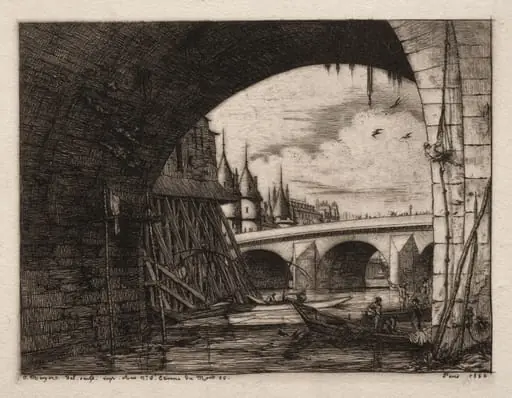 L'arch du Pont Notre Dame, Paris