Artwork
Le Pont Neuf, Paris
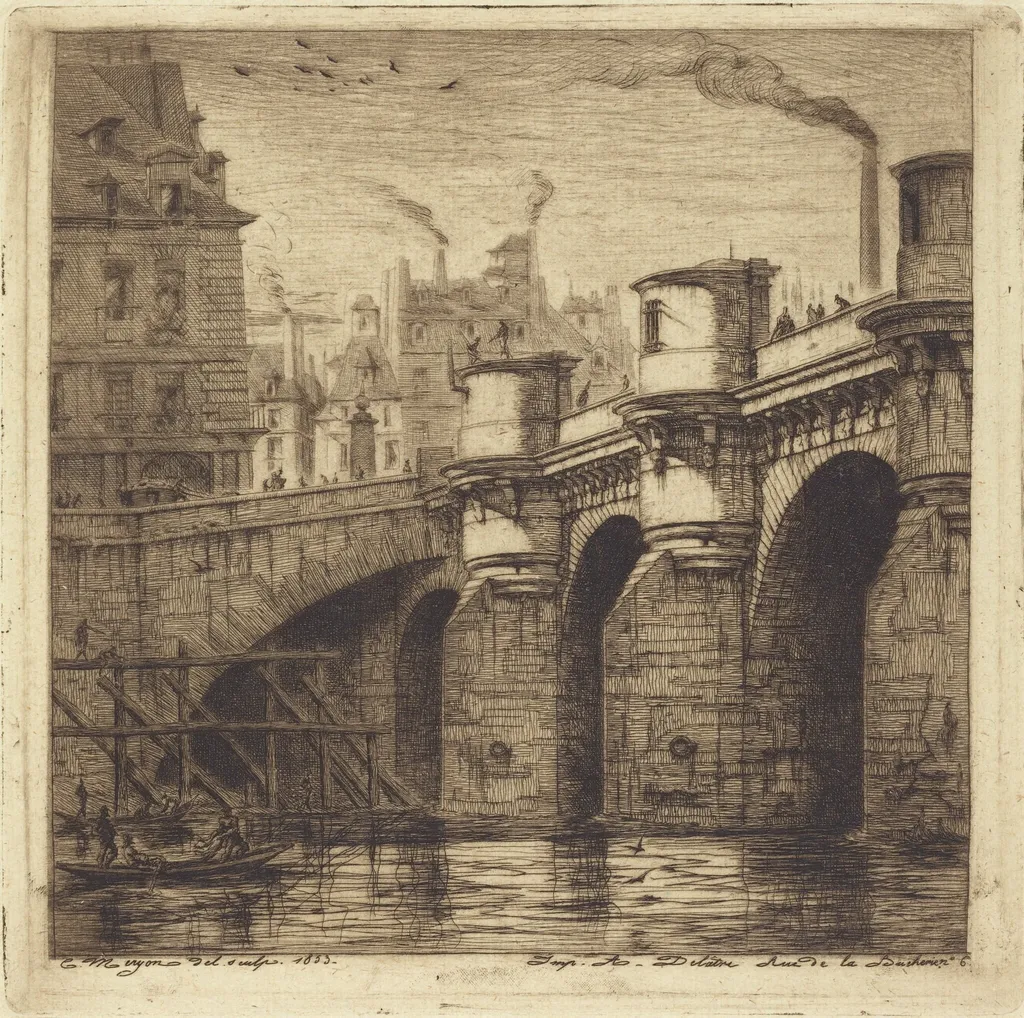
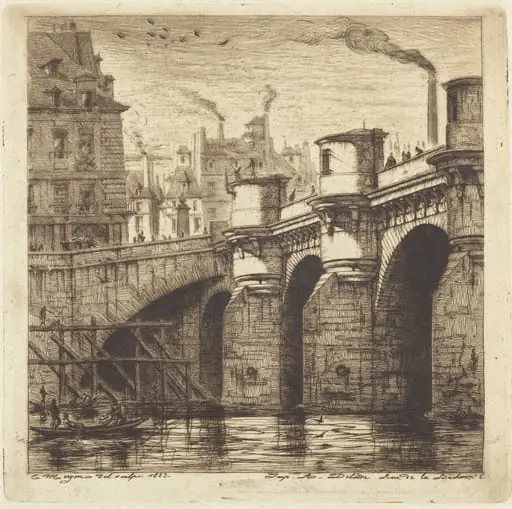
Le Pont Neuf, Paris is an ink print by the Impressionist artist Charles Meryon. It dates from 1853 and is held in the collection of the National Gallery of Art. Created in 1853, this print presents a view of Paris’s historic Pont Neuf.
About this work
This was made in 1853, when artists were starting to focus on real-life scenes instead of fancy ideas.
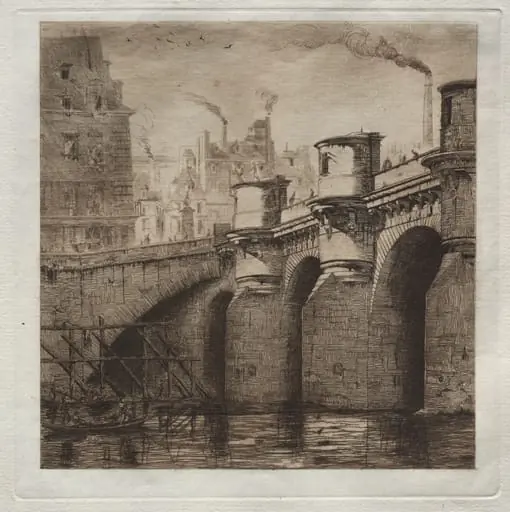
This etching shows a busy Paris bridge packed with people and boats. The buildings on either side are tall, with lots of windows and chimneys puffing smoke. The river below is full of small rowboats, and the whole scene looks detailed but a little dark.
The artist used a sharp, scratchy style to show every tiny part of the bridge and water. This was made in 1853, when artists were starting to focus on real-life scenes instead of fancy ideas.
Look up etching to see how artists like this made their marks.
Overview
Created in 1853, this print presents a view of Paris’s historic Pont Neuf. Executed in etching and drypoint on green laid paper, the image captures the bustling activity on the bridge, its surrounding façades, and the river traffic below.
Subject & Meaning
The composition concentrates on the densely populated bridge, crowded with pedestrians and small rowing vessels. Tall buildings line the quays, their windows and chimneys emitting thin plumes of smoke, suggesting the everyday life of mid‑nineteenth‑century Paris.
Technique & Style
Meryon combined traditional acid‑etched lines with drypoint’s directly incised, ragged marks, producing a sharply detailed yet slightly somber tonal range. The green‑toned paper enhances the atmospheric quality, while the scratchy line work emphasizes texture in stone, water and sky.
History & Provenance
The French printmaker Charles Meryon, who worked almost exclusively in monochrome due to his colour blindness, produced this work during a period when artists were turning toward realistic urban scenes. Though highly regarded in France as the pre‑eminent etcher of his generation, his reputation remained modest in English‑language circles.
Context
The image reflects the mid‑1800s shift toward depicting contemporary city life, moving away from classical or mythological subjects. Pont Neuf, the oldest bridge spanning the Seine, served as a familiar landmark for viewers, embodying both historical continuity and the modern bustle of Paris.
Artist & collection
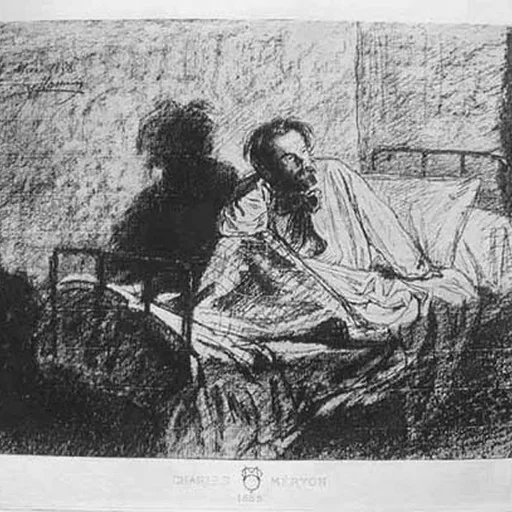
Artist
Charles Meryon (sometimes Méryon, 23 November 1821 – 14 February 1868) was a French artist who worked almost entirely in etching, as he had colour blindness.