Artwork
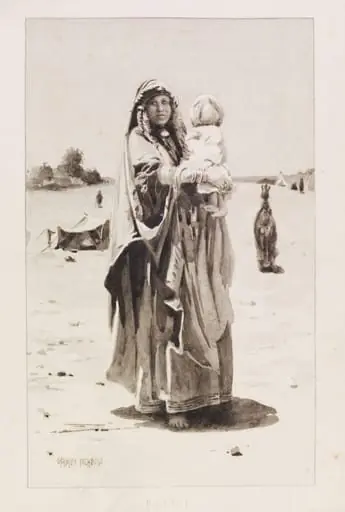
An Egyptian Fellahah with Her Child
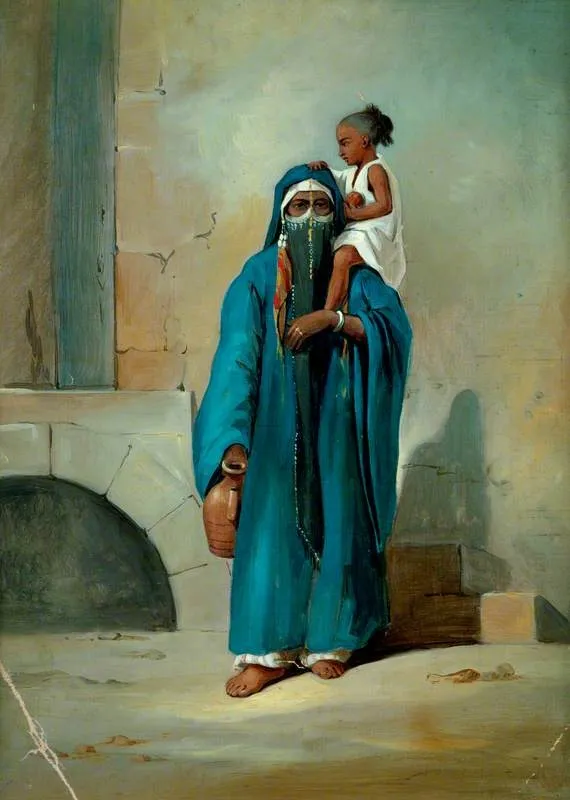
An Egyptian Fellahah with Her Child is an oil painting by the Orientalist artist Émile Prisse d'Avennes. It dates from 1835 and is held in the collection of the Victoria and Albert Museum.
About this work
Overview
Painted in 1835 by Émile Prisse d'Avennes, this oil work portrays an Egyptian peasant woman with her young child. The painting is part of the Victoria and Albert Museum’s collection and reflects the artist’s interest in North African daily life during his travels. It captures a quiet, unidealized moment of domestic routine, grounded in observed detail rather than romanticized exoticism.
Subject & Meaning
The figure is a fellahah, a rural Egyptian woman, depicted in modest attire: a blue robe, white head covering, and a green face veil.
The figure is a fellahah, a rural Egyptian woman, depicted in modest attire: a blue robe, white head covering, and a green face veil. She carries a clay jug, suggesting a task of daily necessity. Her child, perched on her shoulders, grips her headscarf, conveying physical closeness and trust. The scene emphasizes quiet resilience and familial bonds, avoiding theatricality in favor of intimate realism.
Technique & Style
Prisse d'Avennes employs subtle chiaroscuro to model the woman’s form against a plain stone wall, enhancing volume without dramatic contrast. The textures of fabric, skin, and clay are rendered with restrained brushwork, prioritizing accuracy over flourish. The composition is tightly framed, focusing attention on the figures and their spatial relationship, with minimal background detail to reinforce immediacy.
History & Provenance
Created during Prisse d'Avennes’s early travels in Egypt, the painting stems from his ethnographic observations in the 1830s. It entered the Victoria and Albert Museum’s collection as part of its broader 19th-century interest in documenting non-European cultures. The work remained relatively obscure until later scholarly attention to Orientalist art practices brought renewed focus to its quiet realism.
Context
In the 1830s, European artists increasingly traveled to North Africa, drawn by archaeological and cultural curiosity. Prisse d'Avennes, an engineer and antiquarian, approached his subjects with a documentary impulse. Unlike contemporaries who dramatized the Orient, he favored restrained observation, aligning this work with early ethnographic visual practice rather than imperial fantasy.
Legacy
The painting stands as an early example of European art that privileges authenticity over spectacle in depicting non-Western subjects. While not widely exhibited, it contributes to understanding the shift from exoticized Orientalism toward more grounded visual anthropology. Its preservation in a major museum underscores its value as a record of daily life in 19th-century Egypt.
Artist & collection
Artist
Émile Prisse d’Avennes painted scenes of daily life in Egypt in the 1830s, using oil paint to capture people and places.