Artwork
Branch
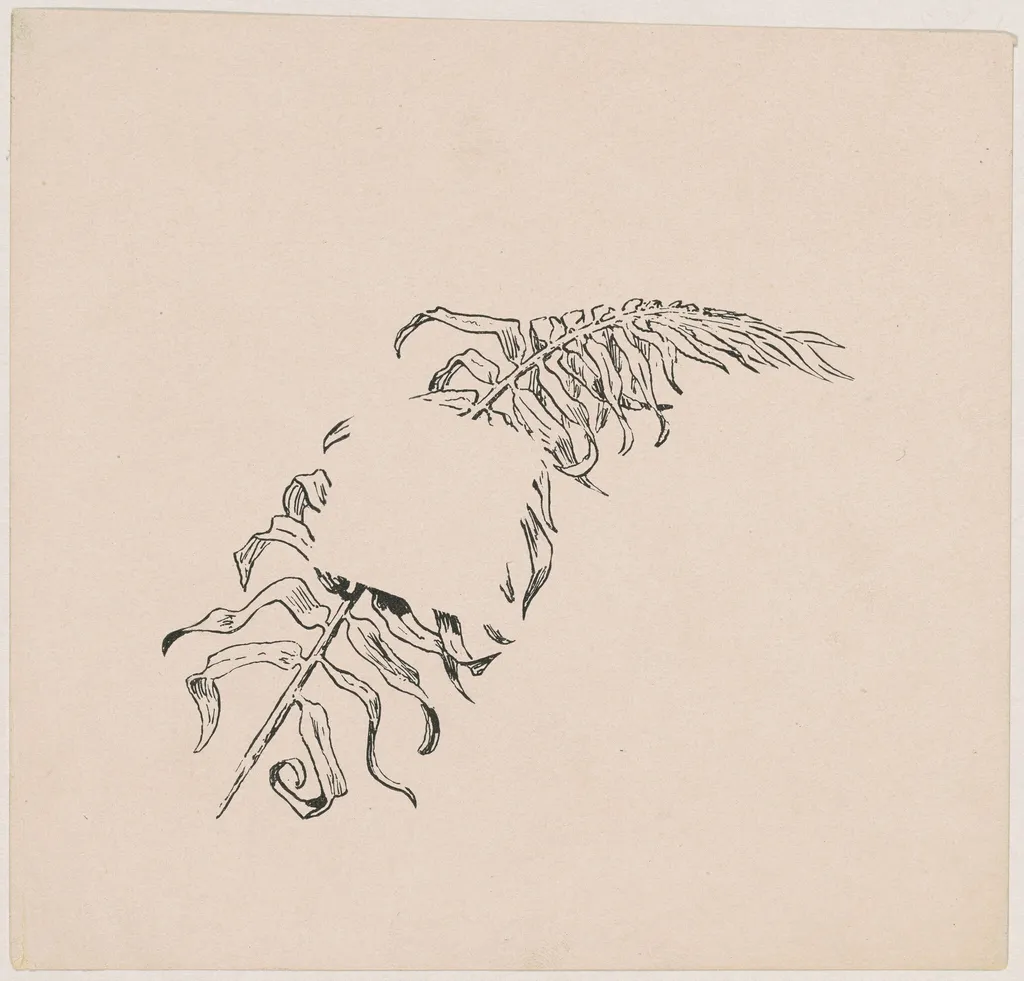
Branch is an ink print by the Impressionist artist James Henry Moser. It dates from 1892 and is held in the collection of the National Gallery of Art.
About this work
Overview
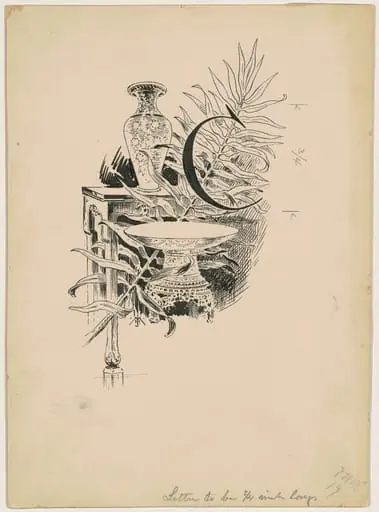
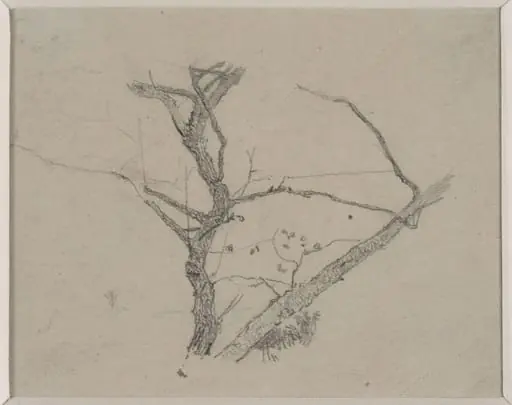
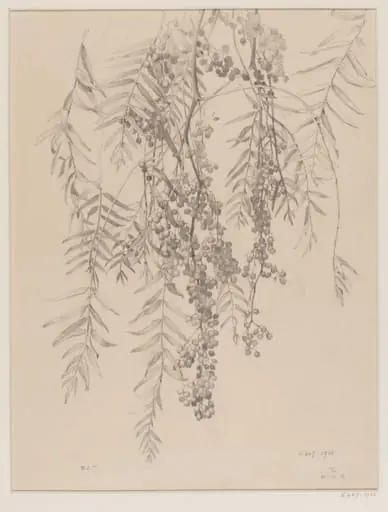
Branch is a 1892 offset lithograph by James Henry Moser, executed in black ink on beige wove paper. The composition centers on a single plant branch rendered with minimal detail, emphasizing line and form over realism. Its stark monochrome palette and uncluttered background focus attention on the rhythmic flow of the foliage, reflecting a quiet but deliberate engagement with natural movement.
Subject & Meaning
The work invites contemplation of nature’s transient gestures, stripped of narrative, yet charged with subtle vitality through its dynamic contours.
The subject is a solitary botanical branch, its elongated leaves varying in curvature and length, suggesting motion as if caught in a breeze. There is no indication of context—no soil, sky, or supporting structure—so the branch exists as an autonomous form. The work invites contemplation of nature’s transient gestures, stripped of narrative, yet charged with subtle vitality through its dynamic contours.
Technique & Style
Moser employed bold, fluid lines to define each leaf, avoiding fine detail in favor of expressive sweeps. The lithographic process allowed for sharp, consistent ink transfer, enhancing the graphic quality of the strokes. The looseness of the drawing aligns with late 19th-century tendencies toward spontaneity, though it avoids the color and light studies typical of Impressionist painting, instead favoring linear economy.
History & Provenance
Created in 1892, Branch was produced as a printed multiple, likely intended for wider distribution rather than as a unique artwork. Its survival in institutional and private collections suggests modest but sustained interest in Moser’s graphic work during the early 20th century. No significant exhibition history or documented ownership chain is widely recorded, indicating its role as a quiet, personal study rather than a public statement.
Context
In the 1890s, American artists increasingly turned to printmaking as a medium for personal expression, influenced by Japanese woodcuts and European modernism. Moser’s work fits within this trend, where simplified natural forms were used to convey emotion and rhythm. While not part of a known movement, Branch reflects a broader cultural shift toward valuing direct observation and expressive line over academic precision.
Legacy
Branch remains a modest example of late 19th-century American graphic art, notable for its restraint and sensitivity to natural form. It has not entered the mainstream canon but is occasionally cited in studies of American printmaking’s evolution. Its enduring presence in archives underscores its value as a quiet, thoughtful record of an artist’s engagement with the natural world through line alone.
Artist & collection


![Study for "Shoeing Calvary Horses at the Front" [verso], by John Singer Sargent](https://artifactworldgallery.com/img/john-singer-sargent--study-for-shoeing-calvary-horses-at-the-front-verso--6f6d1a163e84e9ab-w320.webp)
![Study of Hands Knitting [recto], by Perry, Enoch Wood, Jr.](https://artifactworldgallery.com/img/perry-enoch-wood-jr--study-of-hands-knitting-recto--6db2e53680195bdc-w320.webp)