Artwork
The Train of Maris (Le train de Maris)
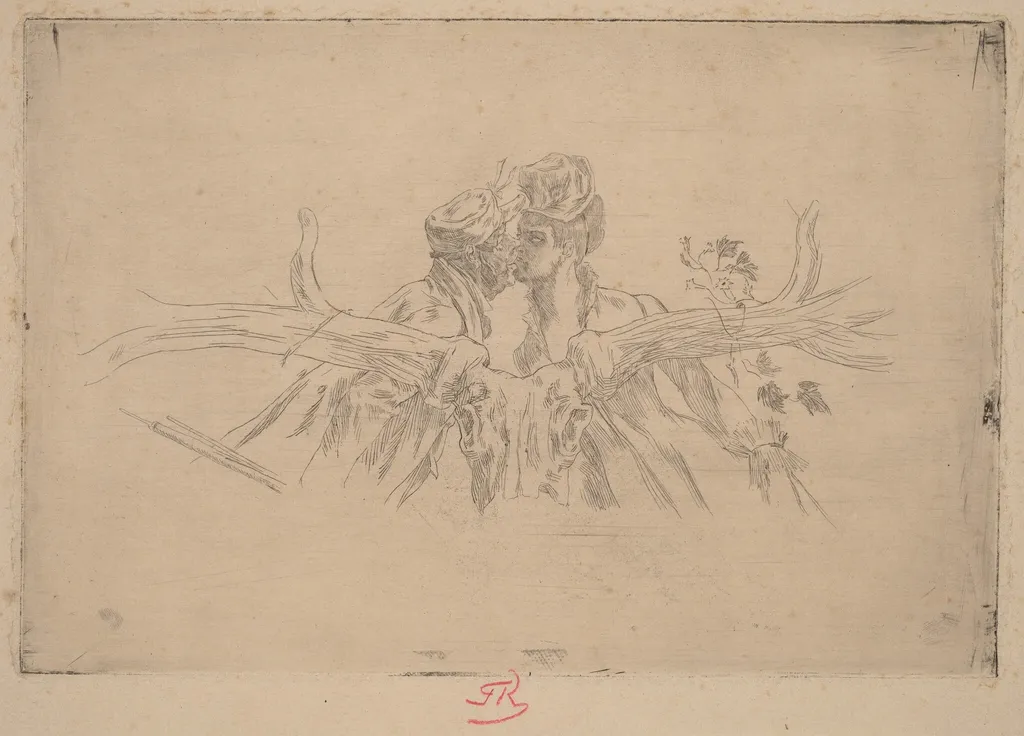
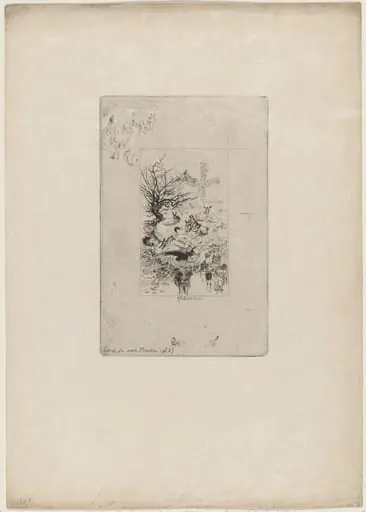
The Train of Maris (Le train de Maris) is an ink print by the Romanticist artist Félicien Rops. It dates from 1866 and is held in the collection of the Rosenwald Collection.
About this work
Overview
Created in 1866, *The Train of Maris* is an etching by Belgian artist Félicien Rops, produced during his early engagement with the Parisian avant-garde.
Created in 1866, *The Train of Maris* is an etching by Belgian artist Félicien Rops, produced during his early engagement with the Parisian avant-garde. Though less known than his later works, this print reveals his experimentation with intaglio techniques and his interest in psychological atmosphere. The work belongs to a period when Rops was developing a distinctive visual language that blended realism with symbolic undertones.
Subject & Meaning
The image depicts a solitary figure seated beneath a tangled tree, clutching a long staff, his posture suggesting exhaustion or detachment. The tilted hat and withdrawn gaze imply inner turmoil or alienation. The title, referencing a mythic or literary train, hints at an unseen journey—perhaps metaphorical—leaving the viewer to interpret the figure’s emotional state within an ambiguous, dreamlike setting.
Technique & Style
Rops employed a loose, rapid etching technique, using a needle to scratch directly into the plate, creating jagged, expressive lines that mimic the texture of wind-tossed foliage. The rough paper surface enhances the tactile quality of the print, while the dense, scratchy patterning around the figure intensifies the sense of isolation. His method prioritizes emotional resonance over precision, aligning with emerging Symbolist sensibilities.
History & Provenance
Produced in 1866, the print emerged during Rops’s formative years in Paris, where he associated with literary circles and publishers interested in transgressive imagery. Though not widely exhibited at the time, it circulated among private collectors and artists connected to the emerging Decadent movement. Its survival reflects its role as a personal, experimental work rather than a commercial print.
Context
In mid-1860s Paris, artists were redefining printmaking beyond illustration, embracing etching as a medium for personal expression. Rops, influenced by Baudelaire and the Symbolist rejection of academic norms, used such works to explore psychological depth. *The Train of Maris* reflects this shift, positioning the individual as a solitary figure within an indifferent, almost hostile natural world.
Legacy
Though overshadowed by Rops’s later, more provocative prints, *The Train of Maris* remains an early indicator of his evolving aesthetic. Its emphasis on mood, line, and psychological ambiguity influenced subsequent generations of printmakers who sought to convey inner states through minimal, expressive forms. The work stands as a quiet precursor to the Symbolist movement’s broader embrace of introspection.
Artist & collection
Artist
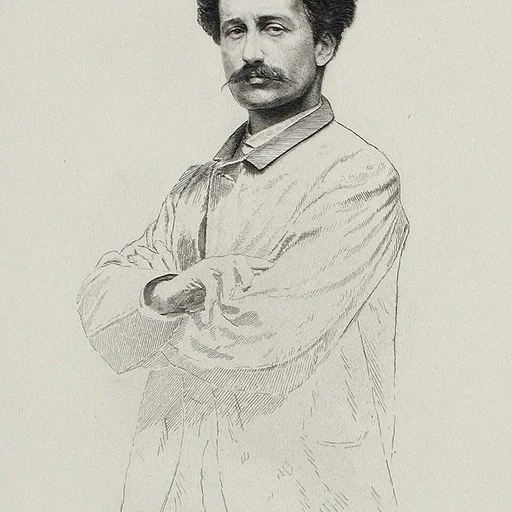
Félicien Victor Joseph Rops (French: ; 7 July 1833 – 23 August 1898) was a Belgian artist associated with Symbolism, Decadence, and the Parisian fin de siècle, and was a member of the Les XX group.
![Study for "Shoeing Calvary Horses at the Front" [verso], by John Singer Sargent](https://artifactworldgallery.com/img/john-singer-sargent--study-for-shoeing-calvary-horses-at-the-front-verso--6f6d1a163e84e9ab-w320.webp)
![Study of Hands Knitting [recto], by Perry, Enoch Wood, Jr.](https://artifactworldgallery.com/img/perry-enoch-wood-jr--study-of-hands-knitting-recto--6db2e53680195bdc-w320.webp)