Artwork
Akbar
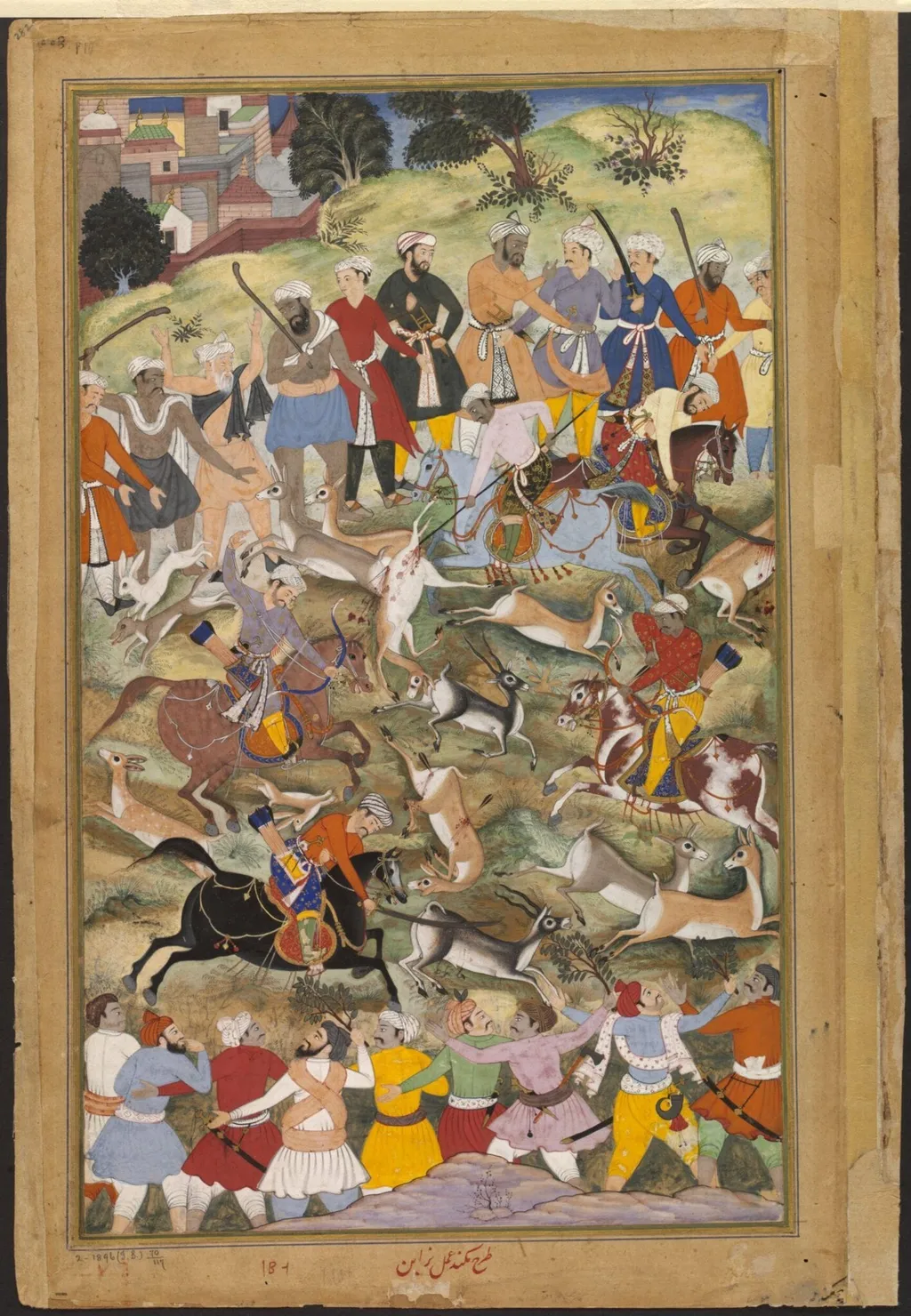
Akbar is a paint painting by the Mughal Painting artist Mukund. It dates from 1592 and is held in the collection of the Victoria and Albert Museum.
About this work
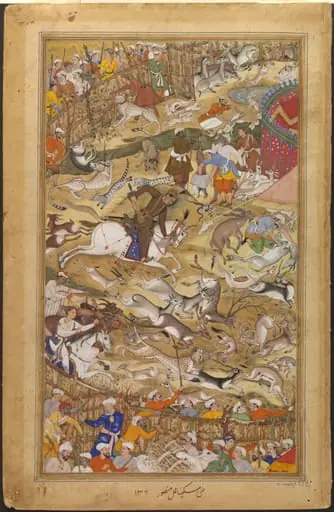
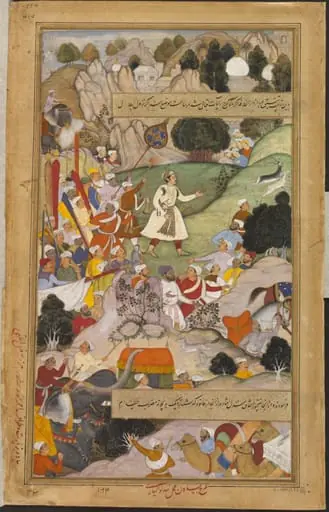
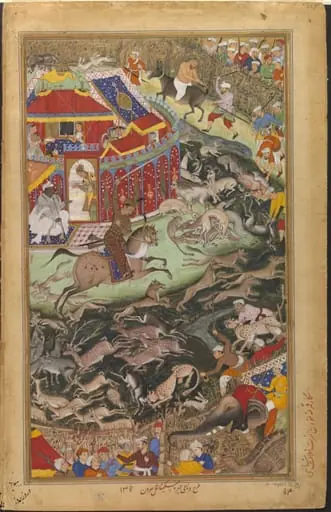
The scene captures a real hunt from 1568, after Akbar’s victory over the Rajput fortress of Chitor.
This painting shows Akbar riding a horse, aiming his bow at a tiger below him. Hunters and soldiers surround him, with spears and flags waving in the background. The scene captures a real hunt from 1568, after Akbar’s victory over the Rajput fortress of Chitor.
Mukund used bright colors and fine details to highlight Akbar’s power and skill. The fight feels dramatic because of how closely the figures are drawn. Look for the tiger—it’s the only animal in the whole scene.
Check out Mukund next to compare how another artist painted royal hunts.
Overview
This painting is one panel of a double-page illustration from the Akbarnama, the official chronicle of Emperor Akbar’s reign. Created around 1590, it depicts a hunting expedition at Palam near Delhi in 1568, shortly after the fall of Chitor. The scene was commissioned by Akbar’s court to document his activities and reinforce his authority through visual narrative. The artist Mukund rendered the moment with meticulous detail and vivid color, aligning with the imperial project of recording history through art.
Subject & Meaning
The scene captures Akbar on horseback, drawing his bow toward a tiger, surrounded by attendants and soldiers. Though presented as a royal pastime, the hunt carried political weight. It symbolized control over nature and rebellion alike, echoing the recent brutal suppression of Chitor. The act reinforced Akbar’s image as a sovereign capable of decisive action, while also serving as a public demonstration of martial readiness to nearby regions still wary of Mughal power.
Technique & Style
Mukund employed fine brushwork and saturated pigments to render figures and landscape with precision. The composition is tightly packed, with figures overlapping to create a sense of urgency and movement. The tiger, the only animal depicted, is rendered with anatomical clarity, contrasting with the stylized horses and armor. The use of perspective is flattened, typical of Mughal manuscript painting, yet the dynamism of motion and gesture conveys tension and focus.
History & Provenance
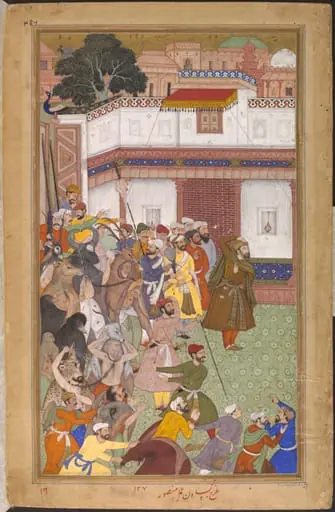
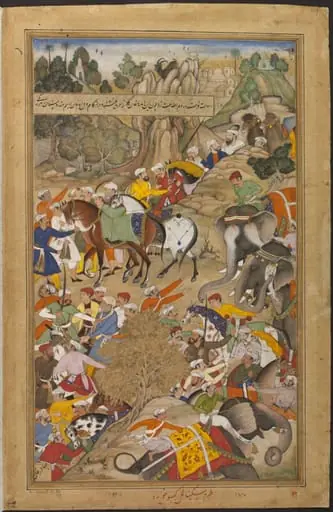
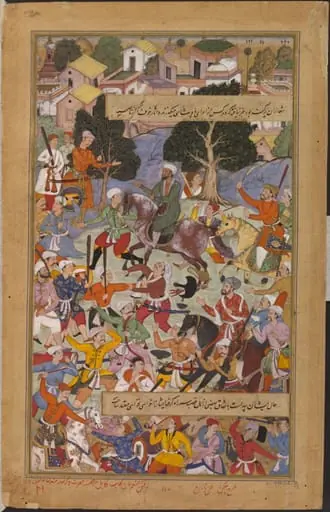
The painting was produced in Akbar’s imperial atelier between 1586 and 1590 as part of a multi-volume illustrated history. It was likely compiled alongside its companion panel, IS.2:71-1896, forming a single narrative spread. The manuscript remained in imperial collections until the 19th century, when it entered the British Museum’s holdings. Its survival reflects the enduring value placed on courtly chronicles as both historical records and artistic achievements.
Context
The hunt occurred during a period of consolidation after Akbar’s conquest of Chitor, a campaign marked by extreme violence. Abu’l Fazl, the chronicle’s author, framed hunting as a tool of governance—allowing the emperor to observe loyalty, inspect distant provinces, and project military strength without open warfare. This scene, though seemingly recreational, was embedded in a broader strategy of political theater, reinforcing imperial presence across the realm.
Legacy
As part of the Akbarnama, this painting helped establish a visual language for Mughal historiography, blending realism with symbolic intent. It influenced later court artists in their depiction of rulers in action. The work remains a key example of how art was used to legitimize power, documenting not just events but the ideology behind them—where the hunt became a metaphor for sovereignty, discipline, and control.
Artist & collection
Artist
Mukund painted lively scenes from the emperor Akbar’s court in the late 1500s. His brush brought to life Akbar being weighed on his birthday and Akbar hunting with cheetahs, both from the Akbarnama, a grand history book…