Artwork
Untitled (Invitation to Party at Jules Pascin's)
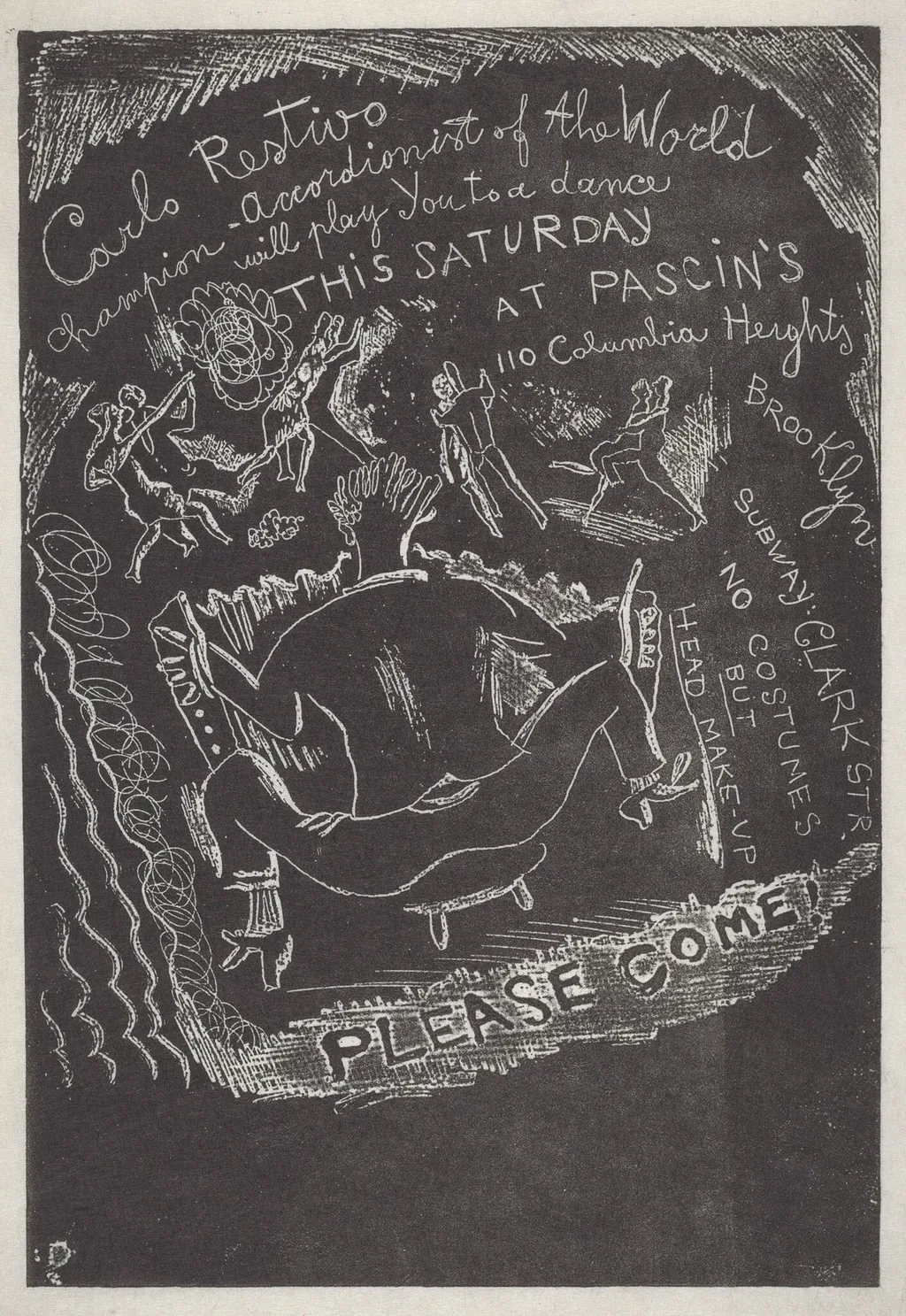
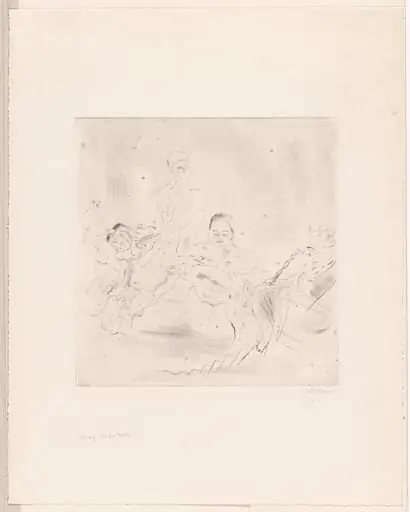
Untitled (Invitation to Party at Jules Pascin's) is an ink print by Jules Pascin. It dates from 1918 and is held in the collection of the National Gallery of Art.
About this work
Overview
The work blends graphic design with personal expression, capturing the energy of a private event through visual noise rather than narrative clarity.
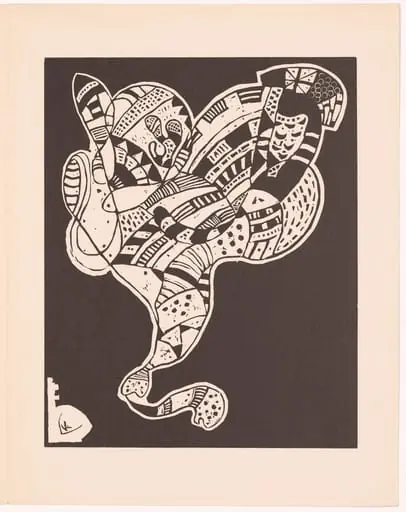
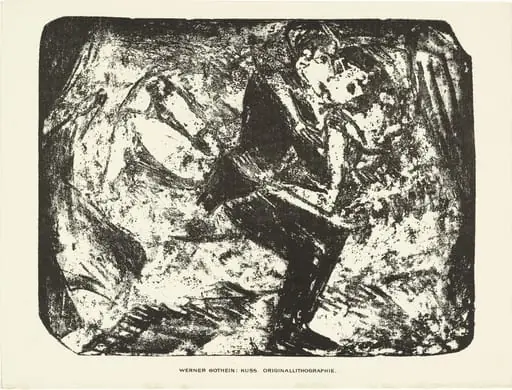
Created in 1918, this relief-printed etching by Jules Pascin functions as a visual invitation to a social gathering at his home. The composition is dominated by a black field with incised white lines forming figures, text, and abstract forms. The printing technique emphasizes raised ink, creating a stark contrast that gives the impression of spontaneous scribbles on a dark surface. The work blends graphic design with personal expression, capturing the energy of a private event through visual noise rather than narrative clarity.
Subject & Meaning
The print depicts an informal, lively gathering, likely among Pascin’s circle of artists and writers in Paris. Figures suggest dancers and musicians, rendered with loose, gestural lines that imply motion rather than detail. Scattered phrases like 'Carlo Restivo will play' and 'Please come' anchor the image as an invitation, yet their disjointed placement undermines formal structure. The work conveys the spontaneity and intimacy of bohemian social life, where art and celebration blurred into daily ritual.
Technique & Style
Pascin employed a relief-printed etching method, carving lines into the plate so that ink sits in raised ridges, transferring as white marks on a dark ground. This reversal of traditional etching creates a luminous, almost electric effect. The drawing style is rapid and unrefined—figures are suggested with minimal strokes, and text is integrated as visual texture. The result is a dynamic, tactile surface that mimics the immediacy of a hastily written note or a chalked announcement on a wall.
History & Provenance
The print was produced during Pascin’s time in Paris, amid the expatriate artistic community of the early 20th century. It likely circulated privately among friends as a hand-printed invite, rather than being issued as a commercial print. Few examples survive, and its origins are tied to Pascin’s domestic life rather than gallery exhibition. Its rarity reflects its function as a personal artifact, not a public artwork.
Context
In the aftermath of World War I, Parisian avant-garde circles thrived on informal gatherings where music, conversation, and art intersected. Pascin’s circle included writers, musicians, and fellow artists who valued authenticity over polish. This print reflects that ethos—its raw aesthetic aligns with contemporaneous experiments in expressionist graphic arts and the rejection of academic refinement. It is a document of a transient, intimate world that valued connection over spectacle.
Legacy
Though not widely exhibited in its time, the work exemplifies Pascin’s ability to merge graphic experimentation with personal narrative. Its informal style influenced later artists exploring the boundaries between fine art and ephemeral communication. Today, it is valued as a rare glimpse into the social fabric of early 20th-century Parisian art life, where the line between invitation and artwork was deliberately blurred.
Artist & collection