Artwork
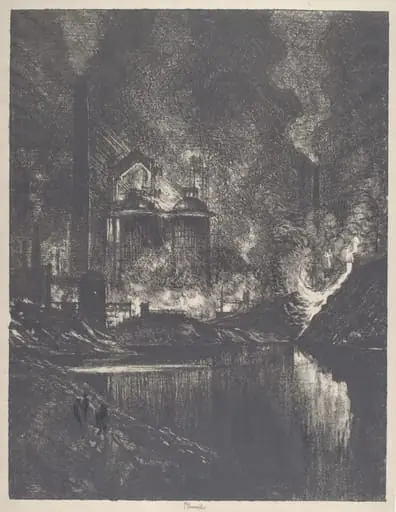
Edgar Thomson Works, Bessemer
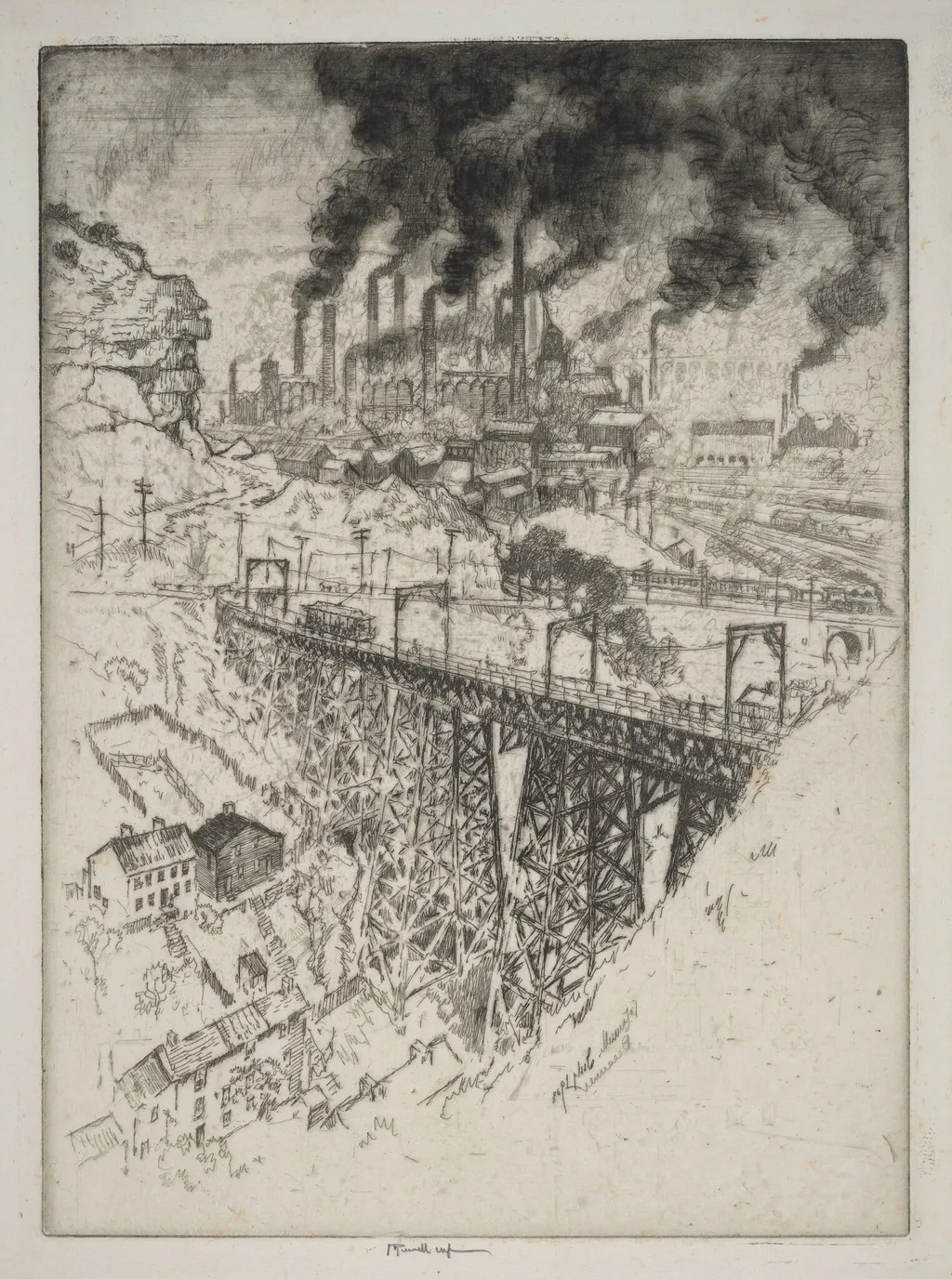
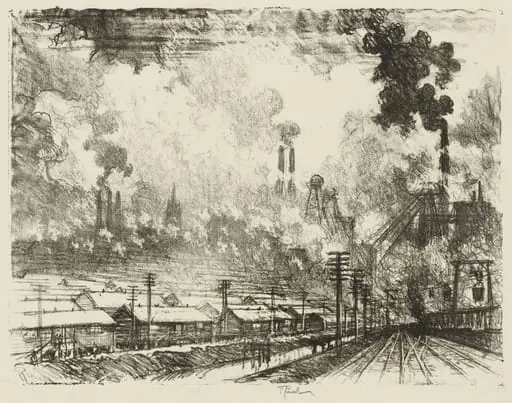
Edgar Thomson Works, Bessemer is an ink print by Joseph Pennell. It dates from 1909 and is held in the collection of the National Gallery of Art.
About this work
This etching by Joseph Pennell shows a huge steel mill belching smoke under a hazy sky. The towering stacks and tangled pipes fill the left side. The right side holds a tiny figure—just a few lines—walking away.
It’s not just an industry scene. Pennell made this in 1909, when steel shaped America’s future. The image feels quiet despite the smoke.
Look up the National Gallery of Art, Washington.
Overview
Joseph Pennell produced this etching in 1909, capturing the Edgar Thomson Steel Works in Bessemer, Pennsylvania. A prominent American draftsman, Pennell was known for his detailed prints of industrial sites, often created during his time in Europe. This work exemplifies his interest in modern infrastructure, rendered with precision and a restrained tonal palette typical of etching techniques.
Subject & Meaning
On the right, a solitary, minimally rendered figure walks away, creating a quiet contrast between human scale and industrial enormity.
The scene centers on the sprawling steel mill, its smokestacks and piping dominating the left half of the composition. On the right, a solitary, minimally rendered figure walks away, creating a quiet contrast between human scale and industrial enormity. Pennell does not glorify the machinery; instead, he presents it as an imposing, almost silent force, suggesting the quiet dominance of industry over the landscape and individual.
Technique & Style
Pennell employed etching to achieve fine linear detail and atmospheric depth. The smoke is suggested through layered, soft lines rather than solid masses, while the machinery is defined by sharp, intersecting contours. The composition balances dense industrial forms with open, hazy sky, using tonal variation to convey distance and volume. His approach reflects Whistler’s influence in its emphasis on mood over narrative.
History & Provenance
Created during a period of rapid American industrial expansion, the etching was made shortly after Pennell’s return from Europe, where he had developed his printmaking style. It was likely produced as part of a series documenting U.S. industrial sites. The work entered the collection of the National Gallery of Art in Washington, D.C., where it remains as part of its holdings of American graphic art from the early 20th century.
Context
In 1909, the Edgar Thomson Works was one of the most productive steel mills in the United States, integral to the nation’s infrastructure and economic growth. Pennell’s depiction avoids overt commentary, instead offering a sober record of a landscape transformed by technology. His choice to include a solitary pedestrian underscores the human presence within, yet apart from, the machinery.
Legacy
Pennell’s etchings of industrial sites helped redefine printmaking as a medium for documenting modernity. This work, among others, contributed to a visual archive of American industry that influenced later realist and documentary artists. Its quiet tone and compositional balance continue to be studied for their nuanced portrayal of technological change without sentimentality.
Artist & collection
Artist
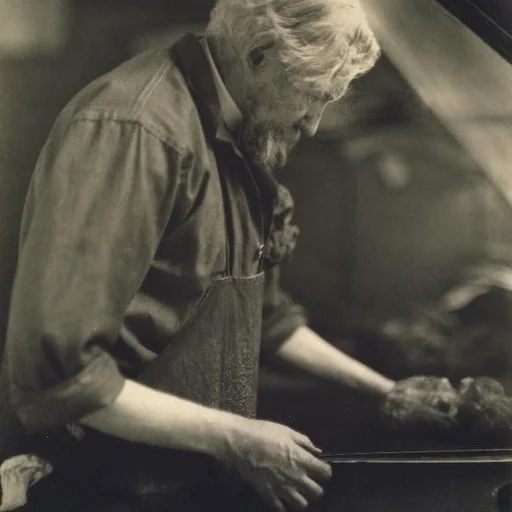
Joseph Pennell (July 4, 1857 – April 23, 1926) was an American draftsman, etcher, lithographer, and illustrator for books and magazines.

 English War Work: Munition Works
 Mouth of the Mine, Ruhrort near Oberhausen
 The Lake of Fire, Charleroi
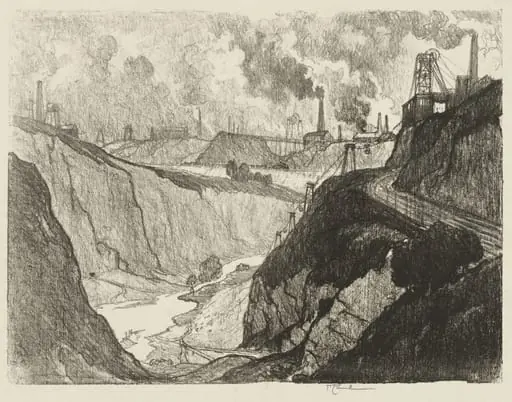 English War Work: The Iron Mine
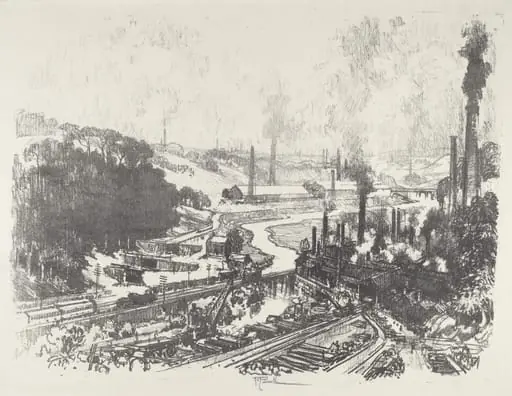 Munition Works
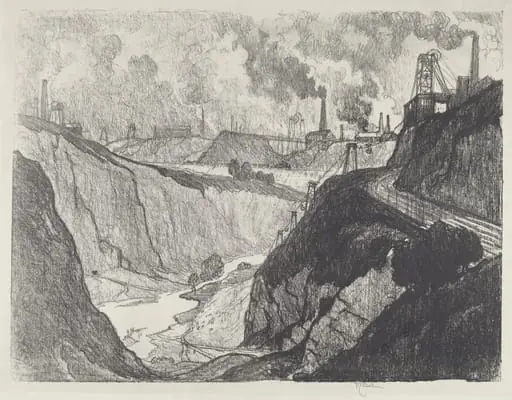 The Iron Mine
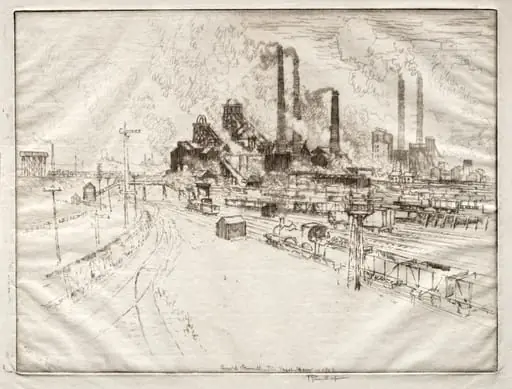 The Great Main, Near Sheffield
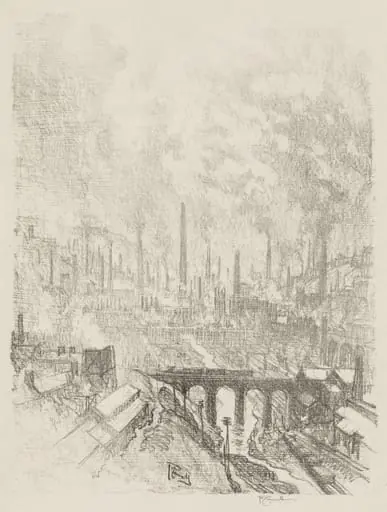 English War Work: Munitions City, No. 1
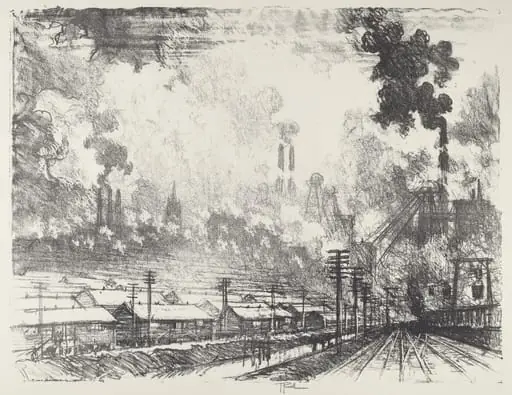 The Coal Mine
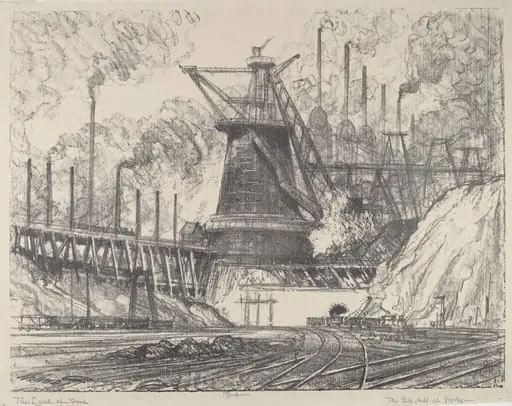 The Big Mill, Gary, Indiana
 English War Work: The Coal Mines
 Munitions City, No.I