Artwork
Hoveringham-on-Trent
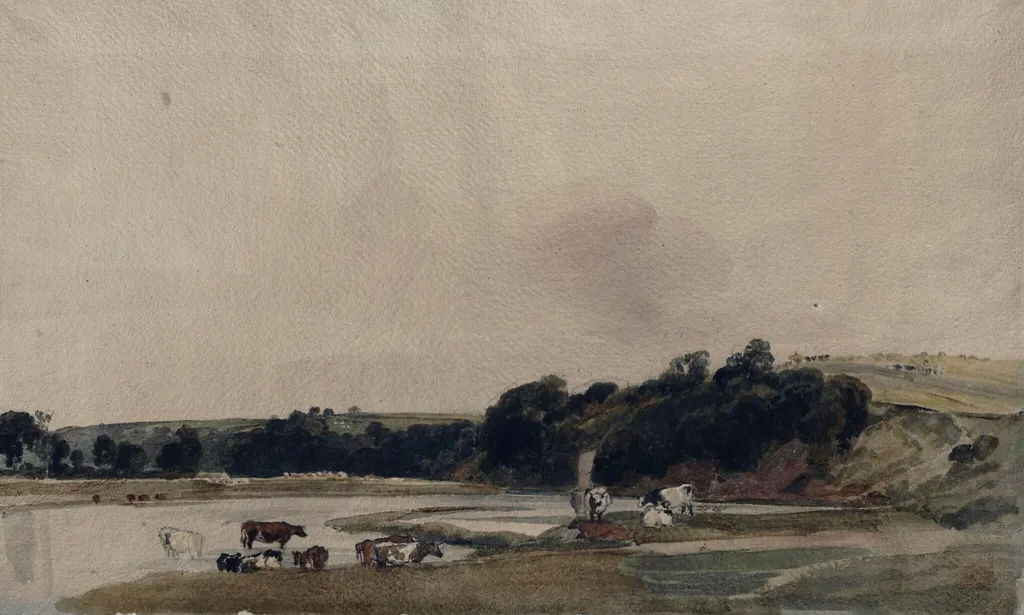
Hoveringham-on-Trent is a watercolor work on paper by Peter De Wint. It is held in the collection of the Victoria and Albert Museum.
About this work
Overview
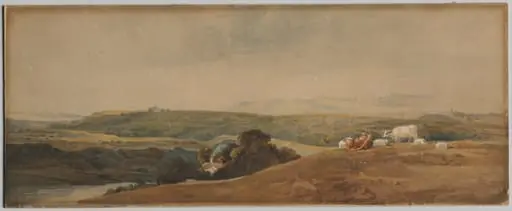
This watercolour depicts a quiet rural scene near Hoveringham-on-Trent, characterized by a winding lane flanked by wooded banks and a distant church tower.
This watercolour depicts a quiet rural scene near Hoveringham-on-Trent, characterized by a winding lane flanked by wooded banks and a distant church tower. The composition emphasizes stillness, with natural elements arranged to guide the eye gently through the landscape. A separate watercolour of Kneeton, Nottinghamshire, appears on the reverse, suggesting the artist’s practice of working on both sides of a single sheet.
Subject & Meaning
The scene captures a modest stretch of countryside, where human presence is implied rather than central: cows graze near the water’s edge, and a church tower rises above the trees as a quiet landmark. There is no narrative drama—only the quiet rhythm of rural life, framed by seasonal vegetation and the stillness of a reflective river. The subject reflects an appreciation for unremarkable, everyday landscapes.
Technique & Style
Soft, translucent washes of watercolour create subtle tonal gradations, particularly in the sky and water. Brushwork is restrained, with delicate strokes defining tree canopies and the texture of the bank. The river’s surface mirrors the surrounding foliage and atmosphere with minimal detail, enhancing the sense of calm. The artist favors muted hues and avoids sharp contrasts, reinforcing the scene’s quietude.
History & Provenance
The work is attributed to Peter De Wint, known for his topographical watercolours of the English countryside. The presence of a second landscape on the reverse indicates it was likely a study or sketch made during travel, possibly during the artist’s tours of Nottinghamshire. Its survival in this form suggests it was kept as a personal record rather than a finished exhibition piece.
Context
Created during the early 19th century, this work aligns with a growing interest in recording local landscapes outside urban centers. De Wint’s approach reflects the influence of the Picturesque movement, valuing naturalism and modest beauty over grandeur. Such watercolours were often made for private enjoyment, circulating among artists and patrons who appreciated quiet, observed nature.
Legacy
Though not widely exhibited in its time, this piece contributes to a broader body of work that helped define British watercolour as a medium for intimate landscape observation. De Wint’s consistent focus on rural scenes influenced later artists who sought to capture the English countryside with sincerity rather than idealization.
Own this work as a print
Artist & collection
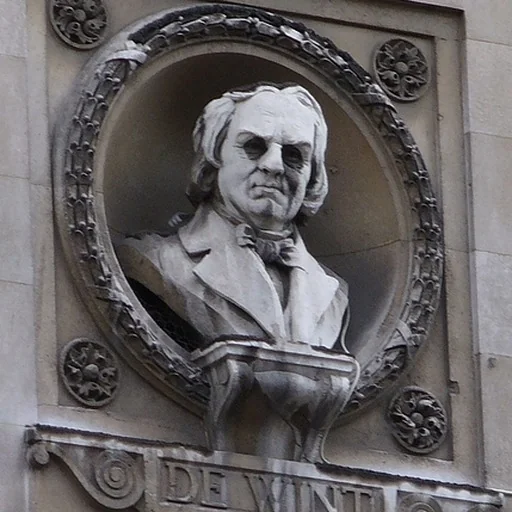
Artist
Peter De Wint was a prolific English painter, mostly in landscape painting in oils and watercolour. A number of his pictures are in Tate Britain, the Victoria and Albert Museum and The Collection, Lincoln. He died in London.

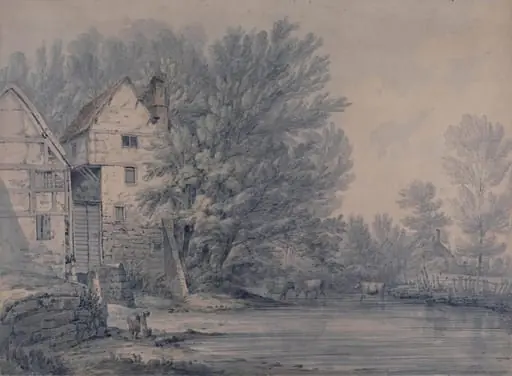 Millpond near Shrewsbury
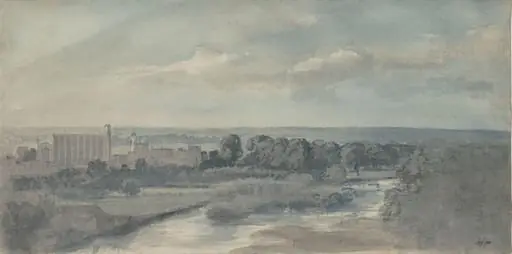 The Thames, with Eton College and chapel
 Hackensack Meadows
 Landscape
 The Southdown, Underhill Road; Clayton to Westmeston
 Landscape
 Landscape with two wood sawyers
 Near Washfield, Devon
 Bisham Abbey, on the Thames
 Landscape
 Mountains and Cattle
 Carting Barley on the Trent, near Burton