Artwork
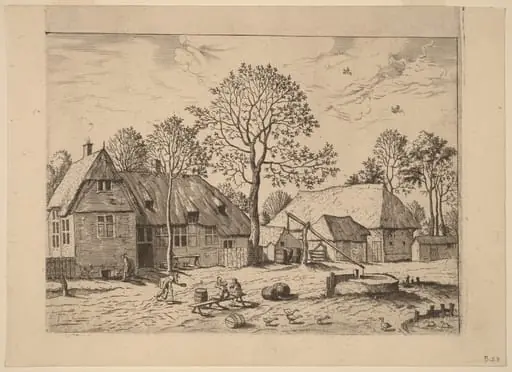
The Farmyard
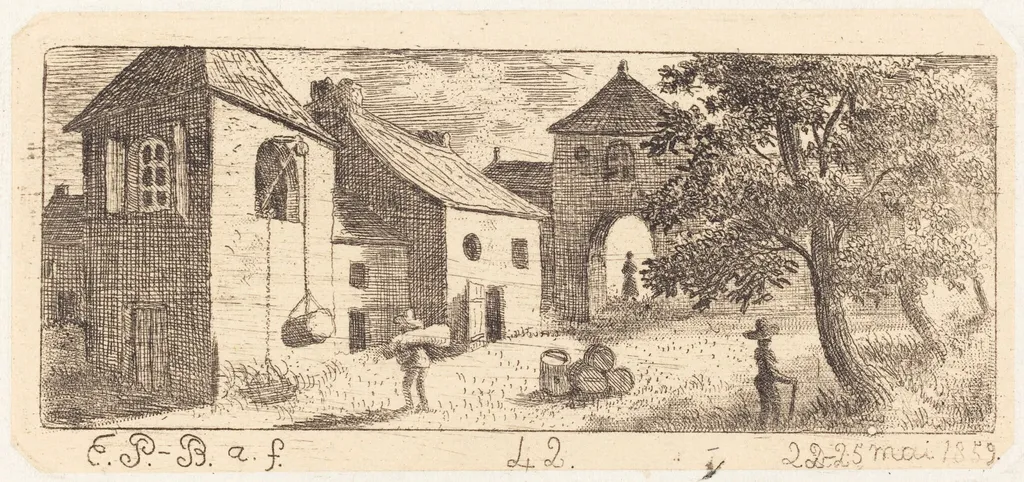
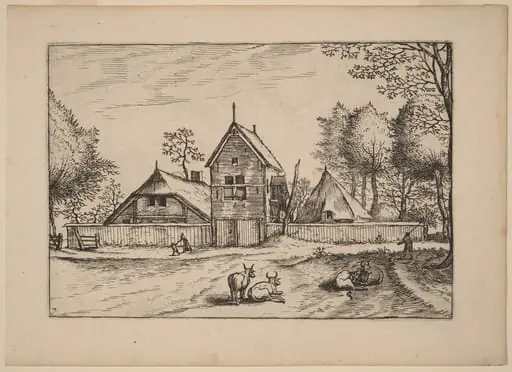
The Farmyard is an ink print by the Impressionist artist Emmanuel Phélippes-Beaulieu. It dates from 1859 and is held in the collection of the National Gallery of Art.
About this work
Overview
The Farmyard, executed in 1859 by Emmanuel Phélippes‑Beaulieu, is a print created through etching and roulette on a chine collé surface adhered to wove paper. The work presents a modest rural tableau rendered in a single monochrome composition, measuring within the typical dimensions of mid‑nineteenth‑century studies.
Subject & Meaning
The image depicts a tranquil farmyard: a modest house with a pitched roof, a secondary structure bearing a window illuminated by a hanging lantern, and a figure drawing water from a well while holding a bucket. Scattered pumpkins, a basket, surrounding trees and a low fence frame the scene, suggesting everyday labor and domestic routine in a countryside setting.
Technique & Style
Phélippes‑Beaulieu employed a scratchy, textured line quality characteristic of etching, enhanced by roulette stippling to convey surface texture. The chine collé technique, in which a thin paper layer is bonded to the wove support, adds subtle depth to the tonal variations. The overall handling is brisk, emphasizing immediacy and a realistic, unembellished portrayal of rural life.
History & Provenance
The print was produced as a study, likely intended for personal reference or limited distribution among peers. No record indicates exhibition or sale during the artist’s lifetime, and the work has remained within private collections before entering public holdings in the late twentieth century, where it is catalogued as an example of mid‑century French rural genre prints.
Artist & collection