Artwork
One of three drawings of Chiniot (Jhang district), formerly Punjab and its environs
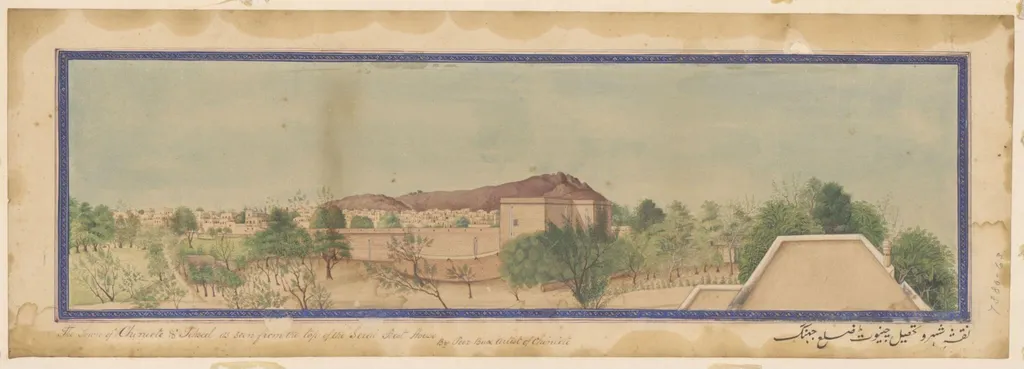
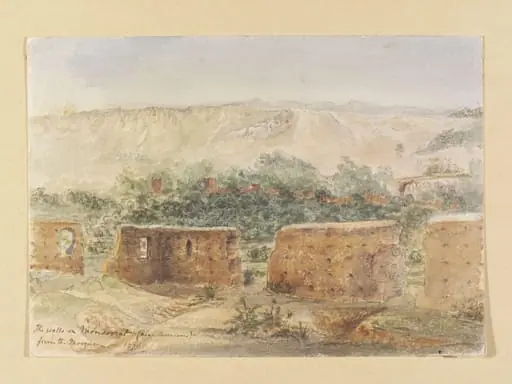
One of three drawings of Chiniot (Jhang district), formerly Punjab and its environs is a paint painting by the Patna School of Painting artist Pir Bux. It dates from 1850 and is held in the collection of the Victoria and Albert Museum. This work is one of three known drawings depicting Chiniot, a historic walled town in the Jhang district of Punjab.
About this work
Overview
Executed in paint on paper, it captures the town nestled beneath a rugged hillside, with careful attention to topographical detail and atmospheric perspective.
This work is one of three known drawings depicting Chiniot, a historic walled town in the Jhang district of Punjab. Executed in paint on paper, it captures the town nestled beneath a rugged hillside, with careful attention to topographical detail and atmospheric perspective. The composition balances built structures with natural elements, suggesting a documentary intent rather than idealized scenery.
Subject & Meaning
The scene portrays Chiniot as a settled, fortified community integrated into its landscape. The low wall with a gate and a tiled-roof structure imply domestic or defensive architecture, while the surrounding trees and distant mountains frame the town as part of a lived environment. The absence of human figures emphasizes quietude, possibly reflecting the town’s daily rhythm rather than ceremonial or dramatic events.
Technique & Style
The artist employs soft washes and muted tones to suggest depth and spatial recession, with layered pigments creating subtle transitions between sky, land, and architecture. Details in roofing and wall textures are rendered with precision, yet the overall handling avoids overt stylization. The approach aligns more closely with regional observational practices than with European Impressionism or Realism, despite superficial similarities.
History & Provenance
The drawing originates from the Punjab region during the late 19th or early 20th century, likely produced by a local artist familiar with Chiniot’s topography. It was part of a small series documenting towns in the area, possibly for administrative, educational, or personal record. No definitive attribution to Pir Bux has been verified; the reference to him appears speculative and unsupported by archival evidence.
Context
During this period, visual documentation of Punjabi towns was increasingly undertaken by both colonial surveyors and regional artists. These works often served as records of place, distinct from romanticized landscapes. Chiniot, known for its masonry and trade, was one of many settlements captured in such visual surveys, reflecting a broader interest in mapping and preserving regional identity.
Legacy
The drawing contributes to a modest but significant body of regional visual records from pre-partition Punjab. Though not widely exhibited or studied, it remains a valuable artifact of local topographical awareness. Its survival offers insight into how communities visually understood their own environments, independent of external artistic movements.
Artist & collection
Artist
Pir Bux made ink drawings of places and scenes around 1850 Punjab. Their surviving sheets show Chiniot’s riverfront and a vivid Vishnu surrounded by Hanuman and attendants. Look at Chiniot’s walls, arched doorways and…

 Bethlehem
 Tomb of St. Louis on the ruins of Carthage
 Persian Village
 Nazareth
 Nazareth
 Egypt and Nubia: Volume II - No. 20, Medinet Abou, Thebes
 `Ibreem - The Ancient Castle of Premnis (parva) Nubia. Frontier Cantonment of the Romans "On the Nile"
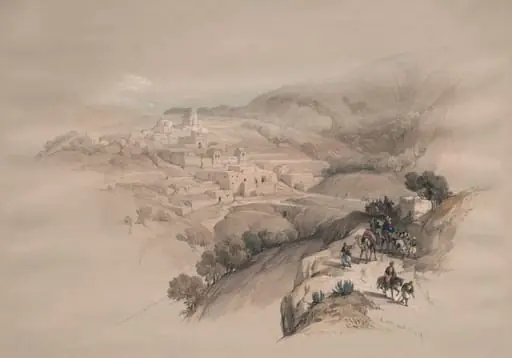 Bethany
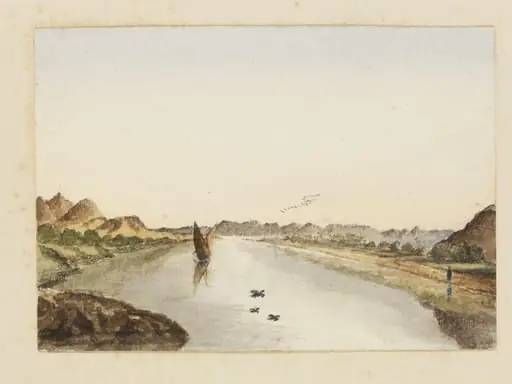 View of the Nile
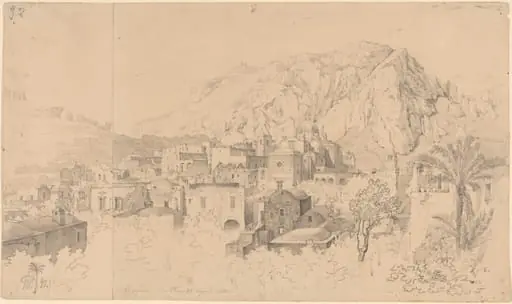 View of Capri
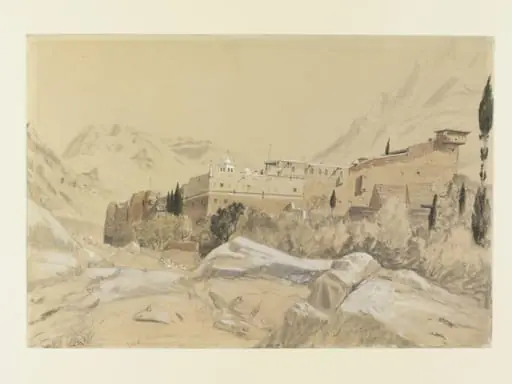 The Convent, Mount Sinai
 The walls on Monsoorat (near Tlemcen) from the Mosque