Artwork
The Last Supper
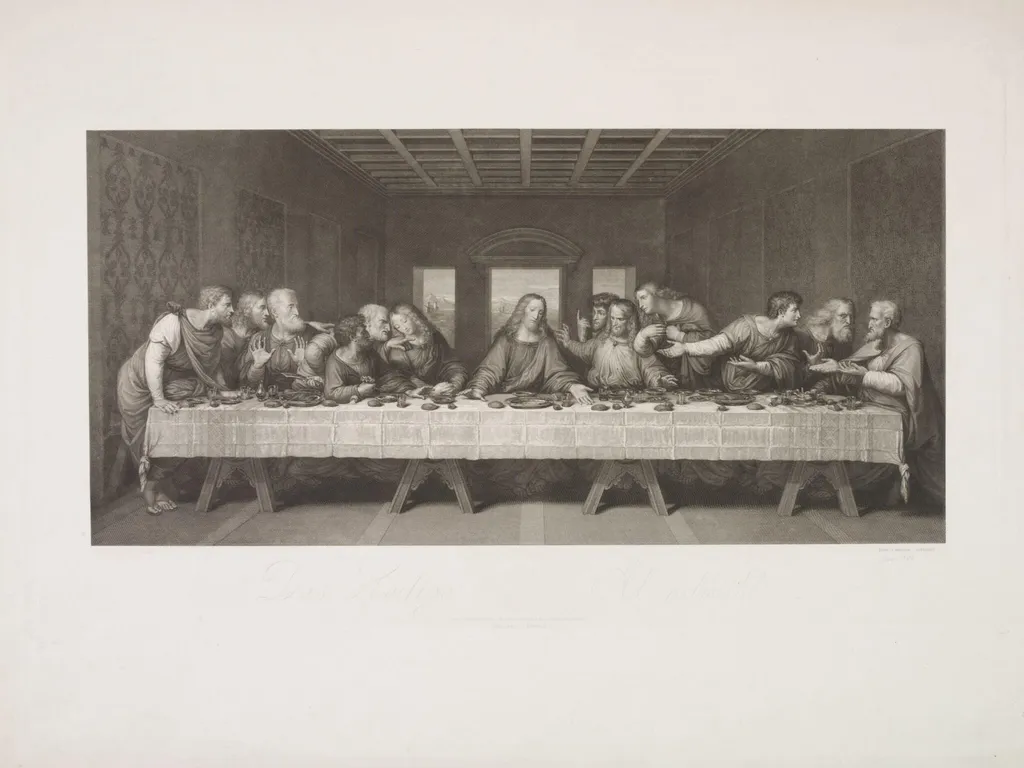
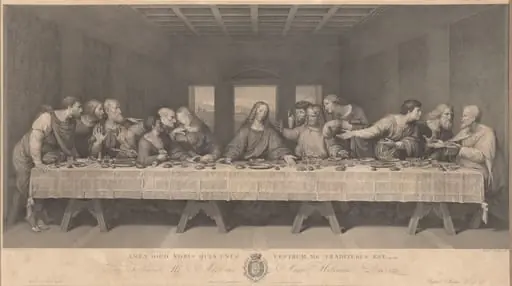
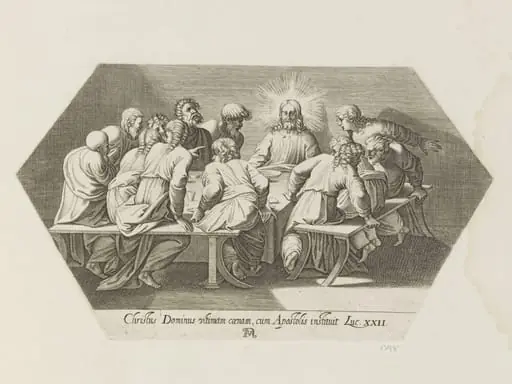
The Last Supper is a print by Hans Rudolph Rahn. It dates from 1850 and is held in the collection of the Victoria and Albert Museum.
About this work
Overview
The composition faithfully follows Leonardo’s arrangement, capturing the moment after Jesus announces that one of his disciples will betray him.
This print on paper reproduces Leonardo da Vinci’s *The Last Supper*, executed by Hans Rudolph Rahn in collaboration with Amsler. The inscription 'Rahn & Amsler sculpsit' identifies the engravers responsible for translating the original fresco into a printed format. The composition faithfully follows Leonardo’s arrangement, capturing the moment after Jesus announces that one of his disciples will betray him.
Subject & Meaning
The scene centers on Jesus at the midpoint of a long table, flanked by twelve apostles grouped in threes. Each figure responds differently to his announcement—some lean in with alarm, others gesture in confusion or denial. The emotional variety among the disciples underscores the psychological tension of the moment, reflecting the narrative’s core: revelation and betrayal among close companions.
Technique & Style
Rahn and Amsler employed fine-line engraving to render the composition with precision, emphasizing contours and subtle shading. The architectural backdrop—high ceiling, wooden beams, and patterned wall—was rendered with careful attention to perspective, mirroring Leonardo’s use of linear depth. The figures’ drapery and facial expressions were simplified but retained enough detail to convey individual reactions.
History & Provenance
The print dates from the late 18th or early 19th century, a period when reproductive engravings of famous artworks were widely circulated for educational and devotional use. Rahn, a Swiss engraver, specialized in reproducing Italian Renaissance works. This version likely served as a reference for collectors and students who could not travel to Milan to view the original fresco.
Context
Reproductive prints like this one played a key role in disseminating Renaissance imagery across Europe before photography. While the original fresco in Santa Maria delle Grazie had deteriorated significantly by this time, engravings preserved its composition for wider audiences. Rahn’s version reflects contemporary interest in classical art and religious iconography during the Enlightenment.
Legacy
Though overshadowed by Leonardo’s original, Rahn’s engraving contributed to the enduring visual familiarity of *The Last Supper*. It represents a bridge between Renaissance painting and the age of mechanical reproduction, helping to standardize the composition in popular consciousness. The print remains a document of how 18th-century artisans interpreted and transmitted canonical imagery.
Artist & collection
Artist
Hans Rudolph Rahn made 19th-century religious prints, often copying famous paintings.