Artwork
The Tribute Money
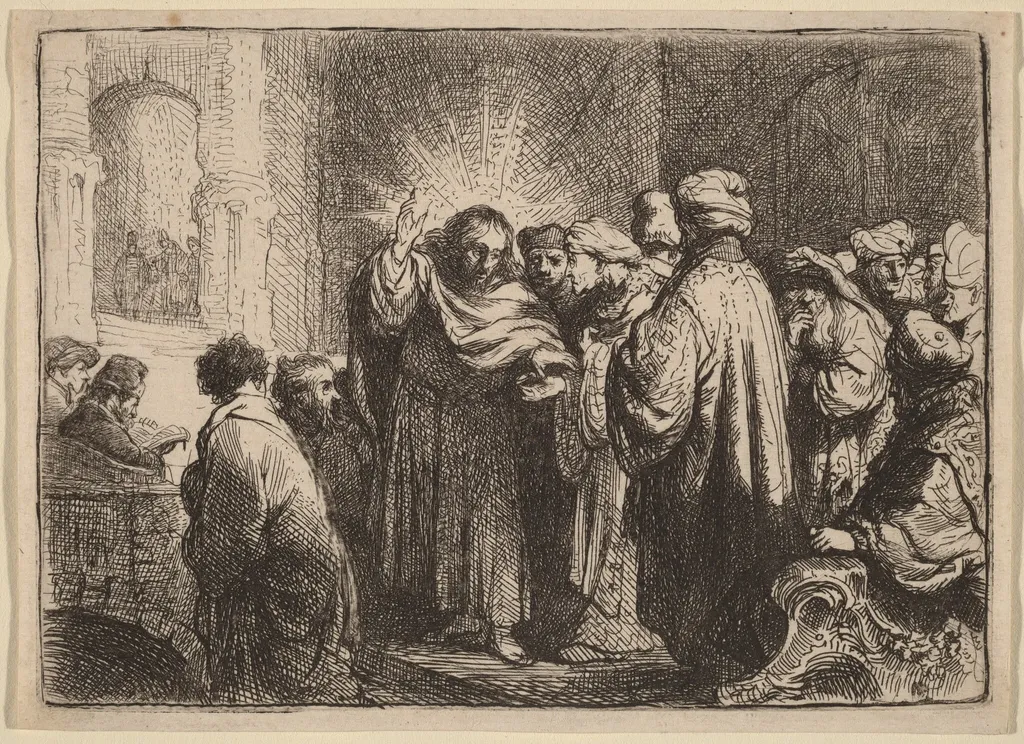
The Tribute Money is an ink print by the Baroque artist Rembrandt. It dates from 1635 and is held in the collection of the National Gallery of Art.
About this work
Overview
The dark, uneven background amplifies the focus on the central interaction, characteristic of Rembrandt’s mastery in printmaking.
Created around 1635, The Tribute Money is an etching by Rembrandt van Rijn on laid paper. It depicts a moment from the Gospel of Matthew, rendered with dense linework and deep tonal contrasts. The composition centers on two figures engaged in a quiet exchange, surrounded by a cluster of onlookers. The dark, uneven background amplifies the focus on the central interaction, characteristic of Rembrandt’s mastery in printmaking.
Subject & Meaning
The scene illustrates Christ instructing Peter to retrieve a coin from a fish’s mouth to pay a temple tax. The central figures—Christ and Peter—are engaged in a moment of quiet authority and submission. Surrounding onlookers, varied in posture and expression, suggest a community witnessing a divine directive. The narrative unfolds not through grandeur but through subtle gesture and attentive gaze.
Technique & Style
Rembrandt employed etching with fine, incised lines to build texture and depth. His use of cross-hatching and varied line weight creates a sense of volume and movement, particularly in the folds of garments and the clustering of figures. The dark ground is left largely untouched, allowing the inked lines to emerge with dramatic contrast, enhancing the scene’s intimacy and psychological tension.
History & Provenance
The print was produced during Rembrandt’s most prolific period in Amsterdam, when he was refining his etching techniques. It circulated among collectors and artists, admired for its emotional nuance and technical innovation. Early impressions are rare, and surviving examples are held in major institutional collections, including the Rijksmuseum and the British Museum.
Context
In the 1630s, Rembrandt was deeply engaged with biblical subjects, often choosing intimate moments over grand spectacle. Etching allowed him to explore narrative complexity and human expression with immediacy. This work reflects broader Dutch interest in personal piety and the moral weight of everyday religious acts, aligning with Calvinist values of humility and observation.
Legacy
The Tribute Money influenced generations of printmakers through its expressive line and compositional economy. Its emphasis on psychological realism over theatricality set a precedent for narrative etching. Later artists studied its tonal gradations and spatial compression, recognizing it as a pivotal example of how print could convey depth of feeling without color or scale.
Artist & collection
Artist
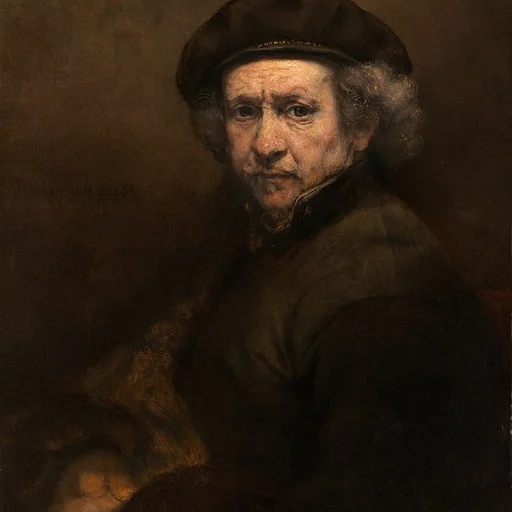
Rembrandt Harmenszoon van Rijn (15 July 1606 – 4 October 1669), known mononymously as Rembrandt, was a Dutch Golden Age painter, printmaker, and draughtsman.

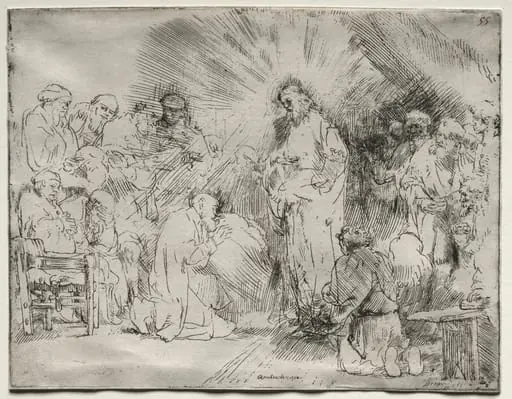 Christ Appearing to the Apostles
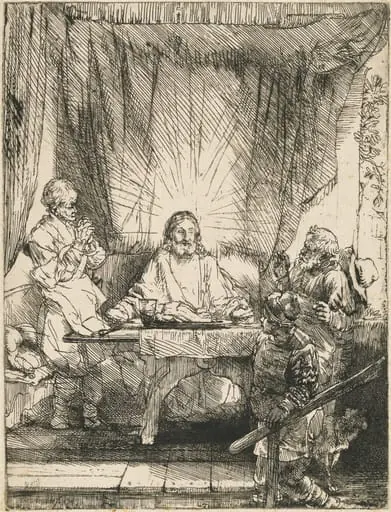 Christ at Emmaus: the Larger Plate
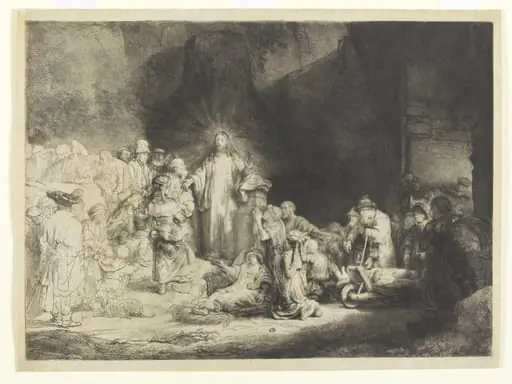 Christ healing the sick: 'The hundred guilder print'
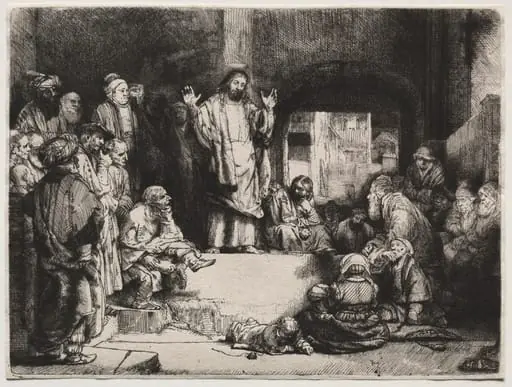 Christ Preaching ('La Petite Tombe')
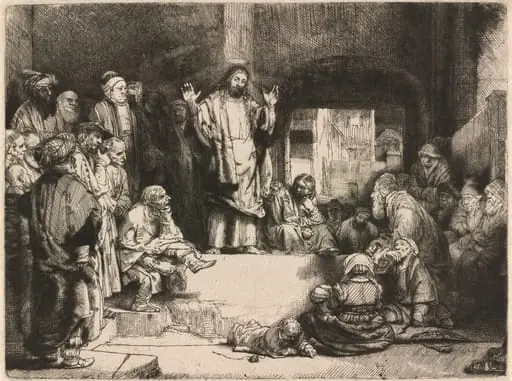 Christ Preaching (La petite Tombe)
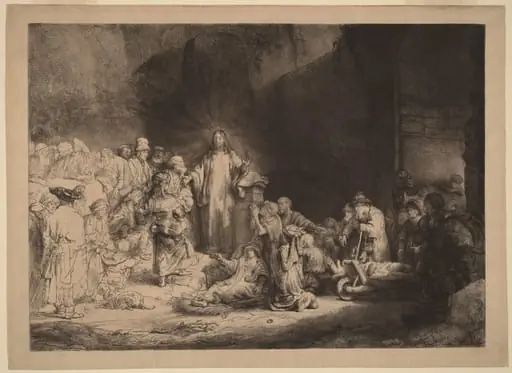 Christ Preaching (The Hundred Guilder Print)
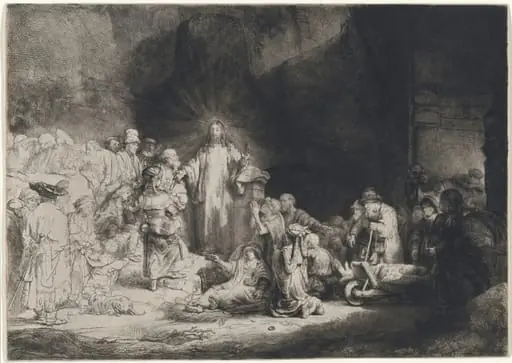 Christ Preaching (The Hundred Guilder Print)
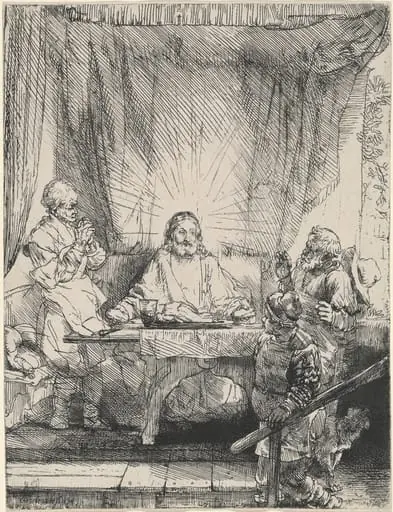 Christ at Emmaus: the Larger Plate
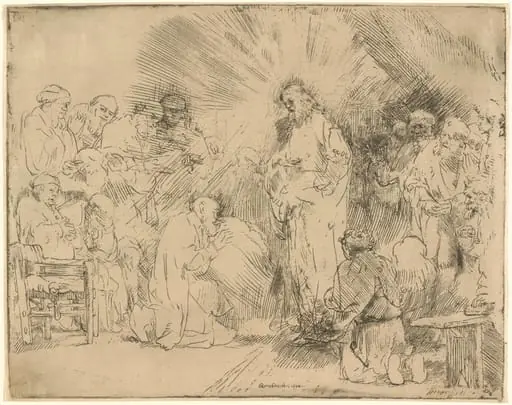 Christ Appearing to the Apostles
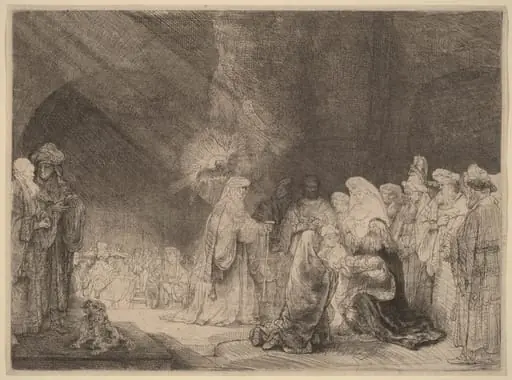 The Presentation in the Temple: Oblong Print