Artwork
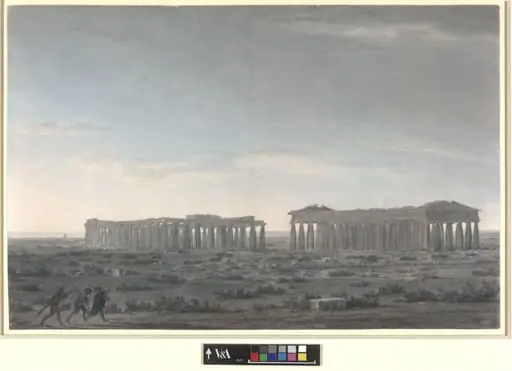
The Temple of Neptune, Paestum
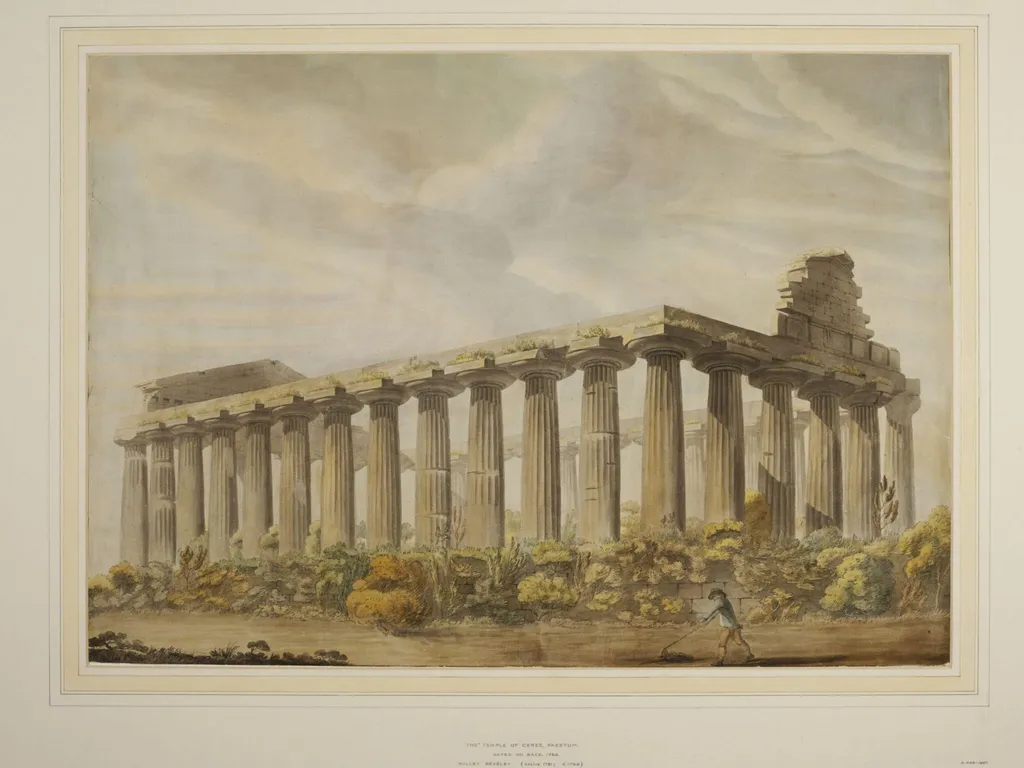
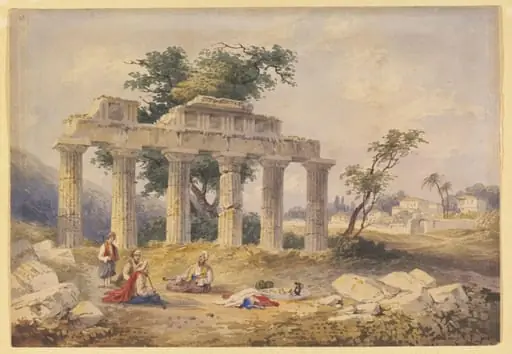
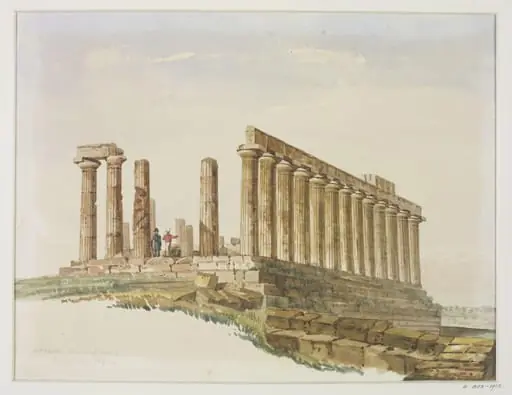
The Temple of Neptune, Paestum is a watercolor work on paper by the Neoclassicist artist Willey Reveley. It dates from 1790 and is held in the collection of the Victoria and Albert Museum.
About this work
Overview
Rendered in delicate washes, the painting emphasizes architectural form over dramatic effect, reflecting scholarly rather than romantic intent.
Willey Reveley created this watercolour in 1790, capturing the Temple of Neptune at Paestum in southern Italy. The work is part of a series documenting ancient Greek architecture in Magna Graecia, executed during a period of heightened European interest in classical ruins. Rendered in delicate washes, the painting emphasizes architectural form over dramatic effect, reflecting scholarly rather than romantic intent.
Subject & Meaning
The temple, one of three well-preserved Doric structures at Paestum, is shown in a state of partial decay, overgrown with vegetation. A solitary figure in period attire, leaning on a walking stick, moves before the colonnade, suggesting scale and quiet contemplation. The composition avoids idealization, presenting the ruin as a tangible relic of antiquity, observed with precision rather than embellished for sentiment.
Technique & Style
Reveley employed fine brushwork and layered watercolour washes to convey texture in stone, foliage, and atmospheric depth. The columns are rendered with careful linear precision, while the surrounding brushwork suggests natural encroachment without overt stylization. The muted palette and controlled tonal gradations reflect topographical accuracy, aligning with the empirical aims of 18th-century antiquarian drawing.
History & Provenance
Painted during Reveley’s travels in Italy, the work was likely made for private collectors or academic circles interested in classical archaeology. It remained in private hands until the 19th century, later entering institutional collections. Its survival as a single sheet suggests it was valued as a documentary record rather than a decorative piece.
Context
Reveley’s watercolour emerged amid a surge of archaeological documentation in southern Italy, following earlier expeditions by Piranesi and others. Unlike theatrical depictions of ruins, his approach aligned with emerging scientific standards — prioritizing measured observation over imaginative reconstruction. Paestum’s temples were still relatively unknown in northern Europe, making such records valuable for architectural study.
Legacy
Reveley’s depiction contributed to the growing corpus of visual evidence used in classical scholarship. Though not widely exhibited in his lifetime, his precise renderings informed later architectural reconstructions and publications on Greek temples. The work endures as a quiet testament to early archaeological documentation, valued for its restraint and fidelity to observed detail.
Artist & collection

Artist
Willey Reveley (1760–1799) was an 18th-century English architect, born at Newton Underwood near Morpeth, Northumberland.