Artwork
Nicolae Golescu
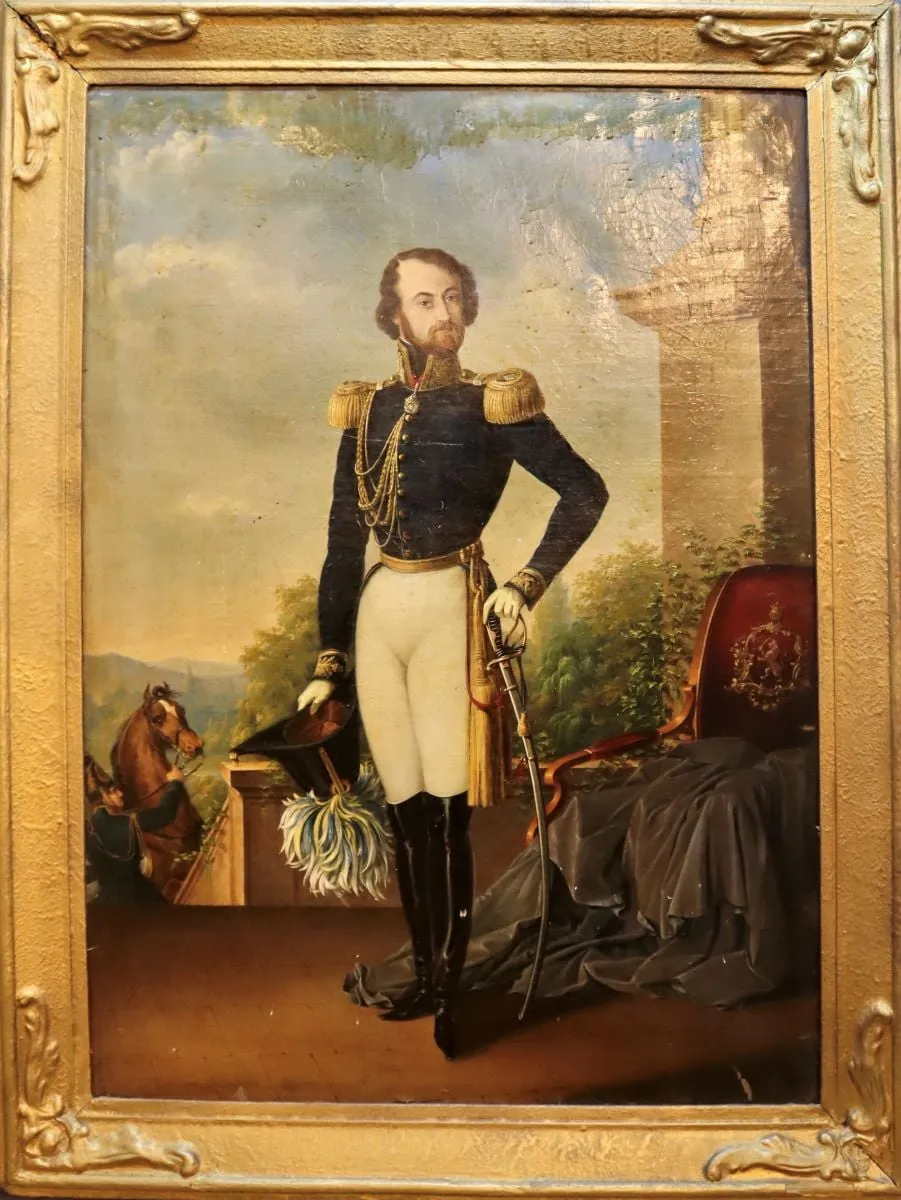
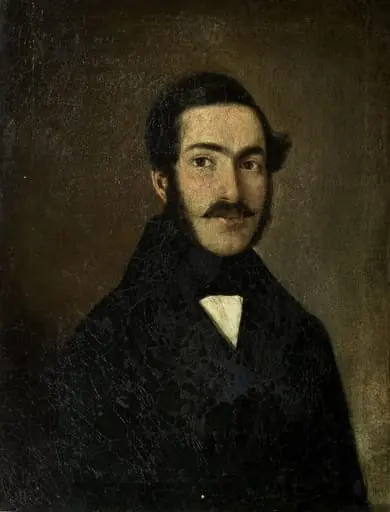
Nicolae Golescu is a print by the Academic Art artist Constantin Daniel Rosenthal. It dates from 1845 and is held in the collection of the King Ferdinand I National Military Museum.
About this work
Overview
This portrait, painted around 1845 by Constantin Daniel Rosenthal, depicts Nicolae Golescu, a Romanian political and military figure.
This portrait, painted around 1845 by Constantin Daniel Rosenthal, depicts Nicolae Golescu, a Romanian political and military figure. Executed in oil on canvas, the work is part of the collection at the Museum of Ethnography. The composition centers on Golescu in full military attire, positioned before a modest interior setting that includes a mounted horse’s head and a window revealing a distant landscape.
Subject & Meaning
Nicolae Golescu, a prominent 19th-century Romanian statesman and army officer, is portrayed with quiet authority. His formal uniform and the presence of a sword suggest his military role, while the mounted horse’s head may reference his connection to equestrian tradition or noble status. The restrained setting emphasizes his dignity rather than grandeur, reflecting a personal, rather than ceremonial, representation.
Technique & Style
Rosenthal employs a restrained realism, with careful attention to texture in the uniform’s gold braid and the leather of the sword scabbard. The lighting is even, avoiding dramatic contrasts, and the background remains deliberately minimal—just a red chair, a dark rug, and a softly rendered landscape beyond the window. This simplicity directs focus to the subject’s presence and attire.
History & Provenance
The painting was completed in the mid-1840s, during a period of rising national consciousness in Romanian territories. It entered the Museum of Ethnography’s collection in the 20th century, likely through institutional acquisition or donation. Its preservation reflects its value as a document of Romanian elite identity during the pre-unification era.
Context
Rosenthal, a Romanian artist of Jewish descent, was active in the cultural circles of Wallachia during the 1840s. His portraits of political figures like Golescu contributed to a visual language of national leadership emerging amid Ottoman and Russian influence. The inclusion of a horse’s head—a symbol tied to cavalry and aristocracy—aligns with contemporary ideals of martial virtue among Romanian elites.
Legacy
The portrait remains a key example of early Romanian portraiture that blends European academic conventions with local identity. While not widely exhibited, it is referenced in scholarly works on 19th-century Romanian visual culture. Its quiet composition and historical specificity offer insight into how leadership was visually constructed before the formation of modern Romania.
Artist & collection

Artist
Constantin Daniel Rosenthal (b.Rosenthal Konstantin, 1820 – July 23, 1851) was a painter and sculptor of Austrian birth and a Romanian 1848 revolutionary, best known for his portraits and his choice of Romanian Romantic nationalist…
Museum
King Ferdinand I National Military Museum
Continue through works from the same source collection.
 Barbu Știrbei Vodă
 Portretul regelui Carol I
 Colonelul Ioan Cornescu
 Portretul pictorului Carol Popp de Szathmári
 Ofițer de cavalerie
 Căpitanul Vilhelm Theodor
 Portrait of H.M. Leopold I, king of the Belgians
 Pedro II of Brazil
 Domnitorul Carol I
 Porträt des Archduke Joseph, Palatine of Hungary (1776-1847)
 Radu Fărcășanu