Artwork
Hérakléa
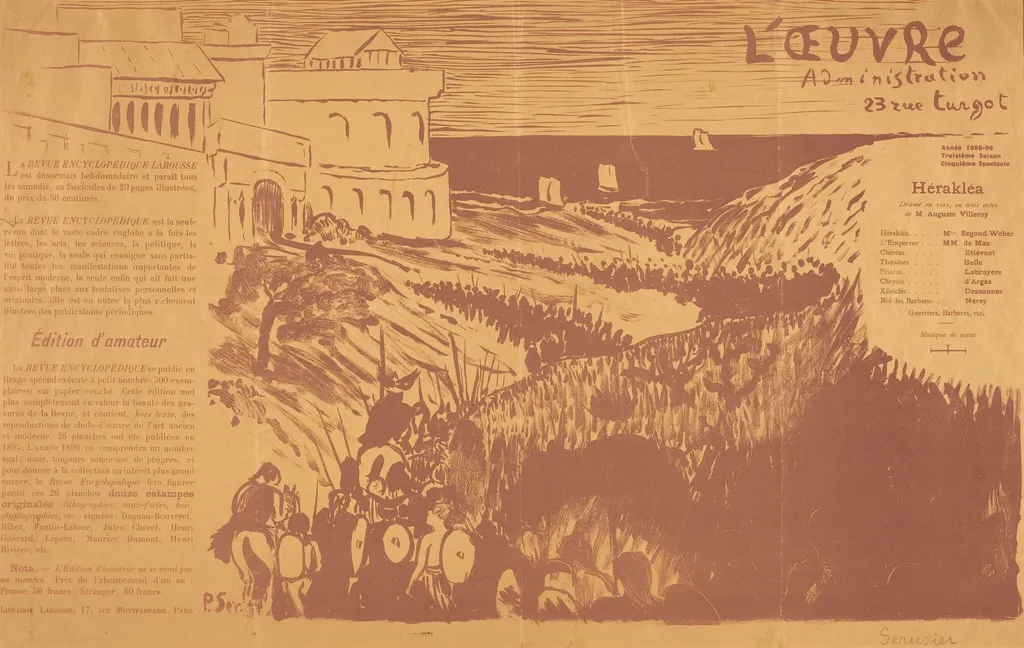
Hérakléa is a print by the Impressionist artist Paul Sérusier. It dates from 1896 and is held in the collection of the National Gallery of Art.
About this work
Overview
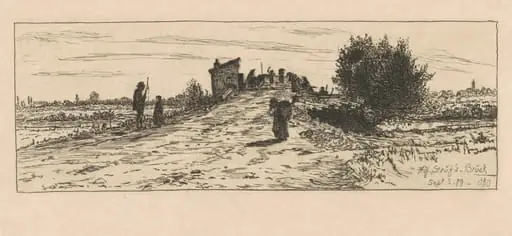
Created in 1896, Hérakléa is a zincograph by Paul Sérusier. Executed on light‑brown wove paper, the print employs a limited palette of red‑brown tones to depict a landscape populated by figures. The composition balances a foreground of armed individuals with architectural elements receding into the distance, establishing a clear spatial hierarchy within a single chromatic scheme.
Subject & Meaning
The image presents a sloping hillside where a small group of people, some bearing spears and shields, occupy the lower plane. Behind them, a wall punctuated by an archway and a cluster of buildings suggest a fortified settlement. The arrangement foregrounds human activity against a built environment, hinting at themes of defense, community, or ritual within a historic or mythic setting.
Technique & Style
Dark shading and thick contours generate a sense of depth, while the uniform red‑brown hue unifies the composition.
Sérusier rendered the scene using zincographic printing, a relief process that allows for bold, decisive lines. Dark shading and thick contours generate a sense of depth, while the uniform red‑brown hue unifies the composition. Although the work predates his later Symbolist phase, its emphasis on outdoor light and color links it loosely to Impressionist concerns, albeit expressed through the graphic medium of print.
History & Provenance
The print was produced in the late nineteenth century, a period when Sérusier was exploring various print techniques. While specific ownership records are scarce, the work is catalogued among his early graphic productions and has appeared in several exhibitions of French printmaking from the 1890s, confirming its place within his formative output.
Context
Hérakléa emerges at a time when French artists were experimenting with new media beyond oil painting, integrating printmaking into avant‑garde practices. Sérusier, a member of the Pont‑Aven circle, was influenced by both Impressionist plein‑air painting and the emerging Symbolist aesthetic, a duality reflected in the work’s atmospheric color scheme and narrative content.
Legacy
Although not as widely reproduced as Sérusier’s later paintings, Hérakléa illustrates his early engagement with graphic processes that would inform his subsequent Symbolist works. The print contributes to a broader understanding of the transition from Impressionist visual strategies to the more evocative, myth‑laden language that defined his later career.
Artist & collection