Artwork
Expulsion of the Jesuits (Expulsion des Jesuites)
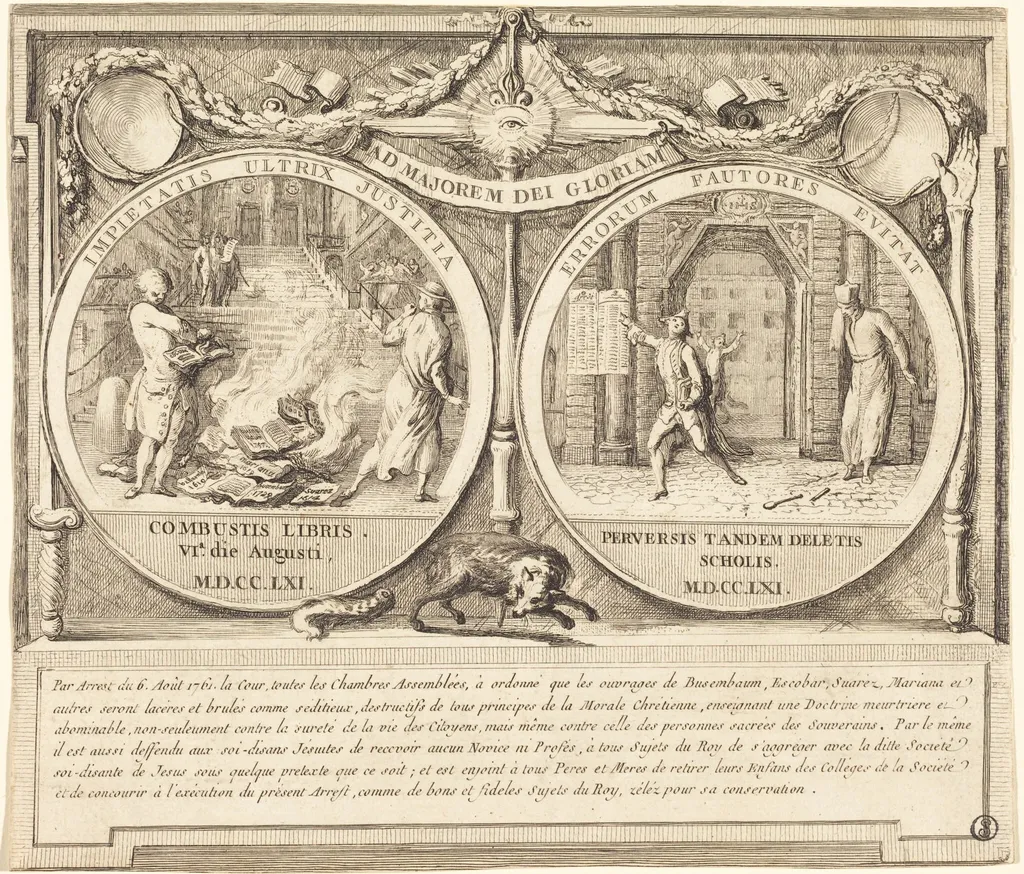
Expulsion of the Jesuits (Expulsion des Jesuites) is an ink print by the Romanticist artist Gabriel de Saint-Aubin. It dates from 1761 and is held in the collection of the National Gallery of Art.
About this work
On the left, a group of people burns books by a fire while a lion lies dead in the foreground.
This print shows two scenes framed by circles. On the left, a group of people burns books by a fire while a lion lies dead in the foreground. On the right, a man in robes stands over a kneeling figure, with a boy watching.
The Latin text at the top and bottom ties the scenes to a 1761 order banning Jesuit writings. The artist used sharp lines to show drama and moral weight.
Look up etching to see how artists create detailed prints like this.
Overview
Created in 1761, this etching by Gabriel de Saint-Aubin captures the political and religious upheaval surrounding the French government’s ban on the Jesuit order. Rendered in fine linear detail on laid paper, the print presents two distinct scenes within circular frames, each illustrating moments of suppression and symbolic defeat. The work functions as both a record and a commentary on the state’s campaign against Jesuit influence.
Subject & Meaning
The left panel shows the public burning of Jesuit texts, with a dead lion at its center—a symbol of the order’s fallen power. The right panel depicts a clerical figure towering over a kneeling individual, while a boy observes silently, suggesting generational consequence. Latin inscriptions above and below link the imagery to the royal decree of 1761, framing the scenes as enforcement of ideological purity and the erasure of dissenting voices.
Technique & Style
Saint-Aubin employed sharp, controlled etching lines to convey tension and moral clarity. The contrast between the chaotic fire and the still, solemn figures enhances the narrative weight. The use of circular frames isolates each scene, directing focus and creating a sense of ritualized judgment. The medium’s precision allows for intricate detail in clothing, gestures, and architectural elements, reinforcing the print’s documentary character.
History & Provenance
Produced shortly after the 1761 royal edict that expelled Jesuits from France and banned their publications, the print emerged amid intense public debate. It likely circulated among educated elites sympathetic to the crown’s anti-Jesuit stance. No early ownership records are widely documented, but its survival in institutional collections suggests it was preserved as a political artifact rather than a commercial print.
Context
The expulsion of the Jesuits in France was part of a broader European movement fueled by Enlightenment critiques of religious authority and state efforts to consolidate control over education and public discourse. Saint-Aubin’s print reflects the climate of secularization and the state’s assertion of dominance over ecclesiastical institutions, aligning with the policies of Louis XV’s ministers who viewed the Jesuits as a threat to royal sovereignty.
Legacy
Though not widely reproduced, the etching remains a rare visual document of the anti-Jesuit campaign in France. It contributes to the historical record of how print media shaped public perception during religious conflicts. Its restrained tone and symbolic language distinguish it from more polemical propaganda, offering a nuanced glimpse into the cultural mechanics of state-driven ideological suppression.
Artist & collection

Artist
Gabriel de Saint-Aubin was a French draftsman, printmaker, etcher and painter.


![Archetypa studiaque patris Georgii Hoefnagelii [Part 4, Title Page], by Jacob Hoefnagel](https://artifactworldgallery.com/img/jacob-hoefnagel--archetypa-studiaque-patris-georgii-hoefnagelii-part-4-title--d842859cac0814bc-w320.webp) Archetypa studiaque patris Georgii Hoefnagelii [Part 4, Title Page]
Archetypa studiaque patris Georgii Hoefnagelii [Part 4, Title Page]![Archetypa studiaque patris Georgii Hoefnagelii [Part 4, Titlepage], by Jacob Hoefnagel](https://artifactworldgallery.com/img/jacob-hoefnagel--archetypa-studiaque-patris-georgii-hoefnagelii-part-4-titlep--a48938e411f894b0-w320.webp) Archetypa studiaque patris Georgii Hoefnagelii [Part 4, Titlepage]
Archetypa studiaque patris Georgii Hoefnagelii [Part 4, Titlepage]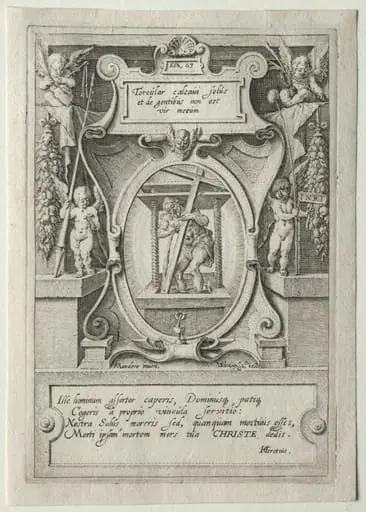 Passion Set
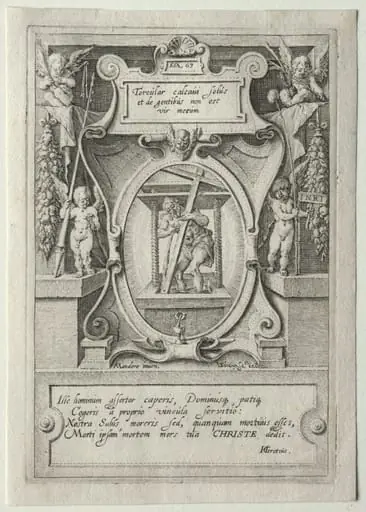 Passion Set: Title Page
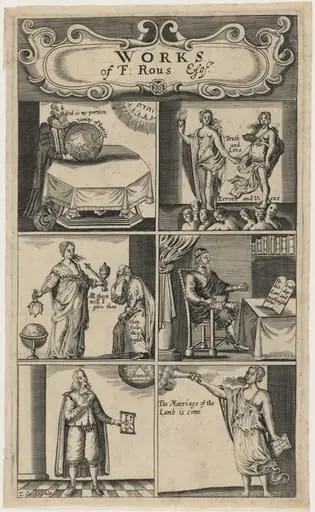 Title Page to F. Rous' Works
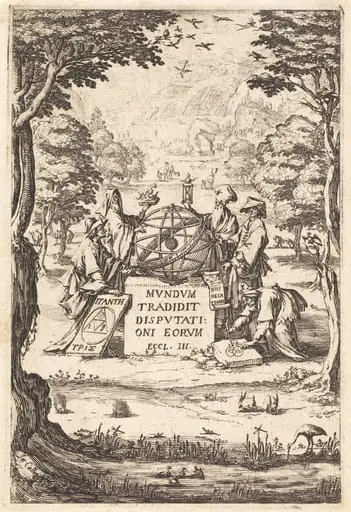 Frontispiece for the Sacred Cosmologia (Title with Astrologers)
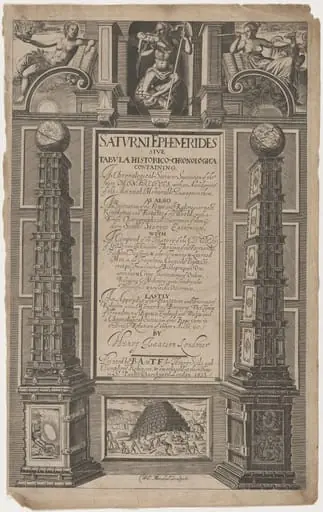 Title Page to Saturne Ephemerides by Henry Isaacson
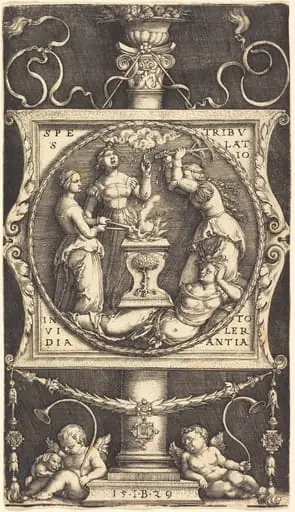 Emblem with Hope, Tribulation, Envy, and Tolerance
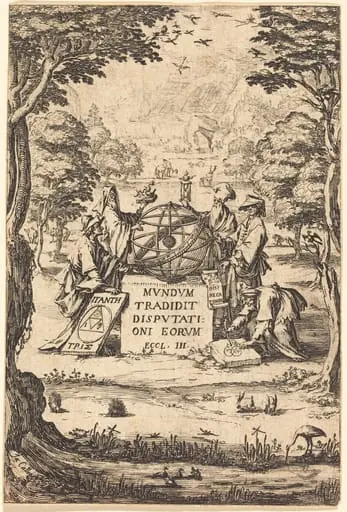 Frontispiece for the Sacred Cosmologia (Title with Astrologers)
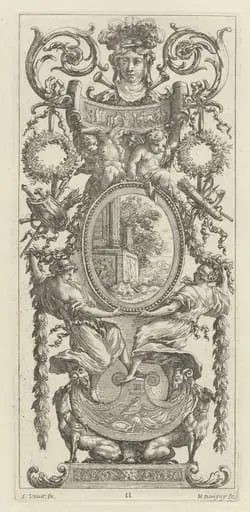 Ornamental Panel Surmounted with a Head Flanked by Foliage
 Title Page for M.C. Sarbievski, Lyricorum Libri IV
 The Temple of Honor