Artwork
Emblem with Hope, Tribulation, Envy, and Tolerance
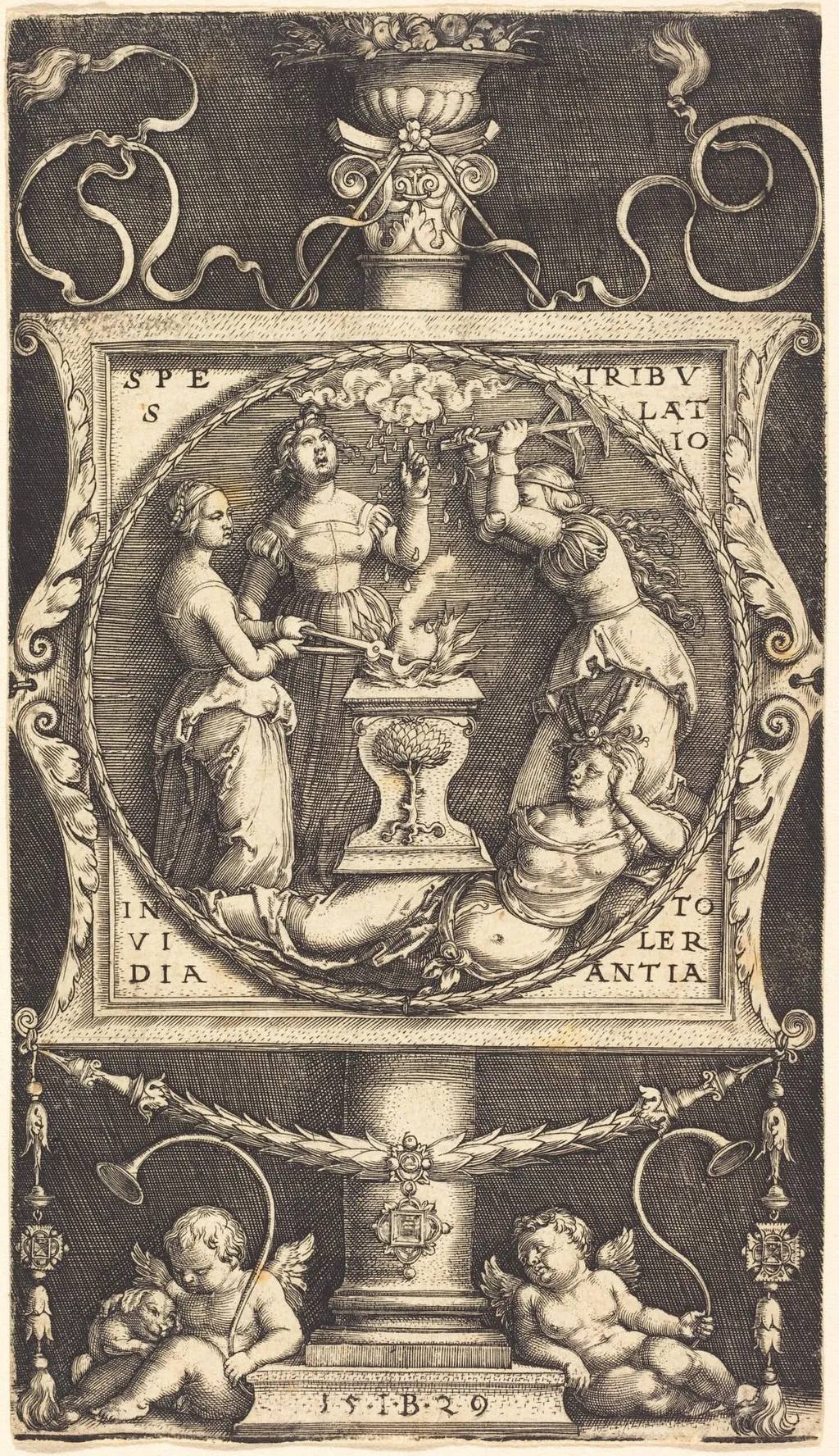
Emblem with Hope, Tribulation, Envy, and Tolerance is an ink print by the Renaissance artist Master IB. It dates from 1529 and is held in the collection of the National Gallery of Art.
About this work
To the right, a man pours from a horn marked *TRIBV LAT IO* (tribulation), and a child reaches for it.
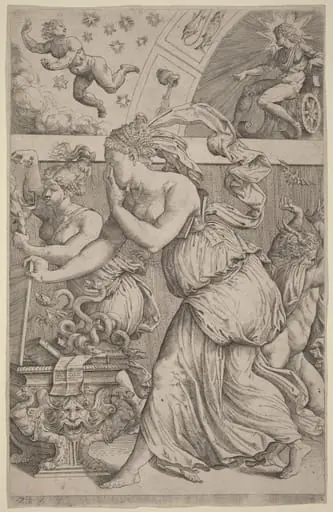
This print shows four figures in a framed scene. On the left, a woman holds a shield with the word *INVIDIA* (envy) and points downward. In the center, a robed figure lifts a vase labeled *SPE S* (hope) while clouds rise behind her. To the right, a man pours from a horn marked *TRIBV LAT IO* (tribulation), and a child reaches for it. Below, two cherubs sit on a ledge with the date *1529* carved into it.
The words around the figures are Latin labels, each naming a virtue or flaw. The scene looks like a lesson—each figure represents an idea, not a real person.
Want to see more? Look up engraving to learn how artists like Master IB carved these details.
Overview
Emblem with Hope, Tribulation, Envy, and Tolerance is a 1529 engraving attributed to the anonymous master known only as Master IB. Executed as a single sheet print, the work arranges four allegorical figures within a framed composition, each identified by a Latin inscription that names a moral quality or vice.
Subject & Meaning
The central figure, robed and holding a vase marked SPE S, embodies Hope, while a woman on the left points downward at a shield bearing INVIDIA, signifying Envy. To the right, a man pours liquid from a horn labeled TRIBV LAT IO, representing Tribulation, and a child reaches toward the flow, suggesting human response to hardship. Below, two cherubic figures rest on a ledge, completing the moral tableau.
Technique & Style
Carved with fine lines characteristic of early 16th‑century engraving, the print relies on cross‑hatching to model volume and convey atmospheric clouds behind the hopeful figure. The Latin captions are incised directly into the plate, integrating text and image in a didactic format common to emblematic prints of the period.
Context
The work reflects the emblem tradition that flourished in Renaissance Europe, where symbolic images paired with explanatory text served as moral instruction. By juxtaposing virtues and vices within a single visual field, the engraving invites contemplation of how hope, suffering, envy, and tolerance intersect in human experience.
Artist & collection