Artwork
The Fleet Off the Coast, Beachy Head
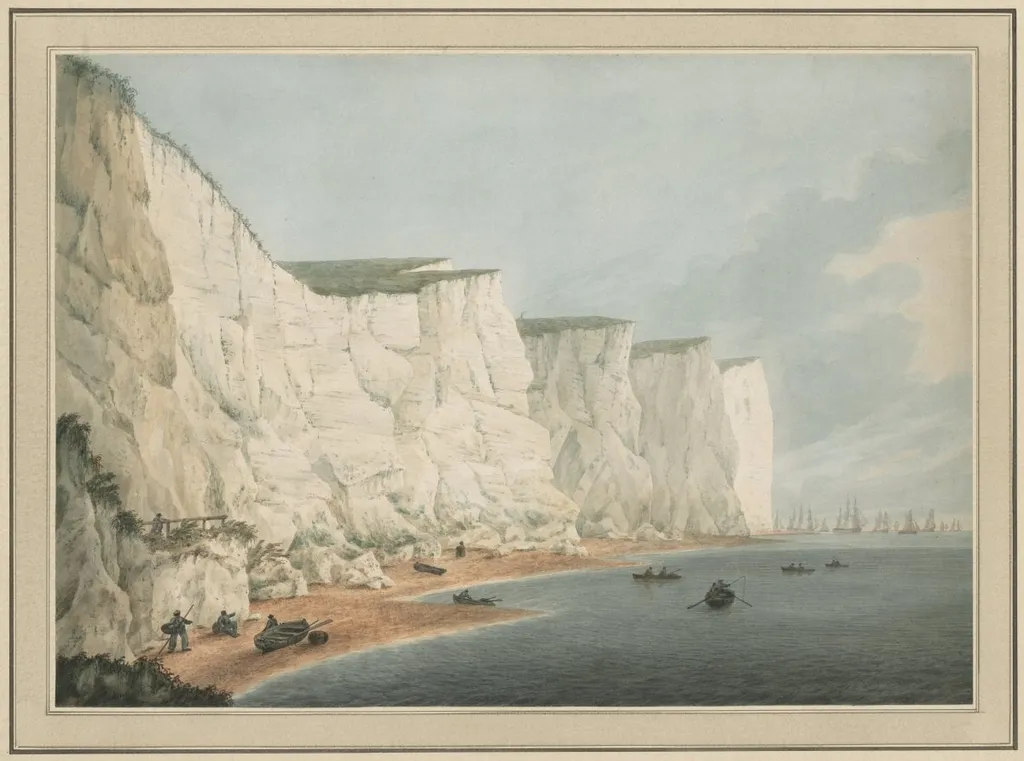
The Fleet Off the Coast, Beachy Head is a drawing by the Romanticist artist Samuel Atkins. It dates from 1798 and is held in the collection of the Cleveland Museum of Art.
About this work
The ships are tiny but sharp—each sail and flag is drawn with care, as if the fleet is leaving for battle.
You see tall white cliffs under a soft sky, with a line of warships sailing past.
Atkins painted this during the Napoleonic Wars, when Britain’s navy was its pride. The ships are tiny but sharp—each sail and flag is drawn with care, as if the fleet is leaving for battle. The cliffs glow in the light, almost like a stage set for history.
If you like this, look up *England, 18th century* for more scenes of ships and coasts.
Overview
This watercolor by Samuel Atkins captures the towering chalk cliffs of Beachy Head, the highest sea cliffs in Britain, with a distant naval fleet under full sail. Created during the Napoleonic Wars, the work reflects the strategic and symbolic importance of Britain’s coastline and maritime power. The composition balances natural grandeur with human activity, emphasizing the relationship between land and sea in national identity.
Subject & Meaning
The scene portrays a rare gathering of the Royal Navy fleet departing from the English Channel. The ships, though small in scale, are rendered with precision, suggesting readiness for duty. The cliffs, bathed in soft light, serve as a silent sentinel, framing the fleet as both a natural extension of the landscape and a symbol of national defense during a time of prolonged conflict.
Technique & Style
Atkins employed delicate watercolor washes to render the luminous chalk cliffs, using subtle gradients to suggest atmospheric depth. The ships are drawn with fine, controlled lines, each sail and flag meticulously indicated. The contrast between the soft, diffuse sky and the sharp, detailed vessels creates a sense of quiet tension, reinforcing the gravity of the moment without overt drama.
History & Provenance
Painted during the height of the Napoleonic Wars, the work aligns with Atkins’s broader practice of documenting Britain’s naval presence. It likely originated as a private commission or personal study, reflecting contemporary interest in maritime strength. The drawing remained within British collections, its significance tied to its historical context rather than public exhibition.
Context
In late 18th- and early 19th-century Britain, coastal views and naval scenes were common subjects, tied to national pride and wartime morale. Atkins’s work fits within a tradition of topographical art that merged documentary detail with patriotic sentiment. The emphasis on the fleet’s departure underscores the navy’s role as both protector and projector of imperial power.
Legacy
Atkins’s drawing contributes to a visual record of Britain’s maritime readiness during a critical era. While not widely known today, it exemplifies how artists documented the intersection of geography and military life. Its quiet precision offers insight into how naval power was perceived—not as spectacle, but as an enduring, natural presence along the coast.
Artist & collection
Artist
Samuel Atkins (fl. 1787–1808), was a British marine painter. Atkins contributed to the Royal Academy between 1787 and 1796. From 1796 to 1804 he was in the East Indies, when he returned to England, and continued to…

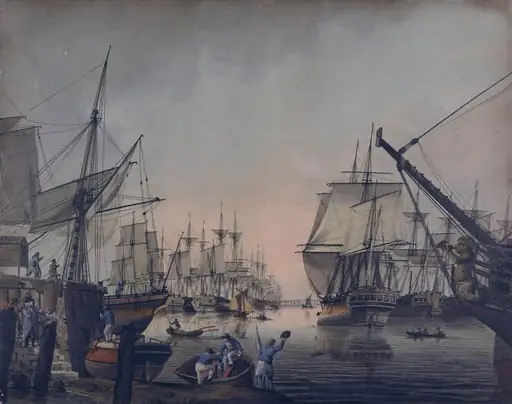
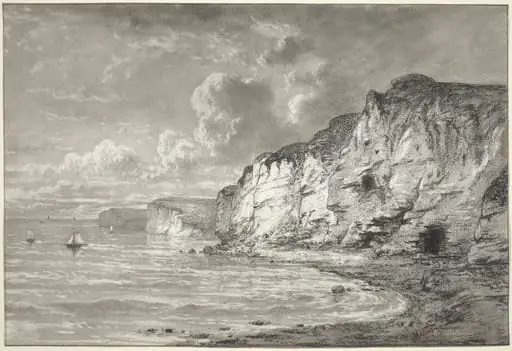 Cliffs along the Normandy Coast
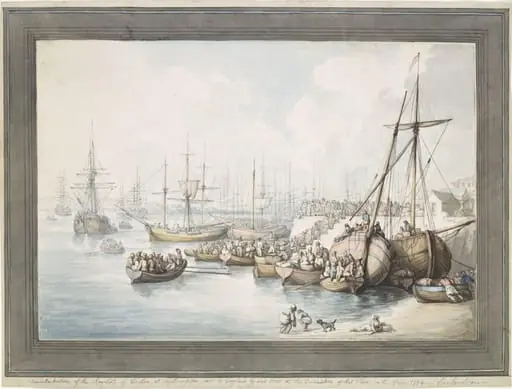 Disembarkation of the Royalists of Toulon at Southampton, 1794
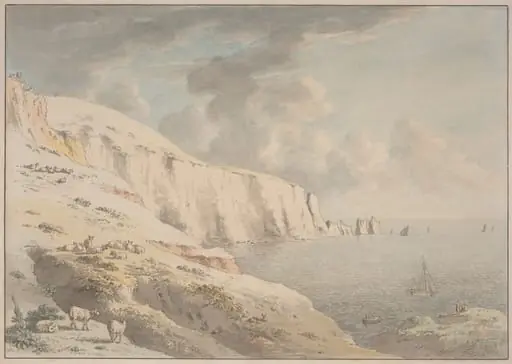 View of the Needles, and White Cliffs Taken from Allum Bay, Isle of Wight
 The coast at Broadstairs
 Tynemouth, Northumberland
 Dover Cliffs
 Shakespeare's Cliff, Dover, with luggers on the beach
 Rocky Coast with figures and boats
 Dover Cliffs
 The Pilot-Boat off Fécamp, Normandy