Artwork
Das Schloss Prediama in Crein XII Stund: von Triest (Predjama Castle in Carniola, Twelve Hours from Trieste)
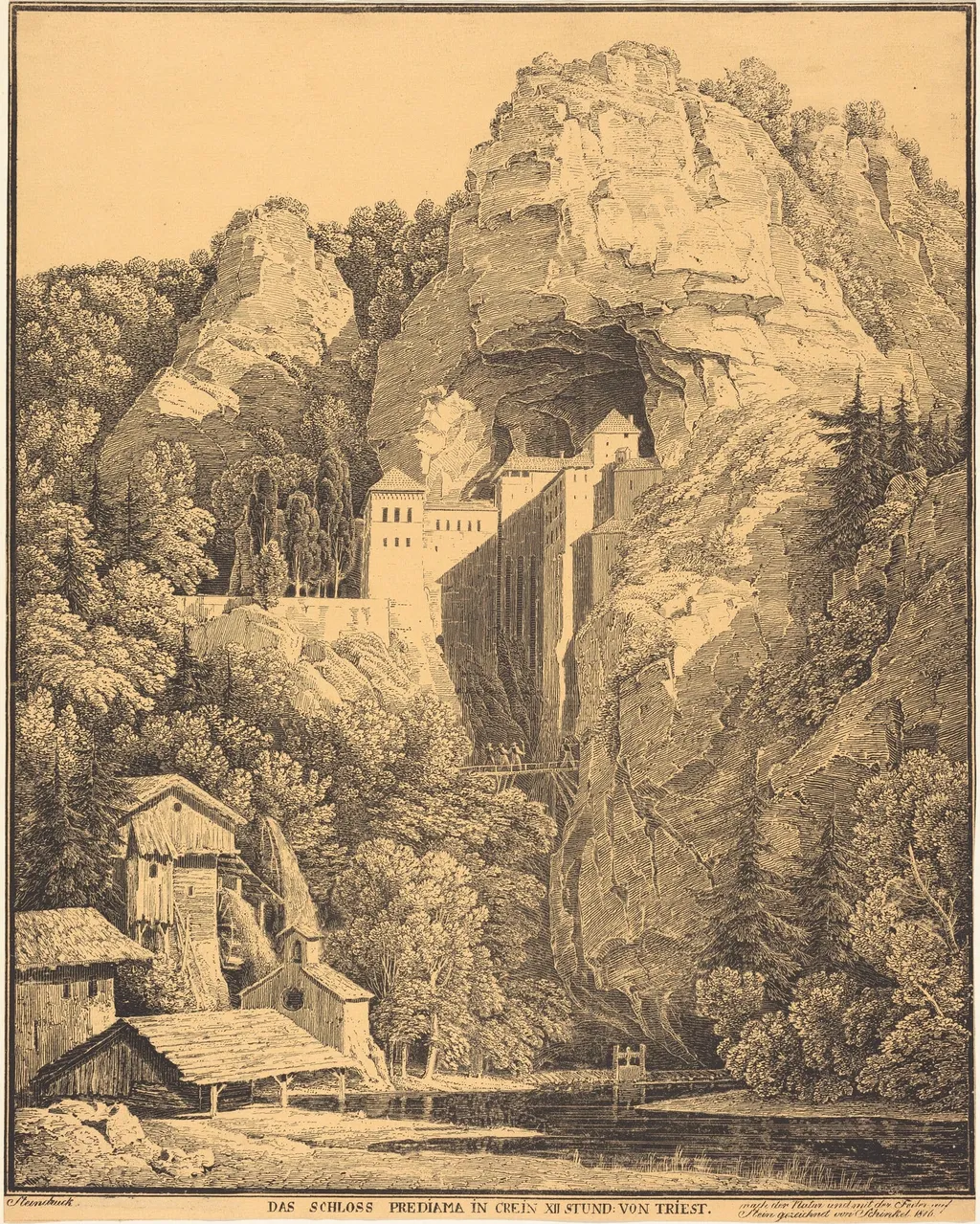
Das Schloss Prediama in Crein XII Stund: von Triest (Predjama Castle in Carniola, Twelve Hours from Trieste) is an ink print by the Romanticist artist Karl Friedrich Schinkel. It dates from 1816 and is held in the collection of the National Gallery of Art.
About this work
Overview
Created in 1816, this lithograph by Karl Friedrich Schinkel captures Predjama Castle in Carniola, depicted as a distant destination twelve hours from Trieste.
Created in 1816, this lithograph by Karl Friedrich Schinkel captures Predjama Castle in Carniola, depicted as a distant destination twelve hours from Trieste. Executed on golden-toned paper and mounted on its original R.A. Winkler mat, the work belongs to a series of topographical prints Schinkel produced during his travels. Though best known for his architectural designs in Berlin, Schinkel also documented European landscapes with precision, blending observation with aesthetic restraint.
Subject & Meaning
Predjama Castle, perched against a rugged cliff face, is rendered not as a ruin but as a quiet, enduring presence within its natural setting. The surrounding trees and winding river frame the structure without dramatizing it, suggesting a contemplative engagement with history and place. Schinkel’s choice to depict this Slovenian fortress reflects an interest in medieval architecture as a harmonious element within the landscape, rather than a symbol of power or conflict.
Technique & Style
Schinkel employed lithography, a technique allowing fine linear detail and tonal gradation, to render the castle’s stonework and the play of light across its surfaces. The use of golden paper enhances the atmospheric warmth, subtly evoking late afternoon light. His draftsmanship is precise yet restrained, avoiding romantic exaggeration; the composition emphasizes structural clarity and spatial depth, characteristic of his architectural training and Neoclassical sensibility.
History & Provenance
The print was made during Schinkel’s journey through the Habsburg territories in 1816, a period when he collected visual material for future architectural projects. It was published on the original mat by R.A. Winkler, a noted Berlin printmaker. The work remained within scholarly and artistic circles, later entering institutional collections. Its survival in original condition, including the mat, is uncommon and underscores its early reception as a refined study rather than a mass-produced image.
Context
In the early 19th century, German artists increasingly turned to regional landscapes and historic sites as subjects worthy of artistic attention. Schinkel’s lithographs, including this one, contributed to a broader cultural movement that valued topographical accuracy and emotional resonance over idealized scenery. Predjama Castle, though remote, was part of a network of medieval structures being documented by travelers and architects seeking to understand Europe’s architectural heritage.
Legacy
This lithograph exemplifies Schinkel’s role in bridging architectural design and graphic art. While not widely exhibited during his lifetime, it influenced later generations of architects and printmakers interested in the relationship between structure and environment. Its preservation in major collections, including the National Gallery of Art, affirms its value as a document of both artistic technique and 19th-century European topographical inquiry.
Artist & collection
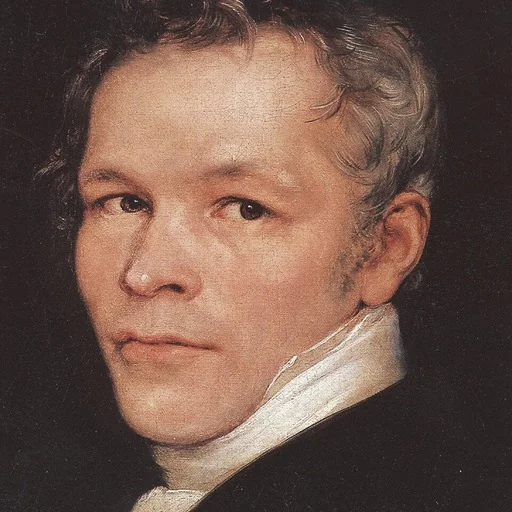
Artist
Karl Friedrich Schinkel (German pronunciation: ; 13 March 1781 – 9 October 1841) was a Prussian architect, city planner and painter who also designed furniture and stage sets.

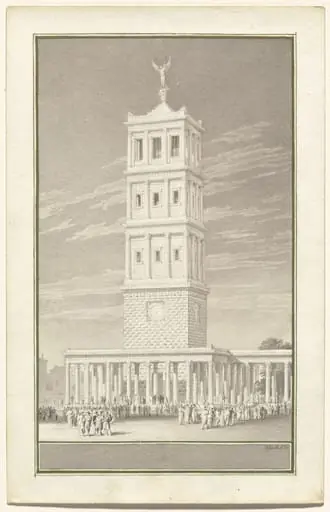 Campanile of a Cathedral for Berlin
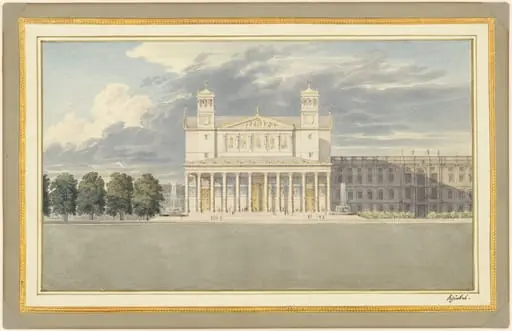 The Façade and Suroundings of a Cathedral for Berlin
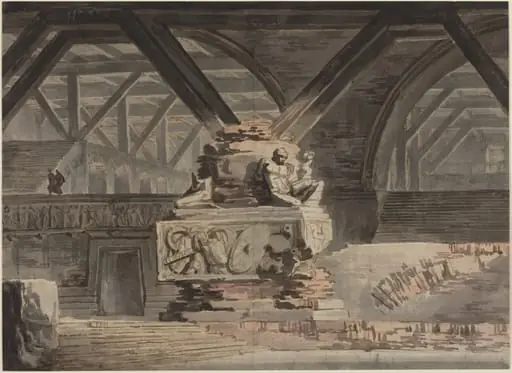 Stage Design: A Sepulchral Vault
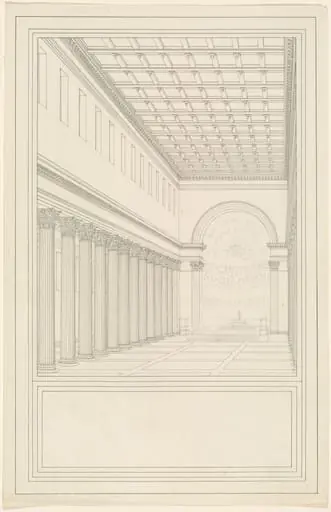 The Nave and Apse, without a Transept, of a Cathedral for Berlin
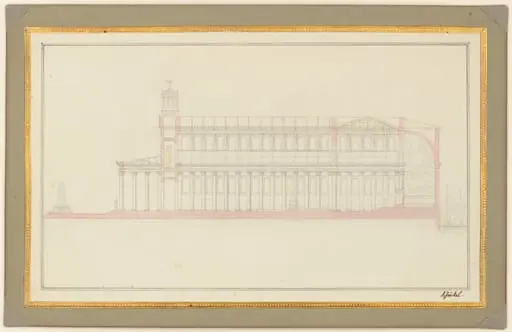 Longitudinal Section of a Cathedral for Berlin
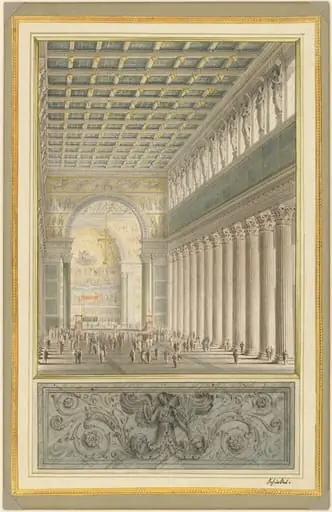 The Nave, Apse, and Crossing of a Cathedral for Berlin
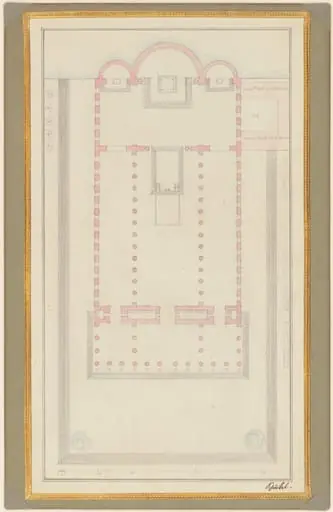 Ground Plan of a Cathedral for Berlin
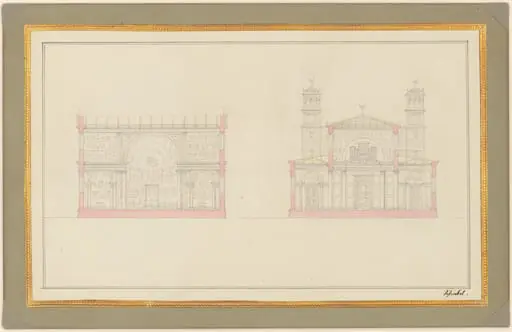 Section of the Crossing and the West End of a Cathedral for Berlin
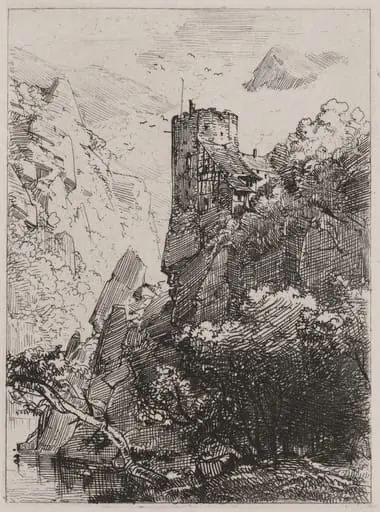 Watchtower on a Cliff with a Stream
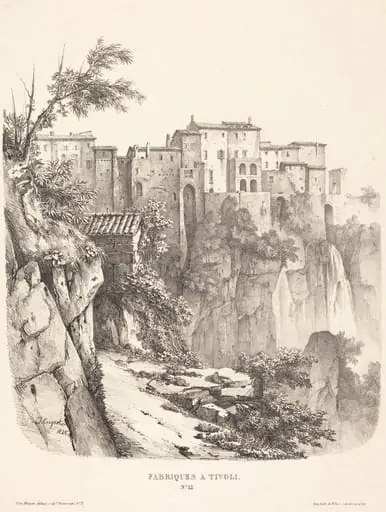 Fabriques à Tivoli (Buildings at Tivoli)
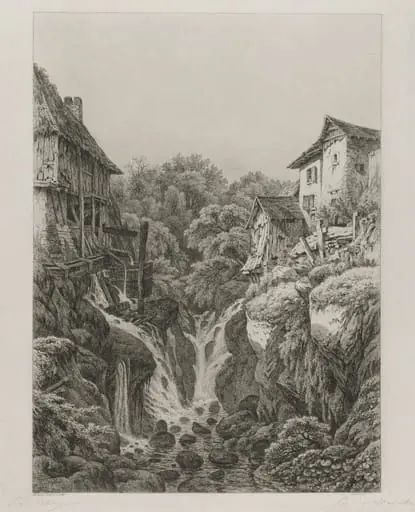 The Mill and Waterfall of Grésy near Aix-les-Bains
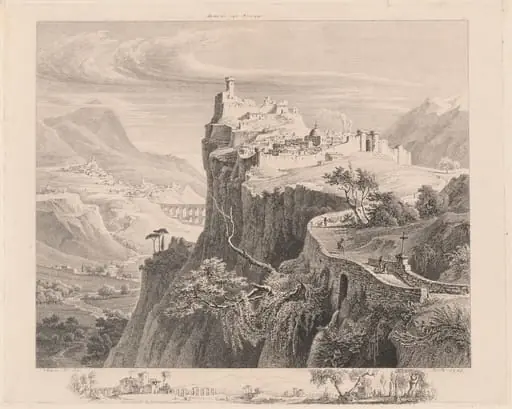 Ovindoli negli Abruzzi
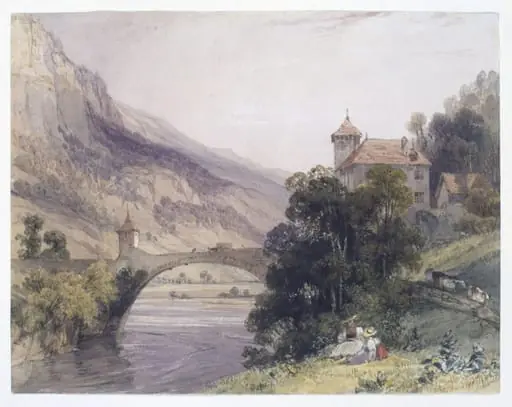 The Bridge of St. Maurice, Valais, Switzerland
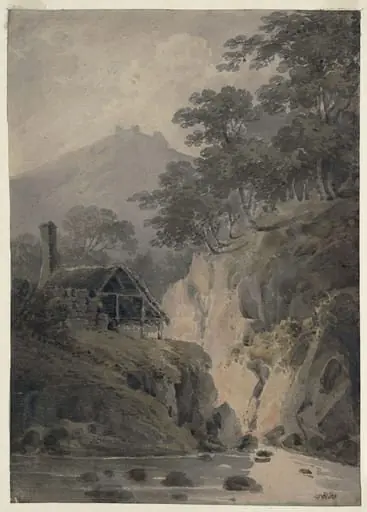 Rocky landscape in Cornwall
 Tivoli and the Temple of the Sibyl Above the Aniene Gorge
 A second drawing done from the same blot
 Les Pêcheurs (The Fishermen)