Artwork
Stanislas Idzikowski
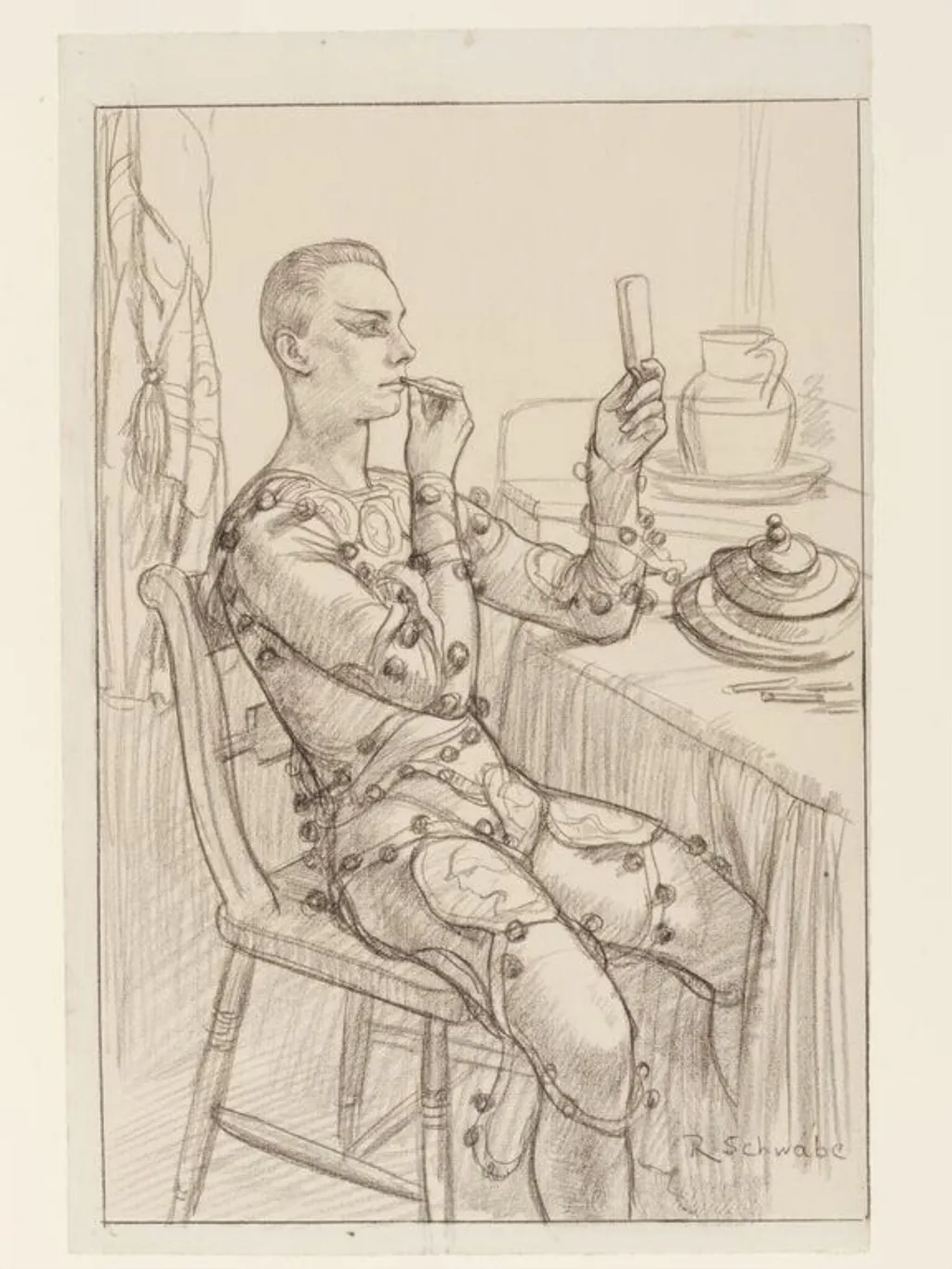
Stanislas Idzikowski is a drawing by Randolph Schwabe. It dates from 1925 and is held in the collection of the Victoria and Albert Museum.
About this work
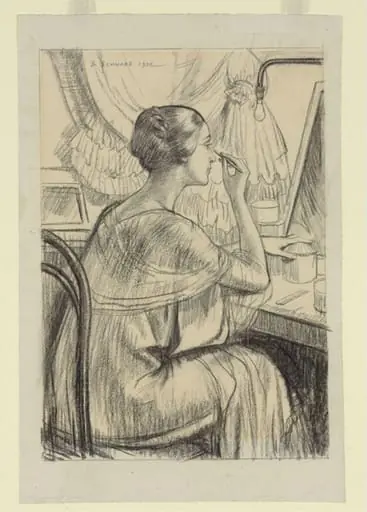
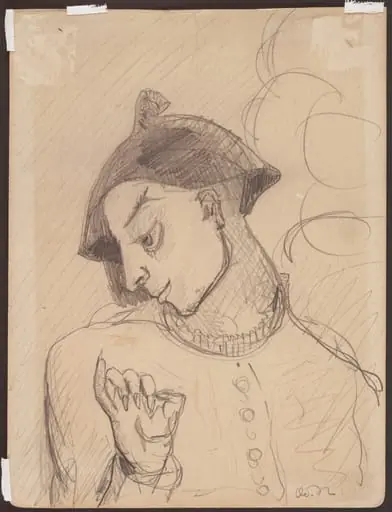
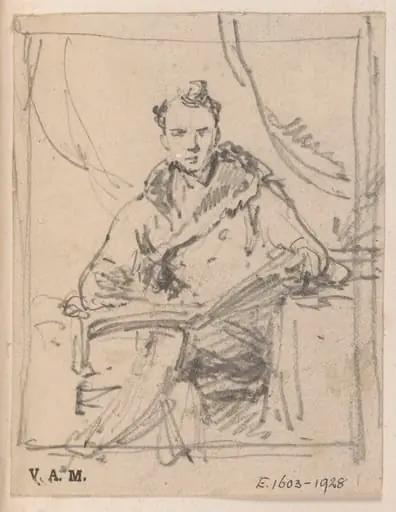
This pencil drawing shows dancer Stanislas Idzikowski getting ready for the pas de deux in a ballet called Cimarosiana.
This pencil drawing shows dancer Stanislas Idzikowski getting ready for the pas de deux in a ballet called Cimarosiana. The year is around 1925. The artist, Randolph Schwabe, signed the work.
Idzikowski sits on a wooden chair, putting on greasepaint with a small mirror. A costume from another ballet, Le Tricorne, hangs on the wall behind him. His outfit has bold “Wedgewood” medallions linked by silver ribbons.
Take a closer look at the Victoria and Albert Museum.
Overview
This pencil drawing by Randolph Schwabe captures the Polish dancer Stanislas Idzikowski in his dressing room, preparing for a performance around 1925. Seated before a makeup table, he applies greasepaint while holding a mirror, surrounded by the tools of his trade. The scene is intimate and unguarded, revealing the quiet ritual before stage performance. Schwabe’s signature appears in the lower corner, affirming the work as a direct observation from life.
Subject & Meaning
Idzikowski, a principal dancer with Diaghilev’s Ballets Russes, is depicted in the moments before performing a pas de deux from Cimarosiana. The focus on his makeup ritual underscores the transformation required of the performer—shifting from private individual to stage persona. The presence of Le Tricorne’s costume on the wall hints at the layered history of his repertoire, suggesting continuity between roles and the physicality of his art.
Technique & Style
Schwabe employs delicate pencil lines to render texture and form with precision: the sheen of silk tights, the grain of the wooden chair, the soft blur of greasepaint on skin. The composition is restrained, centered on Idzikowski’s focused gesture, with minimal background detail. The lighting suggests natural daylight, enhancing the realism and quiet dignity of the moment. The drawing’s economy of line reflects Schwabe’s skill in capturing character without theatrical embellishment.
History & Provenance
The drawing’s reverse bears labels from the 1953 Diaghilev Exhibition in Edinburgh, including handwritten notes by Richard Buckle and commercial tags from James Bourlet & Sons, a known theatrical supplier. These markings trace its journey through museum and collector circles after Idzikowski’s career. The survival of the original costume in Stockholm’s Dance Museum corroborates the drawing’s documentary value as a record of early 20th-century ballet practice.
Context
In the 1920s, Idzikowski was among the leading male dancers of the Ballets Russes, inheriting roles once performed by Nijinsky and excelling in Massine’s choreography. His performance in Cimarosiana—a divertissement derived from an opera—was notable for its technical finesse and expressive nuance. Schwabe’s drawing captures a moment within this vibrant, itinerant world of ballet, where costume, makeup, and discipline converged to create ephemeral art.
Legacy
Idzikowski’s later influence as a ballet teacher in Britain extended the reach of his artistry beyond performance. Schwabe’s drawing preserves not only his physical presence but also the meticulous preparation behind the scenes—a quiet counterpoint to the spectacle of the stage. As a record of a dancer’s daily ritual and a testament to Schwabe’s observational acuity, the work remains a significant artifact of ballet’s material culture.
Artist & collection
Artist
Randolph Schwabe made drypoint prints and pencil drawings in the 1920s. His prints show dancers like Enrico Cecchetti teaching and quiet portraits such as Stanislas Idzikowski. He worked in a straightforward, lined…