Artwork
Untitled
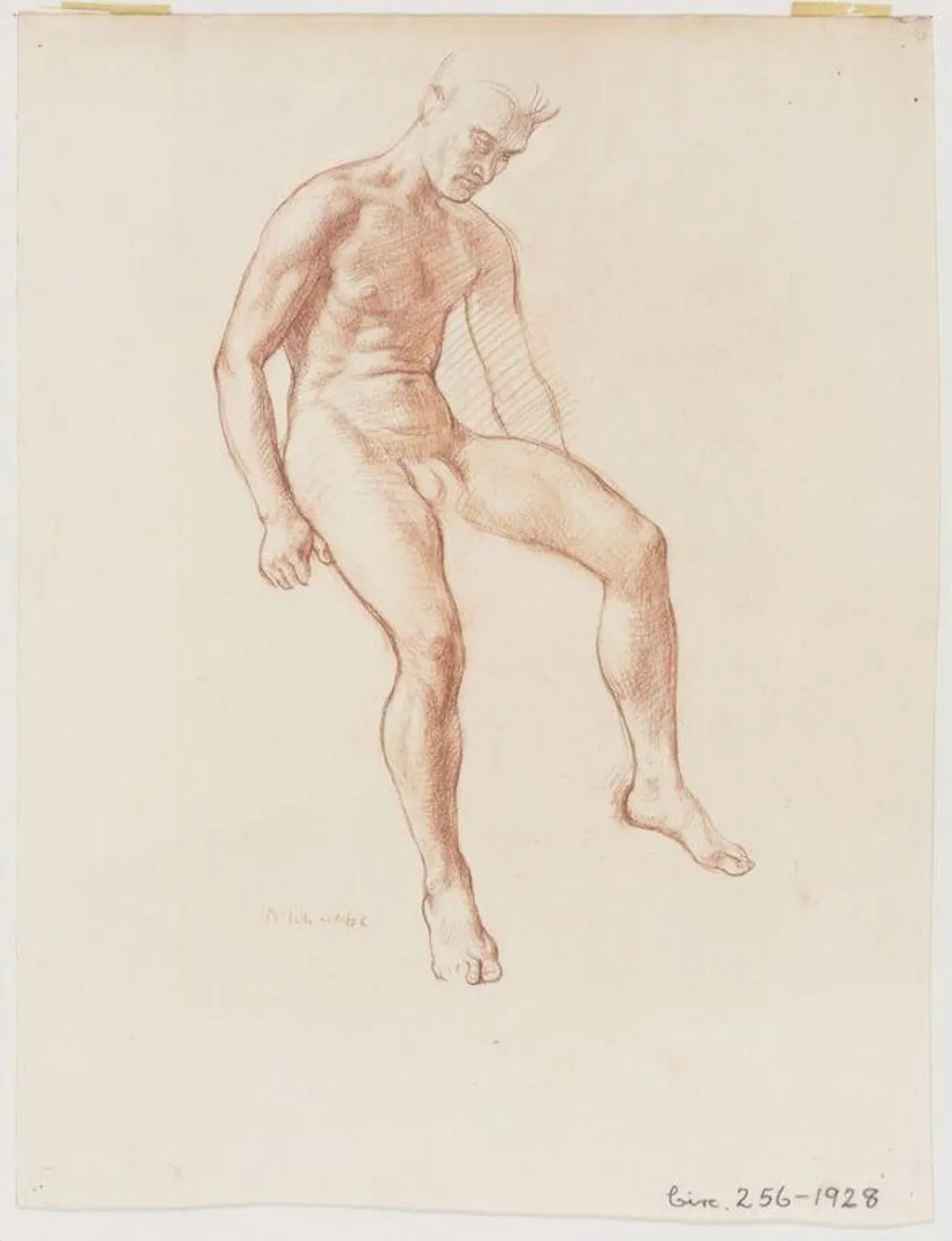
Untitled is a drawing by Randolph Schwabe. It is held in the collection of the Victoria and Albert Museum.
About this work
Overview
This pencil drawing by Randolph Schwabe presents a solitary male nude in a contemplative posture. The figure sits with one leg drawn up and the opposite arm stretched outward, creating a balanced yet dynamic composition. The plain off-white background eliminates distraction, directing focus entirely to the form and its subtle emotional tone.
Subject & Meaning
The figure appears absorbed in introspection, head bowed and gaze lowered, suggesting inner focus rather than external engagement. There is no narrative context or symbolic object to anchor interpretation; the work derives its resonance from the quiet dignity of the pose and the vulnerability of the exposed body, inviting reflection on solitude and physical presence.
Technique & Style
Schwabe employs precise linear contours and layered cross-hatching to model the figure’s musculature and suggest volume. Subtle gradations of tone define the play of light across the skin, while the absence of color or background detail emphasizes the economy of his draftsmanship. The technique conveys texture and weight without embellishment, rooted in observational precision.
History & Provenance
It likely originated as an academic exercise or preparatory sketch, part of a broader body of work documenting the human form through sustained observation.
Created during Schwabe’s tenure as a professor at the Royal College of Art, this drawing reflects his commitment to life study as a foundational practice. It likely originated as an academic exercise or preparatory sketch, part of a broader body of work documenting the human form through sustained observation. Its survival suggests it was retained by the artist or institution for its pedagogical value.
Context
In early 20th-century British art, the nude remained a central subject in academic training, even as modernist movements shifted focus. Schwabe’s approach aligns with the tradition of disciplined figure drawing, resisting abstraction in favor of anatomical truth. This work stands as a quiet counterpoint to the era’s more radical experiments, valuing stillness over spectacle.
Legacy
The drawing endures as an example of mid-century British life drawing at its most restrained and attentive. It exemplifies how minimal means—line, tone, posture—can convey psychological depth without narrative. Its influence lies in its pedagogical clarity, continuing to inform approaches to figure study in art education.
Artist & collection
Artist
Randolph Schwabe made drypoint prints and pencil drawings in the 1920s. His prints show dancers like Enrico Cecchetti teaching and quiet portraits such as Stanislas Idzikowski. He worked in a straightforward, lined…

 Male Nude
 Study for "Apollo and Daphne"
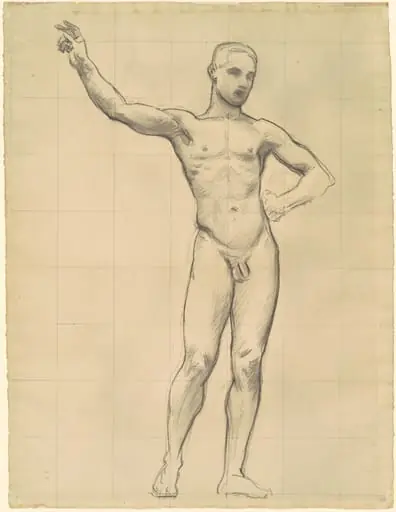 Study of Apollo for "Apollo and the Muses"
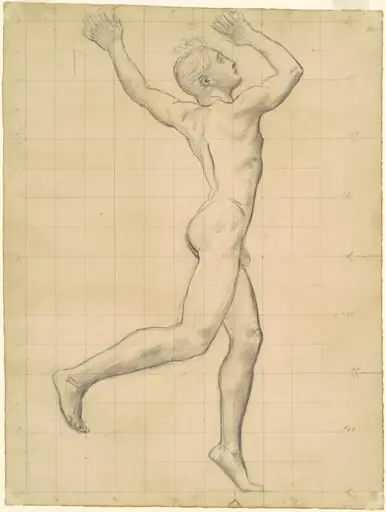 Study of Apollo for "Apollo and Daphne"
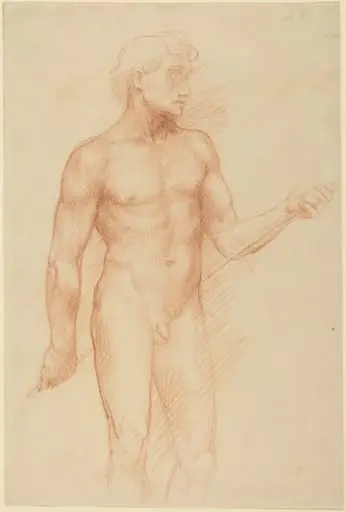 Study of a Man's Figure, Holding Rod behind Back
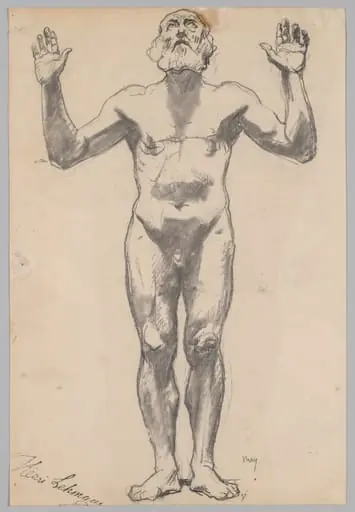 Nude Study of an Old Man
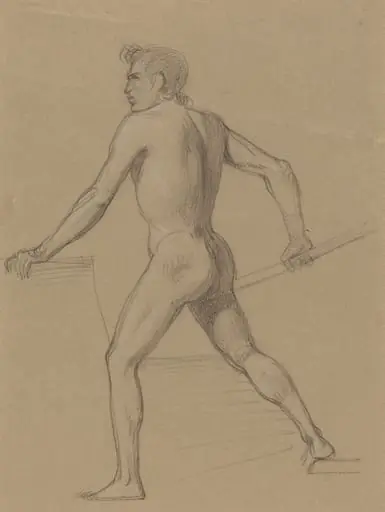 A Male Nude Moving to the Left
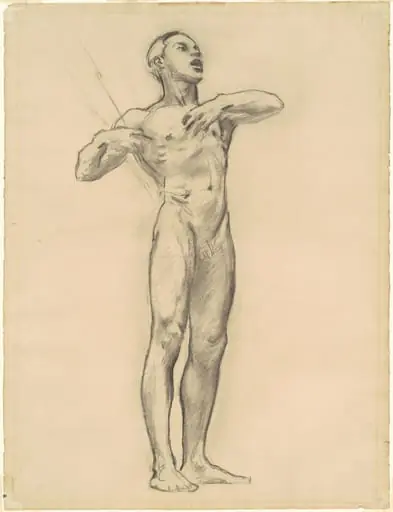 Study of Orpheus for "Classic and Romantic Art"
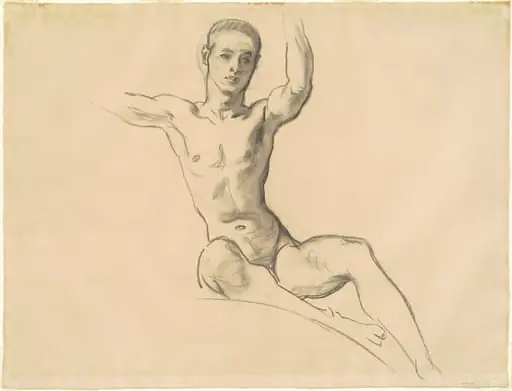 Study for Figure above "Music"
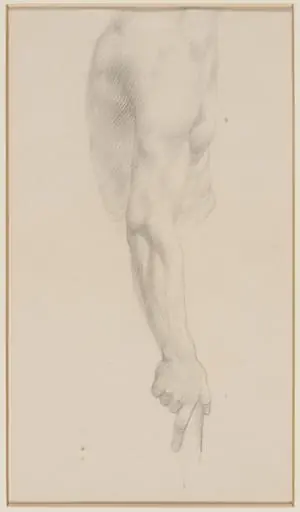 Arm
Arm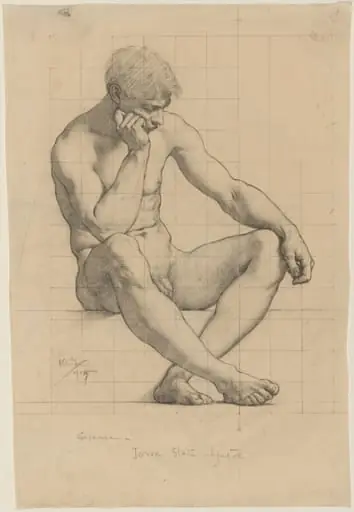 Seated Male Nude: Study for "Science" - Iowa State Capitol
 A Seated Male Nude with His Hands Crossed over His Head