Artwork
Άποψη των Δαρδανελίων
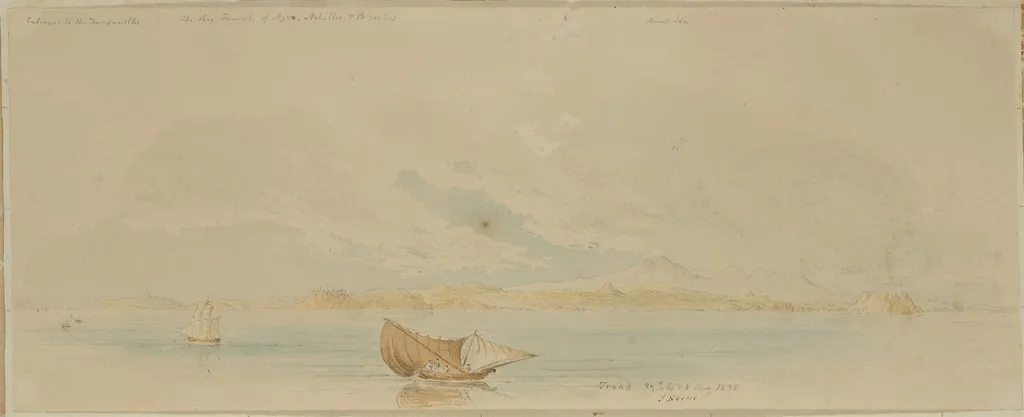
Άποψη των Δαρδανελίων is an unspecified painting by the Romanticist artist James Skene. It dates from 1838 and is held in the collection of the Historical & Ethnological Society of Greece.
About this work
In the background, a rocky coastline stretches under a pale sky with soft clouds.
This sketch shows a quiet sea scene with two boats. One is a small, rounded sailing boat in the foreground, its brown sail drooping. The other is a larger ship farther out, with three masts. In the background, a rocky coastline stretches under a pale sky with soft clouds.
The title mentions the Dardanelles, a famous strait. The artist wrote the date—July 8 to August 1838—in the corner.
Look up the Museum of Ethnography to see more works like this.
Overview
Created in 1838 by Scottish artist James Skene, this pencil and ink sketch depicts a tranquil seascape of the Dardanelles. The work captures a moment of quiet maritime activity, with two vessels on calm waters under a muted sky. Skene inscribed the dates of his journey—July to August 1838—indicating it was made during travel. The piece is now part of the Museum of Ethnography’s collection, reflecting its documentary character rather than purely aesthetic intent.
Subject & Meaning
The scene portrays two vessels: a small, single-masted sailing boat in the foreground with a slack sail, and a larger three-masted ship farther out. The rocky shoreline and soft clouds suggest a still, early afternoon. The Dardanelles, a historically significant strait, frames the composition not as a dramatic landmark but as a working maritime corridor. The image conveys observation over narrative, emphasizing the everyday rhythm of sea travel in the region.
Technique & Style
Skene employed delicate pencil lines and light ink washes to define forms without heavy shading. The boats are rendered with precise but unembellished contours, and the coastline is suggested through sparse, rhythmic strokes. The sky, rendered in pale tones, lacks dramatic contrast, reinforcing the subdued mood. The work’s sketch-like quality reflects its function as a visual record, prioritizing accuracy and immediacy over polished finish.
History & Provenance
James Skene produced this sketch during a journey through the eastern Mediterranean in mid-1838. The inscription of dates confirms it was made on-site, likely as part of a broader collection of topographical studies. It entered the Museum of Ethnography’s holdings at an unknown date, possibly through donation or acquisition tied to 19th-century ethnographic expeditions. Its preservation suggests recognition of its value as a cultural document rather than fine art.
Context
In the 1830s, European travelers frequently documented the Ottoman Empire’s landscapes and seascapes, often for scholarly or diplomatic purposes. Skene’s sketch aligns with this trend, capturing a region of strategic and commercial importance. Unlike grand historical paintings, this work reflects the growing interest in ethnographic detail—ordinary scenes of local life and navigation—making it part of a broader movement toward empirical visual recording.
Legacy
The sketch remains a modest but valuable record of 19th-century maritime observation. It contributes to understanding how Western travelers perceived and recorded the Dardanelles—not as a mythic passage, but as a lived environment. Its presence in an ethnographic museum underscores its role as evidence of cultural and geographic documentation, rather than artistic innovation.
Artist & collection

Artist
James Skene of Rubislaw (1775–1864) was a Scottish lawyer and amateur artist, best known as a friend of Sir Walter Scott.
Museum
Historical & Ethnological Society of Greece
Continue through works from the same source collection.
 Bay of Aden
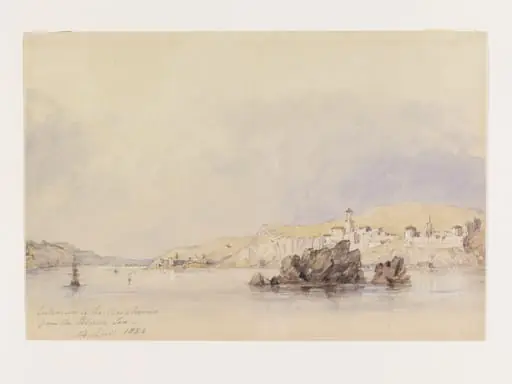 Entrance to the Bosphorus from the Black Sea
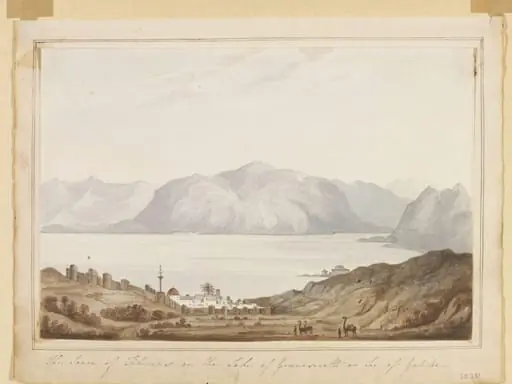 The Town of Tiberias on the Lake of Gennesereth or Sea of Galilee
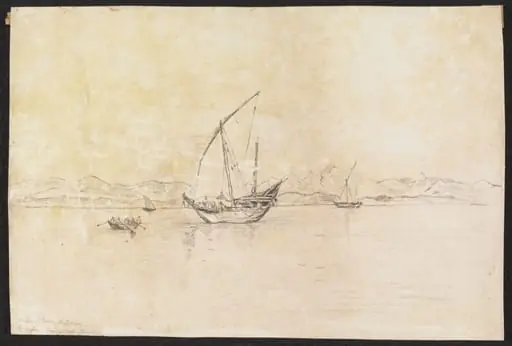 An Arab Dhow in the Red Sea
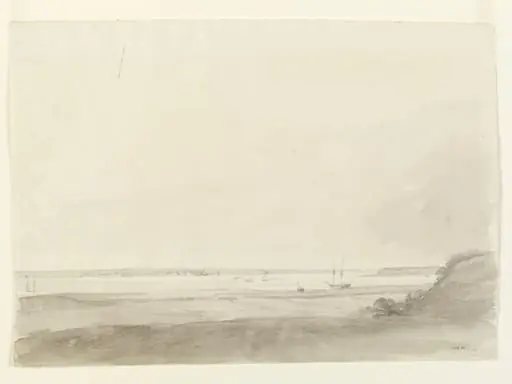 View from the shore over the Thames or the Medway
 Shipping in a breeze in the Thames or the Medway
 The Tide Rising at Briton Ferry
![Lake Shore, Menaggio [recto], by John Singer Sargent](https://artifactworldgallery.com/img/john-singer-sargent--lake-shore-menaggio-recto--2cbfc8ee4d60729d-w320.webp) Lake Shore, Menaggio [recto]
Lake Shore, Menaggio [recto] The Gulf of Pozzuoli
 `Cataracts of Assouan. Midway. - Our Candjia Moored for the Night - On the Nile'