Artwork
River View
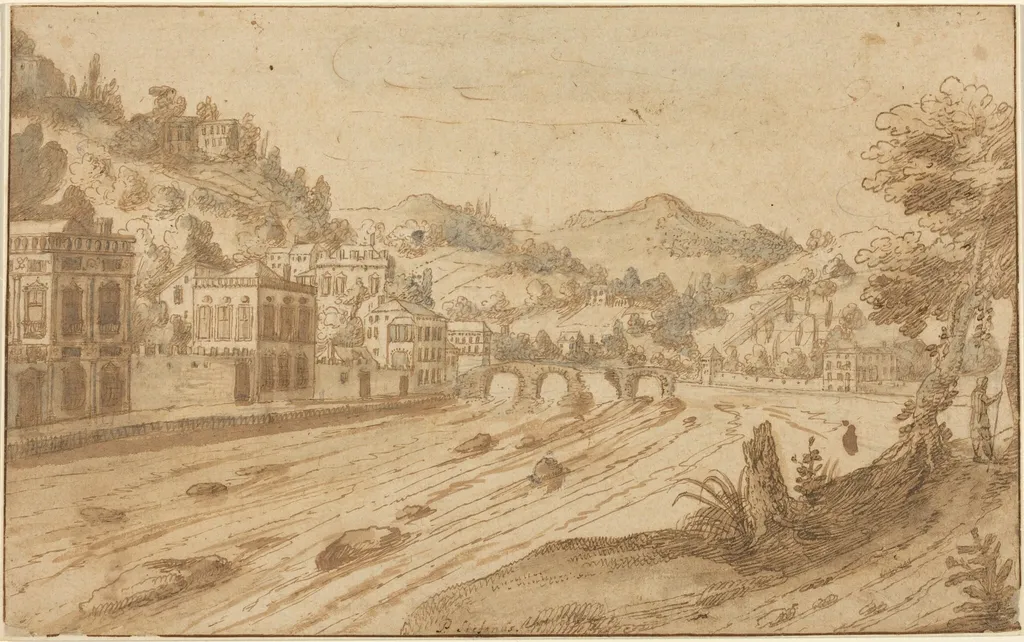
River View is an ink drawing by the Renaissance artist Pieter Stevens. It dates from 1596 and is held in the collection of the National Gallery of Art.
About this work
Overview
Created in 1596, *River View* is a delicate drawing by Pieter Stevens II, executed in pen and brown ink with layered brown and gray washes on laid paper.
Created in 1596, *River View* is a delicate drawing by Pieter Stevens II, executed in pen and brown ink with layered brown and gray washes on laid paper. As a Flemish artist active at the court of Emperor Rudolf II in Prague, Stevens specialized in landscape subjects. This work exemplifies his skill in capturing natural topography with subtle tonal gradations, reflecting the growing interest in landscape as an independent genre during the late 16th century.
Subject & Meaning
The scene portrays a quiet river winding through a rural landscape, with a small town on the left bank and a bridge linking it to the opposite shore. Hills and trees frame the composition, while a solitary figure on the bank introduces a human scale without disrupting the calm. The absence of narrative or dramatic action suggests an emphasis on observation and atmosphere, aligning with the era’s shift toward landscape as a subject worthy of contemplation in its own right.
Technique & Style
Stevens employed fine pen lines and washes to build depth and texture, using cross-hatching to model forms and suggest shadow. The brown and gray washes create atmospheric perspective, softening distant hills and enhancing the illusion of space. The laid paper’s texture subtly interacts with the ink, adding organic variation. His method prioritizes quiet modulation over bold contrast, characteristic of Northern European draftsmanship of the period.
History & Provenance
Pieter Stevens II moved from Flanders to Prague around 1590 to join the imperial court, where he produced numerous landscape drawings for patrons and collectors. *River View* dates from his early years in Prague, a time when his work began to influence the development of landscape drawing in Central Europe. Though specific ownership records are sparse, the drawing’s survival reflects its value within artistic circles connected to the Habsburg court.
Context
During the late 1500s, landscape imagery gained traction across the Low Countries, aided by the circulation of prints and the rise of collectors interested in natural scenes. Stevens’ work contributed to this trend, blending Flemish attention to detail with the more expansive views favored in imperial Prague. His drawings, though not widely published, helped bridge regional styles and laid groundwork for later landscape traditions in Central Europe.
Legacy
Stevens’ *River View* stands as a representative example of early modern landscape drawing, illustrating how artists moved beyond religious or mythological themes to explore the natural world with quiet precision. Though less known than contemporaries, his technique influenced regional draftsmen and contributed to the evolution of landscape as a sustained artistic pursuit in Central Europe during the early 17th century.
Own this work as a print
Artist & collection
Artist
Pieter Stevens II or Peter Stevens II (ca. 1567 in Mechelen – after 1626 in Prague) was a Flemish painter and draughtsman known for his landscapes. He left Flanders to work for the court of Emperor Rudolf II in Prague.…

 Landscape with Fortress and River
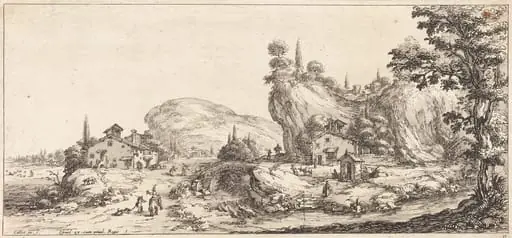 Returning Home from the Hunt
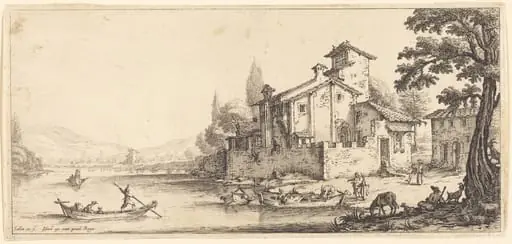 The Walk by the Water
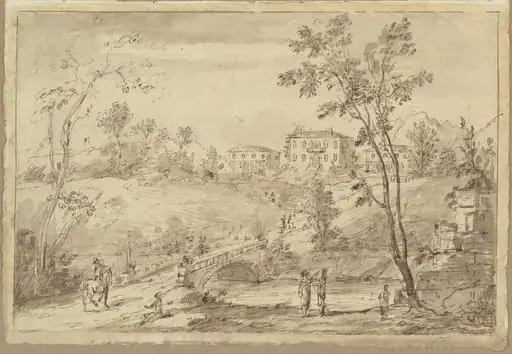 Landscape with a Bridge
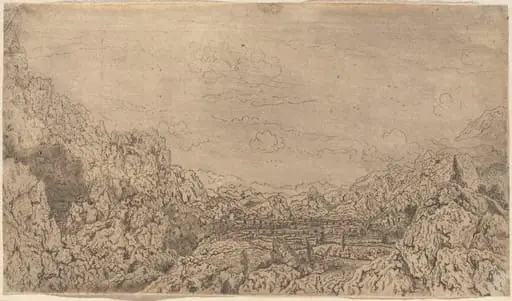 The Enclosed Valley
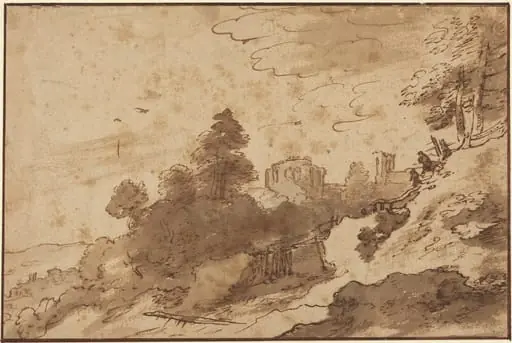 Landscape with Bridge and Ruins in Background
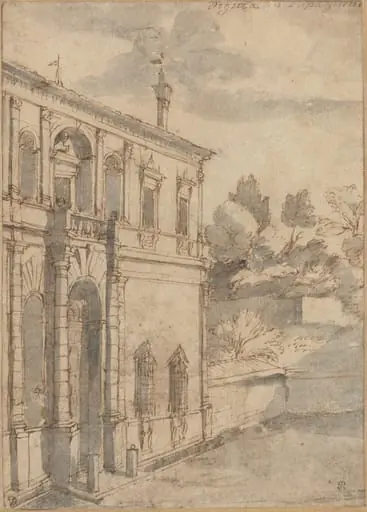 Villa di Papa Giulio
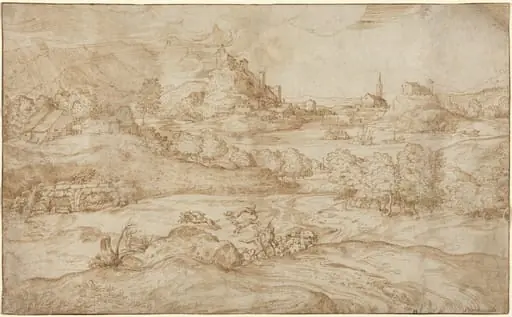 Landscape with Shepherds Driving Away a Wolf
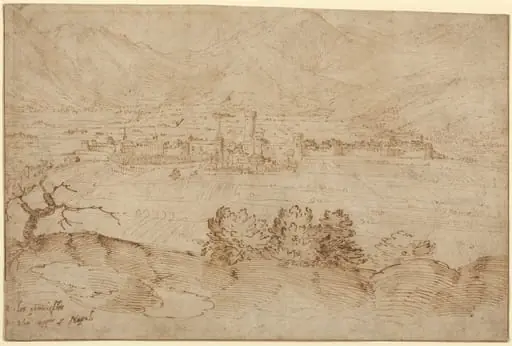 View of Fondi
 Round Tower near the Tiber
 River Landscape
 View of the Janiculum Hill Seen from the Tiber (recto)