Artwork
Wickham St. Paul's Church
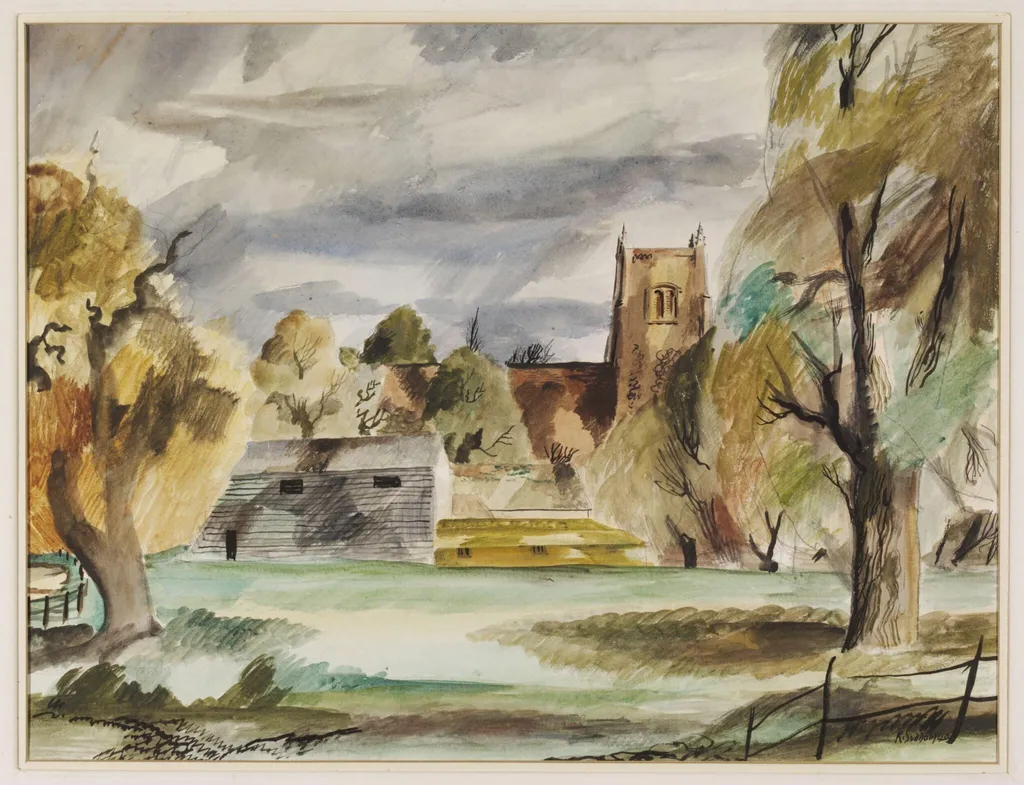
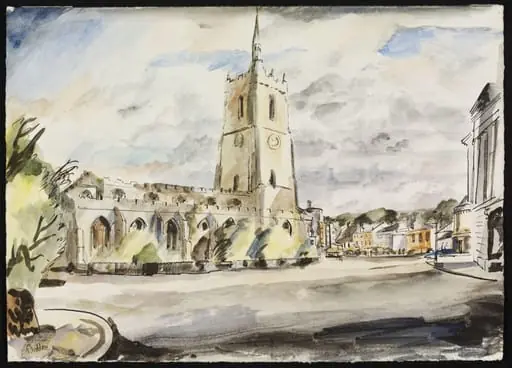
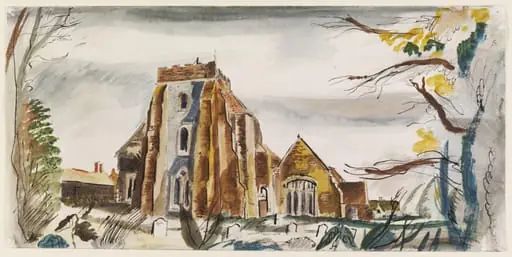
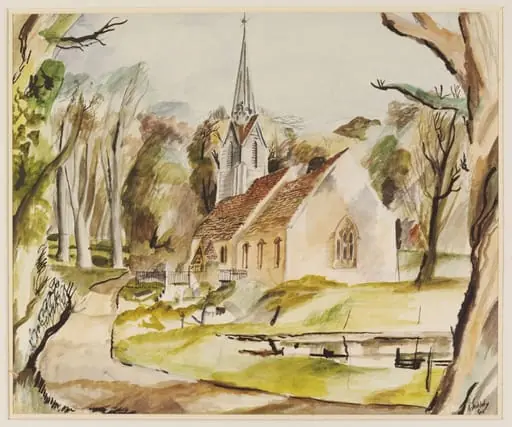
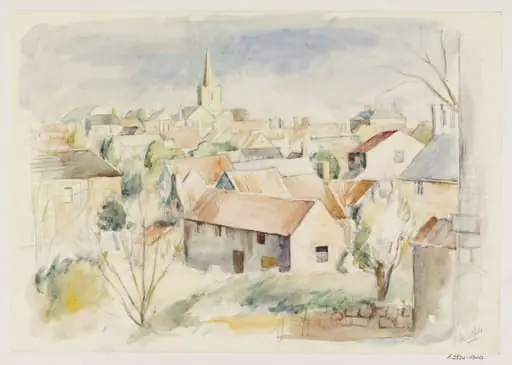
Wickham St. Paul's Church is a watercolor work on paper by Suddaby. It dates from 1940 and is held in the collection of the Victoria and Albert Museum. This watercolour, created in 1940, portrays All Saints Parish Church in Wickham St.
About this work
Overview
It is part of the 'Recording Britain' project, a wartime effort to preserve visual records of the British countryside amid the threat of conflict.
This watercolour, created in 1940, portrays All Saints Parish Church in Wickham St. Paul, Essex. It is part of the 'Recording Britain' project, a wartime effort to preserve visual records of the British countryside amid the threat of conflict. The scene captures the church rising above trees and outbuildings, framed by a quiet, overcast sky and two large trees flanking the foreground. The work reflects a deliberate focus on ordinary, enduring landscapes during a time of national uncertainty.
Subject & Meaning
The church stands as the central anchor, its tower and roof emerging above the surrounding foliage, symbolizing continuity amid disruption. The modest outbuildings to the left and the fenced foreground suggest a rural, lived-in environment rather than a grand monument. The muted tones and stillness of the composition evoke a sense of quiet resilience, aligning with the project’s aim to document the quiet dignity of Britain’s vernacular architecture during wartime.
Technique & Style
The artist employs delicate watercolour washes to suggest atmospheric depth and subtle texture. Soft, controlled brushwork defines the church’s stonework, the foliage’s layered canopies, and the diffuse light beneath a clouded sky. No sharp lines dominate; instead, gentle transitions between tones create a hushed, contemplative mood. The medium’s transparency allows underlying paper to suggest highlights, enhancing the sense of natural light filtering through the clouds.
History & Provenance
Created in 1940, the work belongs to the 'Recording Britain' initiative, funded by the Pilgrim Trust and organized by the Victoria and Albert Museum. Artists were commissioned to document landscapes and buildings at risk from war or modernization. This piece, by artist Suddaby, entered the V&A’s collection as part of this effort, preserving a moment in time when rural England’s visual character was seen as culturally vital to safeguard.
Context
During the early years of the Second World War, Britain faced widespread destruction and cultural upheaval. The 'Recording Britain' project emerged as a quiet act of preservation, countering the loss of heritage with careful observation. Artists like Suddaby focused on unassuming villages and churches, emphasizing the value of everyday places. These works were not propaganda, but testimonies to a landscape deemed worth remembering.
Legacy
The watercolour remains part of the Victoria and Albert Museum’s permanent collection, serving as a historical record of rural Essex in the early 1940s. It contributes to broader scholarly understanding of how art was mobilized during wartime to sustain national identity through documentation rather than heroism. Its quiet realism continues to inform studies of British topographical art and the role of visual culture in times of crisis.
Artist & collection
Artist
A British watercolor artist from the mid-20th century, Suddaby painted quiet, detailed scenes of East Anglia’s streets and churches in the 1940s.