Artwork
A Woman sweeper
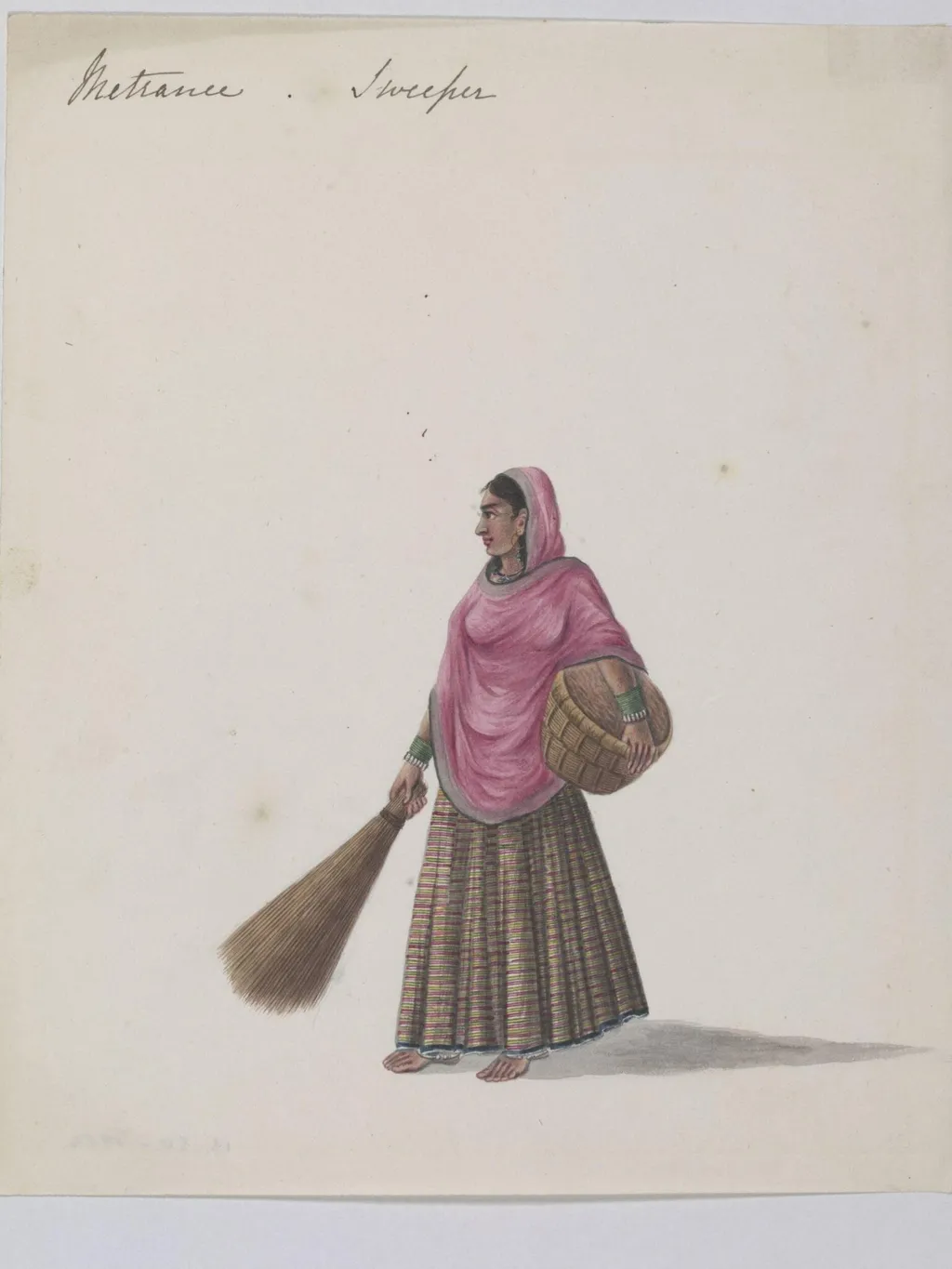
A Woman sweeper is a paint painting by the Realist artist Unknown. It dates from 1826 and is held in the collection of the Victoria and Albert Museum. This watercolor painting, dated around 1826, portrays a woman engaged in the act of sweeping a stone floor.
About this work
At the time, many artists in Europe focused on everyday life instead of grand scenes.
This painting shows a woman sweeping a stone floor with a wooden broom.
She wears a simple dress and her hair is tied back. The room looks bare, with just a plain wall behind her.
This was made around 1826. At the time, many artists in Europe focused on everyday life instead of grand scenes. We don’t know who painted it, so we can’t say more about the artist.
Look up the Victoria and Albert Museum to see other art like this.
Overview
This watercolor painting, dated around 1826, portrays a woman engaged in the act of sweeping a stone floor. It belongs to a series of thirty-five works documenting labor and daily trades. Executed in a restrained palette, the image captures a quiet, unadorned moment of domestic work. The artist remains unidentified, and the piece was likely produced as part of a broader observational project rather than a commissioned portrait.
Subject & Meaning
The subject is a working-class woman performing a routine household task, depicted without idealization or narrative embellishment. Her simple attire and tied-back hair emphasize practicality over ornamentation. The bare room and neutral background focus attention on her labor, suggesting an interest in the dignity of ordinary work. This aligns with early 19th-century trends that valued the observation of everyday life over historical or mythological themes.
Technique & Style
Rendered in watercolor, the painting employs delicate washes and minimal detail to convey form and texture. The wooden broom and stone floor are suggested with soft lines rather than precise rendering, reflecting a documentary approach. The composition is uncluttered, with the figure centered against a plain wall, reinforcing the emphasis on the act of sweeping rather than its setting. The medium’s transparency lends a quiet, intimate quality to the scene.
History & Provenance
The painting’s origins are undocumented, with no record of its creator or initial patron. It entered the collection of the Victoria and Albert Museum as part of a larger group of occupational studies from the early 1820s. Its survival suggests it was preserved for its ethnographic value rather than its artistic fame. The absence of signatures or inscriptions leaves its production context largely speculative.
Context
In the 1820s, European artists increasingly turned to scenes of common labor, influenced by social changes and the rise of realism. This work reflects a growing interest in documenting the lives of ordinary people, particularly in urban settings. Such series were sometimes compiled for educational or philanthropic purposes, offering visual records of trades that were becoming less visible amid industrialization.
Legacy
Though unsigned and unattributed, the painting contributes to a broader archive of 19th-century visual ethnography. It stands as a quiet testament to the visibility of domestic labor during a period when such work was rarely celebrated in art. Its preservation in a major museum underscores its value as a historical document, offering insight into the material conditions of everyday life in early Victorian England.
Artist & collection

 Domestic Scene
 Giacomo and Cardinal Marco, investing Andrea, Abbot of San Zeno, with his Benefice
 The Nymph of Fontainebleau
 Portrait of a Woman
 Madonna and Child with Saints in the Enclosed Garden
 Venus and Minerva
 Family Group of Four on Sofa
 Wall painting from Room H of the Villa of P. Fannius Synistor at Boscoreale