Artwork
Convent of the Pantanassa, Mistra
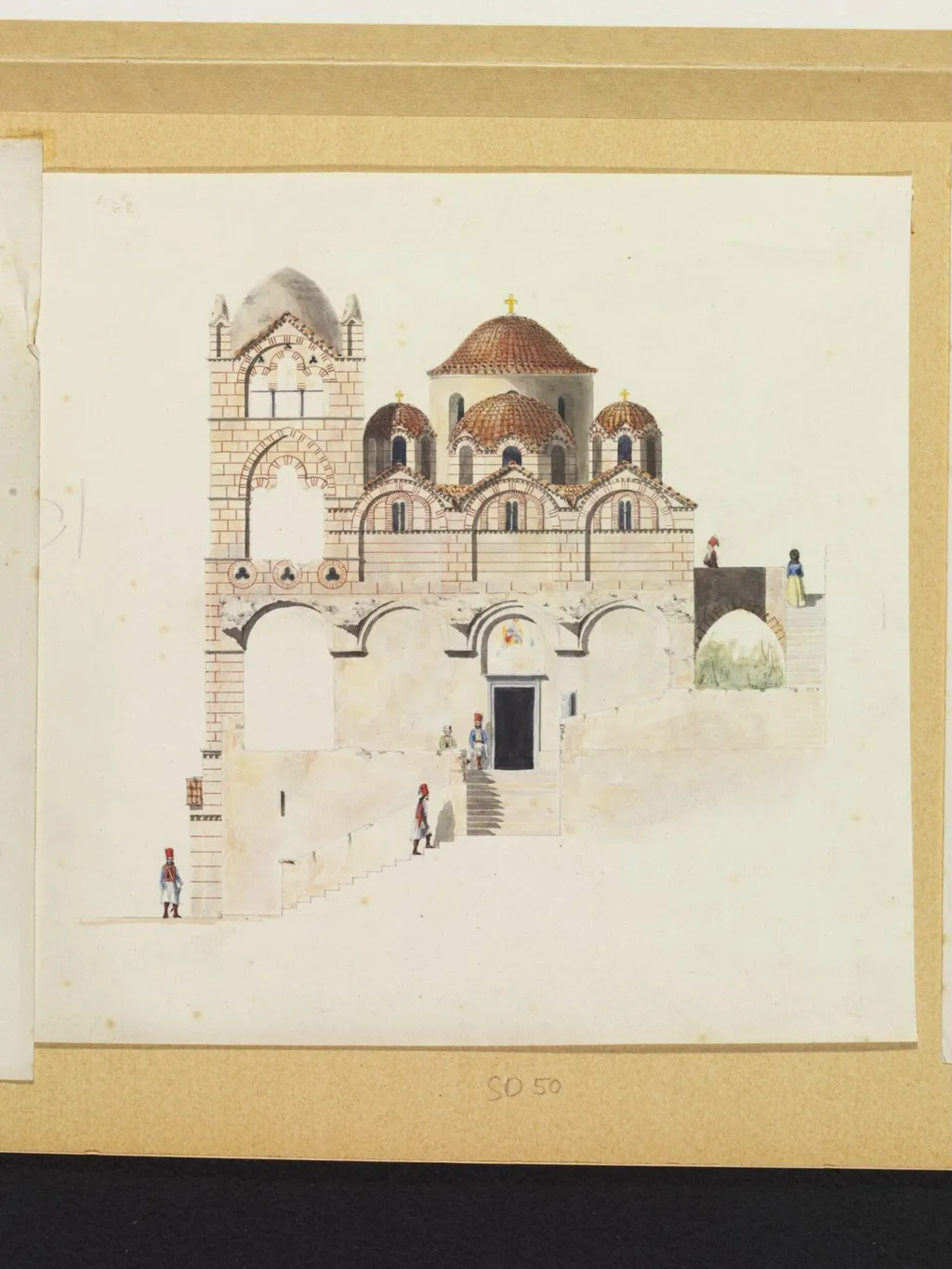
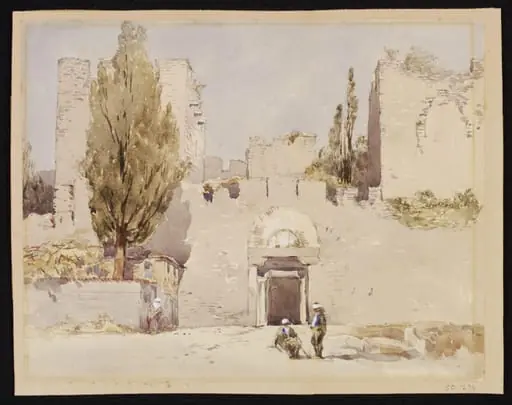
Convent of the Pantanassa, Mistra is a watercolor work on paper by the Byzantine icon painting artist Unknown. It dates from 1840 and is held in the collection of the Victoria and Albert Museum. A watercolour from 1840 depicts the Convent of the Pantanassa in Mistra, Greece, rendered in subdued hues by an unidentified artist.
About this work
Overview
A watercolour from 1840 depicts the Convent of the Pantanassa in Mistra, Greece, rendered in subdued hues by an unidentified artist.
A watercolour from 1840 depicts the Convent of the Pantanassa in Mistra, Greece, rendered in subdued hues by an unidentified artist. The work was once part of a bound collection of architectural sketches, though its brushwork and tonal approach align more closely with drawings attributed to William Henry Bartlett and Charles Arundale. It entered the V&A’s collection in 1967 after acquisition from W. Spencer for £12, reflecting 19th-century interest in documenting Byzantine ruins.
Subject & Meaning
The scene captures the convent’s stone architecture—rounded domes, arched windows, and weathered masonry—surrounded by small, incidental figures: soldiers in red caps near the entrance and a woman in a long garment passing along a wall. These figures, rendered with minimal detail, serve not as portraits but as indicators of daily life around the ancient site. The focus remains on the structure’s endurance, emphasizing its quiet presence amid human activity.
Technique & Style
The artist employed delicate washes to suggest the texture of aged stone and the fading remnants of plaster, avoiding bold outlines. Small crosses atop the domes and subtle variations in brickwork are carefully noted, revealing an eye for architectural nuance. Figures are scaled down to underscore the monument’s scale, a common practice among topographical artists of the period who prioritized accuracy over narrative drama.
History & Provenance
The watercolour was once part of a larger album of architectural studies, likely compiled during travels in the Peloponnese. Its stylistic ties to works by Arundale suggest it may have been made by a contemporary or follower. Acquired by the Victoria and Albert Museum in August 1967 from dealer W. Spencer, its provenance before that remains undocumented, though its condition implies careful preservation over decades.
Context
Created during a period of growing European interest in Byzantine heritage, this drawing reflects the trend of amateur and professional artists documenting ancient sites in Greece following its independence. Such works served both scholarly and aesthetic purposes, contributing to the visual record of monuments before extensive restoration or decay altered their appearance.
Legacy
Though unsigned and unattributed, the watercolour contributes to a broader archive of 19th-century topographical art focused on the Eastern Mediterranean. Its inclusion in the V&A’s collection preserves a quiet, observational record of Mistra’s architecture at a time when such sites were being rediscovered by Western travelers, offering insight into how these ruins were perceived before modern conservation efforts.
Artist & collection

 Domestic Scene
 Giacomo and Cardinal Marco, investing Andrea, Abbot of San Zeno, with his Benefice
 The Nymph of Fontainebleau
 Portrait of a Woman
 Madonna and Child with Saints in the Enclosed Garden
 Venus and Minerva
 Family Group of Four on Sofa
 Wall painting from Room H of the Villa of P. Fannius Synistor at Boscoreale
 Udkast til freskerne i Viborg Domkirke. Orgelbuen
 A Koubba, Soussa
 Türbes in the Royal Cemetery of the Muradiye (Murad II), Bursa
 Το Τζαμί του Τζισδαράκη στο Μοναστηράκι
 Constantinople
 Smyrne
 Beirut. Al-Omari Mosque
 Udkast til freskerne i Viborg Domkirke. Væggene. Nordre sideskib og felterne over Triforierne
 Roman Buildings on a Hill
 The City Walls, Jaffa, Palestine
 A gateway with a domed turret, Macau
 Entrance to the Cannon Gate (Top Kapisi) in Constantinople