Artwork
European Costume Scene
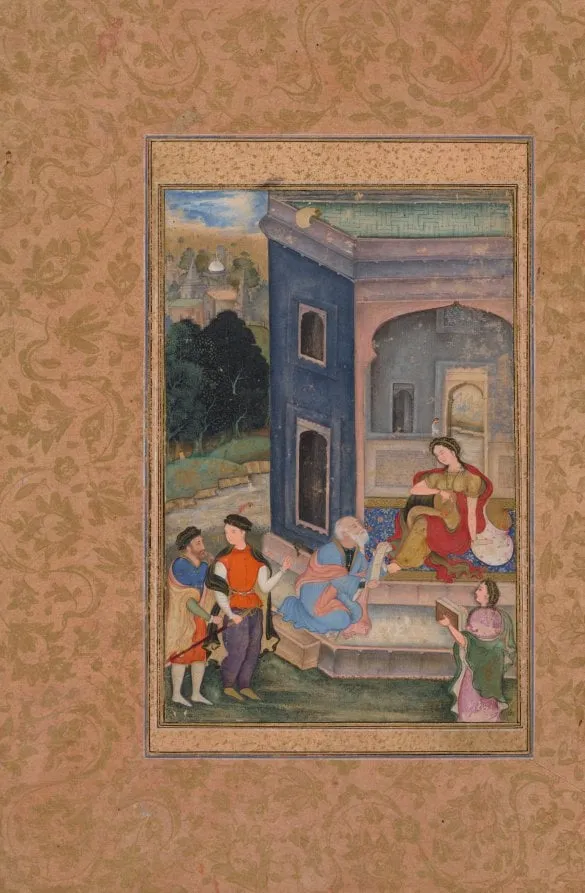
European Costume Scene is an unspecified painting by the Patna School of Painting artist Unknown. It dates from 1592 and is held in the collection of the Cleveland Museum of Art. An Indian artist working in the Mughal court around 1600 created a scene blending European and South Asian visual elements.
About this work
He copied poses and clothes from European prints brought by Jesuit missionaries, but the distant city in the corner is pure Mughal—flat, patterned, no shadows.
You see two European-style merchants in fancy clothes talking to a woman under a tent, while a holy man kneels and shows her a scroll.
The artist was Indian, working for the Mughal court around 1600. He copied poses and clothes from European prints brought by Jesuit missionaries, but the distant city in the corner is pure Mughal—flat, patterned, no shadows. The mix makes the scene feel like a story no one wrote down.
Look up more paintings tagged india, mughal dynasty (1526-1756) to see how Indian artists remade European pictures in their own way.
Overview
An Indian artist working in the Mughal court around 1600 created a scene blending European and South Asian visual elements. The composition depicts figures in foreign attire engaged in an ambiguous ritual, likely inspired by printed images introduced by Jesuit missionaries. Yet the setting and spatial logic remain rooted in indigenous traditions, resulting in a hybrid narrative that resists clear interpretation.
Subject & Meaning
Two figures dressed in European-style garments approach a pavilion where a seated woman receives a kneeling holy man presenting a scroll. The identities of the figures and the nature of the interaction remain unresolved. The scene may reference religious exchange, courtly reception, or allegory, but no textual source confirms its intent, leaving it as an open-ended visual enigma.
Technique & Style
The artist adapted poses and costumes from European engravings but rendered them with Indian miniature conventions: fine brushwork, flat planes, and decorative patterning. The distant cityscape lacks Western perspective, instead echoing Mughal landscape traditions with stylized architecture and absence of shadow. This fusion reflects selective appropriation rather than direct imitation.
History & Provenance
The painting originated in a Mughal atelier during the reign of Akbar or Jahangir, when European prints entered the court through Jesuit missions. These images were studied and reinterpreted by local artists, who integrated them into existing visual vocabularies. The work’s survival suggests it was valued as a curiosity or study, not as a religious or historical record.
Context
Mughal artists routinely engaged with imported European imagery, not as copies but as sources for reinterpretation. This painting exemplifies a broader trend: the absorption of foreign motifs into indigenous frameworks, where Christian iconography, aristocratic dress, and architectural forms were reimagined through local aesthetic principles and symbolic systems.
Legacy
This work stands as an early example of cross-cultural visual dialogue in South Asia. It demonstrates how Indian artists did not passively receive European influences but actively transformed them, creating new visual languages that reflected both curiosity and autonomy. Such hybrid works remain key to understanding early global artistic exchange in the Mughal context.
Artist & collection

 Domestic Scene
 Giacomo and Cardinal Marco, investing Andrea, Abbot of San Zeno, with his Benefice
 The Nymph of Fontainebleau
 Portrait of a Woman
 Madonna and Child with Saints in the Enclosed Garden
 Venus and Minerva
 Family Group of Four on Sofa
 Wall painting from Room H of the Villa of P. Fannius Synistor at Boscoreale
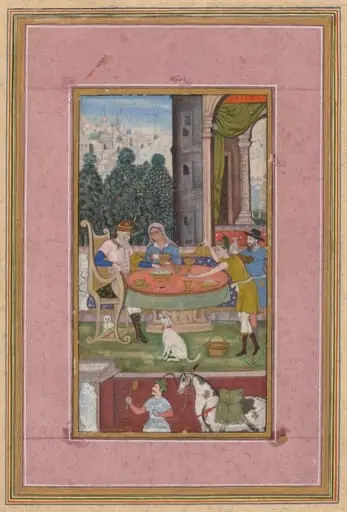 Dining Scene with European Elements
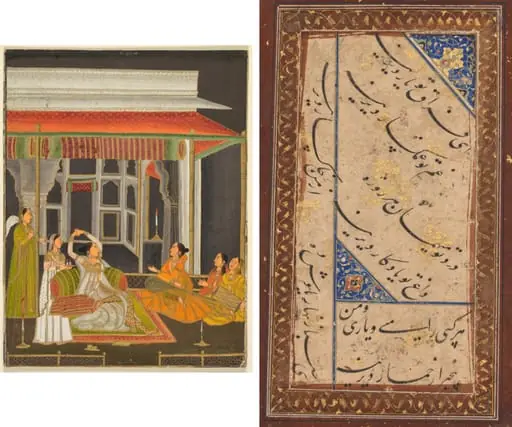 A princess on a terrace with attendants at night (recto); Calligraphy (verso)
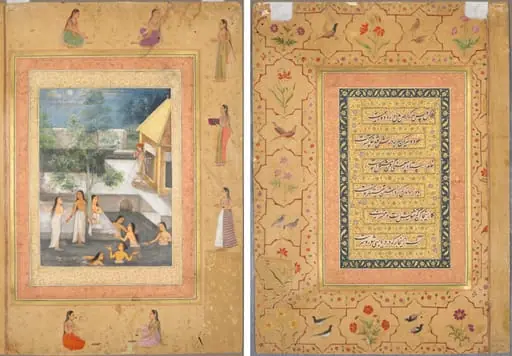 Leaf from the Late Shah Jahan Album: Harem Night-Bathing Scene (recto); Calligraphy Framed by an Ornamental Border of Flowers and Birds (verso)
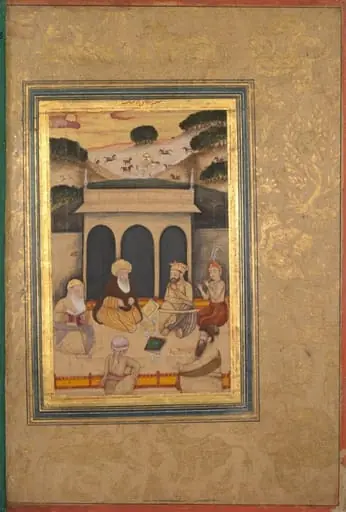 Nobleman Visiting Saint at his Shrine
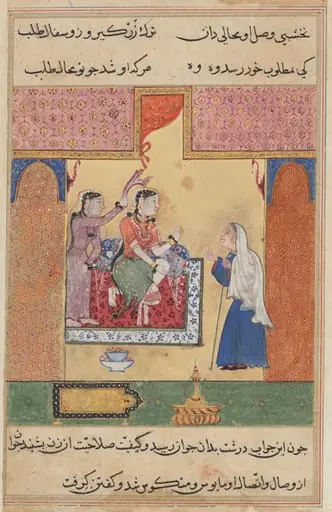 The old procuress conveys the young man’s message of love to Mansur’s wife, from a Tuti-nama (Tales of a Parrot: Seventeenth Night
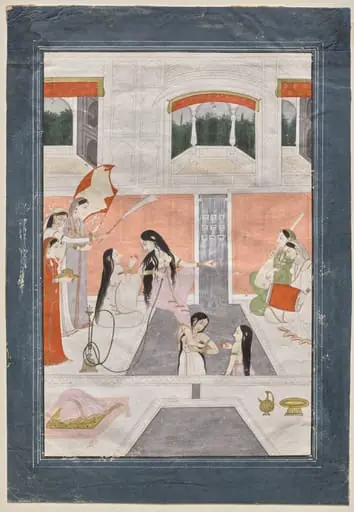 Palace women enjoy music by the side of a cascade
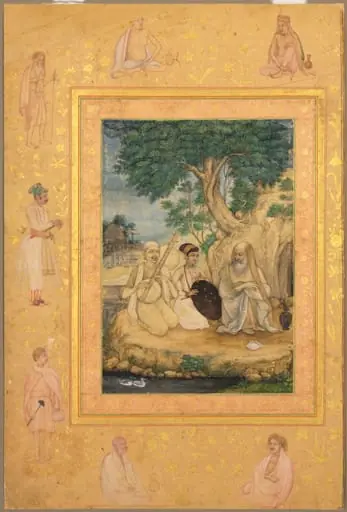 Prince and ascetics, from the Late Shah Jahan Album
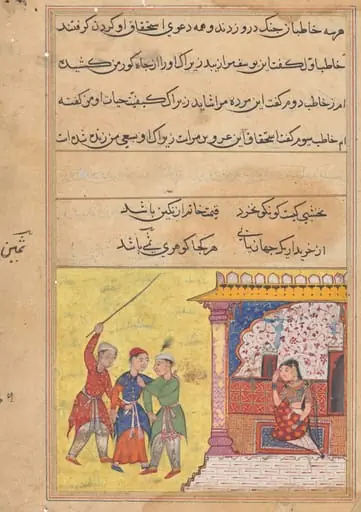 The three suitors again begin to quarrel among themselves for the hand of the devotee’s daughter, from a Tuti-nama (Tales of a Parrot): Twentieth Night
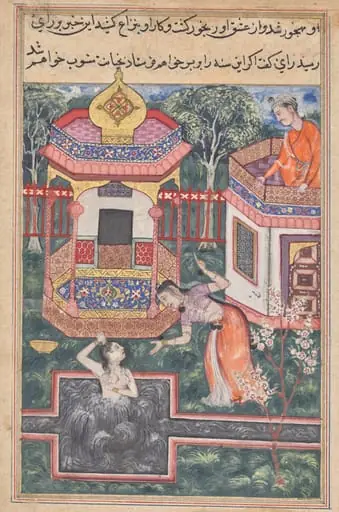 The son of the king of Babylon sees the Brahman transformed into a woman bathing and falls in love with her, from a Tuti-nama (Tales of a Parrot): Thirty-fifth Night
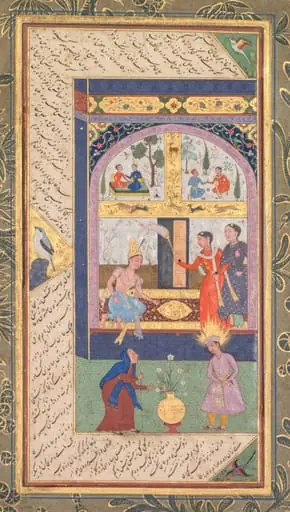 Zulaykha in her palace and as an elderly woman with Joseph (recto), from a Panj Ganj (Five Treasures) of Abd al- Rahman Jami (Persian, 1414–1492)