Artwork
Icoană pe carton, conținând o imagine centrală și un chenar dreptunghiular. Chenarul are fondul auriu și are pictat motive vegetale și florale. Scena din interior reprezintă o abordare originală a Răstignirii. Fondul este de culoare verde-gri (culoarea oului de rață). În partea de jos este iarbă de culoare verde deschis, nuanță caldă, iar între cele două nuanțe de verde este dispusă pe toată lungimea imaginii centrale o perdea de flăcări. În centrul imaginii este Iisus răstignit pe cruce, picioarele sunt bătute cu un singur cui, ceea ce indică faptul că este o icoană romano-catolică sau greco-catolică. La stânga, la dreapta și sub cruce sunt toate simbolurile patimilor și ale răstignirii. Sub cruce este craniul lui Adam, un șarpe, la botul căruia este "fructul oprit", de culoare roșie în pictură. La stânga crucii este un stâlp cu două postamente pătrate succesive, pe stâlp este un cocoș. De stâlp sunt legate cu o sfoară obiecte referitoare la Patimile lui Iisus: trestia cu care a fost batjocorit, o făclie, un bici și marama Sf. Veronica cu chipul Mântuitorului. Între stâlpi și cruce este un felinar. La dreapta crucii este o scară de care sunt sprijinite
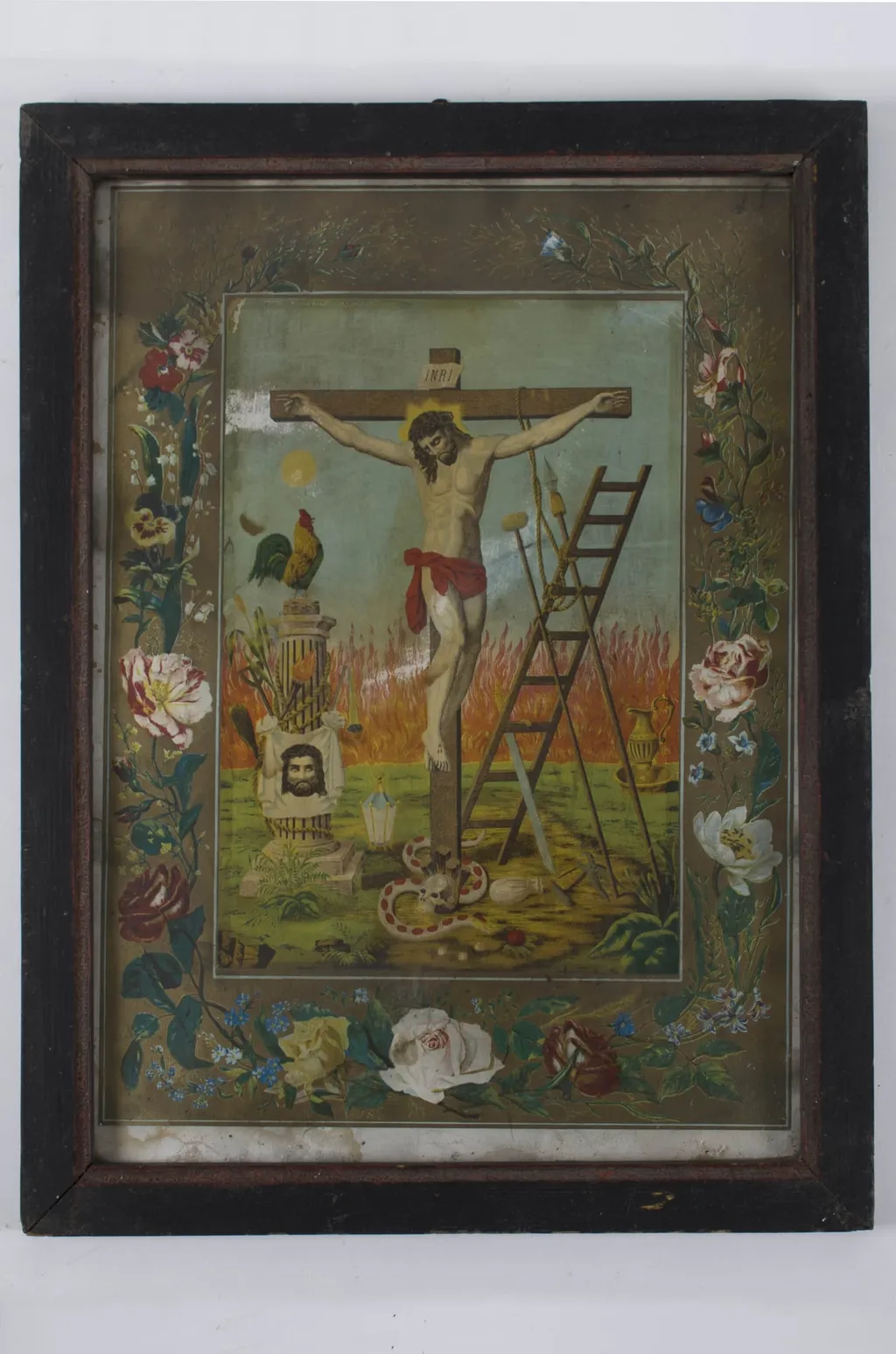
Icoană pe carton, conținând o imagine centrală și un chenar dreptunghiular. Chenarul are fondul auriu și are pictat motive vegetale și florale. Scena din interior reprezintă o abordare originală a Răstignirii. Fondul este de culoare verde-gri (culoarea oului de rață). În partea de jos este iarbă de culoare verde deschis, nuanță caldă, iar între cele două nuanțe de verde este dispusă pe toată lungimea imaginii centrale o perdea de flăcări. În centrul imaginii este Iisus răstignit pe cruce, picioarele sunt bătute cu un singur cui, ceea ce indică faptul că este o icoană romano-catolică sau greco-catolică. La stânga, la dreapta și sub cruce sunt toate simbolurile patimilor și ale răstignirii. Sub cruce este craniul lui Adam, un șarpe, la botul căruia este "fructul oprit", de culoare roșie în pictură. La stânga crucii este un stâlp cu două postamente pătrate succesive, pe stâlp este un cocoș. De stâlp sunt legate cu o sfoară obiecte referitoare la Patimile lui Iisus: trestia cu care a fost batjocorit, o făclie, un bici și marama Sf. Veronica cu chipul Mântuitorului. Între stâlpi și cruce este un felinar. La dreapta crucii este o scară de care sunt sprijinite is a drawing by Unknown. It dates from 1850 and is held in the collection of the ASTRA National Museum Complex. This devotional image is painted on cardboard, framed in a rectangular gold-ground border adorned with intricate floral and vine motifs.
About this work
Overview
This devotional image is painted on cardboard, framed in a rectangular gold-ground border adorned with intricate floral and vine motifs.
This devotional image is painted on cardboard, framed in a rectangular gold-ground border adorned with intricate floral and vine motifs. The central scene depicts the Crucifixion with unusual symbolic density, arranged around Christ’s cross. A green-gray background, resembling duck eggshell, contrasts with warm light green grass at the base, while a horizontal band of flames separates the earthly and divine planes.
Subject & Meaning
The composition centers on Christ nailed to the cross with a single nail through both feet, a detail common in Roman Catholic and Greek Catholic traditions. Beneath the cross lies Adam’s skull and a serpent gripping a red fruit, symbolizing the redemption of original sin. The rooster on its pillar recalls Peter’s denial, while the ladder and scattered tools signify the instruments of Christ’s Passion, reinforcing theological narratives of sacrifice and atonement.
Technique & Style
The artist employed tempera or similar pigments on cardboard, with careful layering to achieve subtle tonal shifts in the green backgrounds. The gold frame’s vegetal patterns are rendered in fine, linear detail, contrasting with the more expressive handling of the flames and symbolic objects. The use of a single nail for both feet, along with the precise placement of relics like the veil of Saint Veronica, reflects adherence to liturgical iconography rather than naturalism.
History & Provenance
The work likely originated in a region with strong Greek Catholic influence, possibly Transylvania or Moldavia, during the 17th or 18th century. Its cardboard support and protective glass backing suggest domestic or small chapel use rather than liturgical display. The dark brown wooden frame, intact and original, indicates careful preservation, though no documented provenance has been established beyond its regional stylistic traits.
Context
This image aligns with Eastern Christian traditions that integrated Western Passion symbols during periods of Catholic-Orthodox interaction. The inclusion of the red fruit, the rooster, and the veil of Veronica reflects a syncretic visual language, blending Byzantine iconographic structure with Latin devotional elements. Such works were often commissioned for private prayer, serving as meditative aids in households or monastic cells where liturgical art was accessible but not standardized.
Legacy
The piece exemplifies a localized, vernacular approach to sacred imagery that prioritized symbolic richness over formal hierarchy. Its survival with original frame and protective glazing offers rare insight into domestic religious practice in Eastern Europe. While not widely reproduced, it contributes to understanding how regional communities adapted broader theological narratives into intimate, materially modest devotional objects.
Artist & collection

 Domestic Scene
 Giacomo and Cardinal Marco, investing Andrea, Abbot of San Zeno, with his Benefice
 The Nymph of Fontainebleau
 Portrait of a Woman
 Madonna and Child with Saints in the Enclosed Garden
 Venus and Minerva
 Family Group of Four on Sofa
 Wall painting from Room H of the Villa of P. Fannius Synistor at Boscoreale
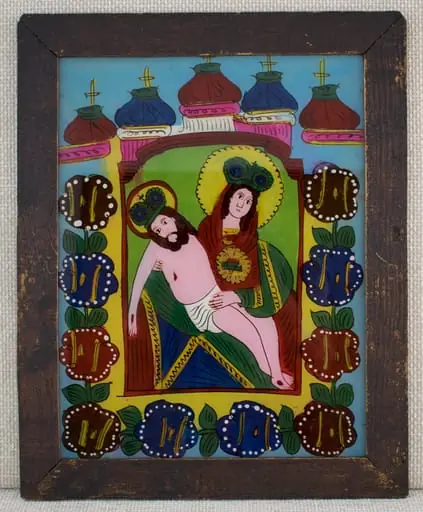 Temă de insiprație catolică foarte rar întâlnită în pictura pe sticlă din Transilvania, corespondentul scenei plângerii, a prohodului. Desenul este executat probabil fără tipar, într-un stil naiv, cu un instrument de scris cu cerneala.Culorile sunt stridente, dar se observă o oarecare măiestrie.Pietà este o pictură care o reprezintă pe Madona ținându-și fiul mort pe genunchi sau în brațe. Există numeroase reprezentări plastice ale scenei „Pietà”.Central, pe un fond verde deschis, este redată Fecioara Maria ținând pe brațe trupul lui Isus după ce a fost coborât de pe cruce. Amândoi au coroane mari împărătești, bipartite, de culoare verde, proiectate ă fondul nimbului galben mărginit de o linie roșie la Isus, dantelat la Maică. Ochii mari, deschiși. Fecioara are părul creț, castaniu, Este înveșmântată cu un veșmât policrom/roșu, verde și albastru)pe pe piept fiind redată sfânta inimă(a lui Isus) într-un cerc incandescent galben. Isus are corpul diform, poartă un veșmânt alb în jurul mijlocului. Pe membre și coastă se văd urmele supliciului. Carnația este roz.Scena este încadrată de o zonă galbenă, urmată de chenarul lat, specific: laturile inferioare - flori mari pe fond albastru, în partea de sus de 5 turle de biserici inspirate din pictura rusească.Florile chenarului sunt rotunde, de culoare bleumarin, grena, roșie, cu șirururi de puncte albe și lini galbene, frunzele mici, verzi, câmpul chenarului albastru bleu. Paleta cromatică variată, culorile stridente. Pe spate a avut lipită o hârtie mai groasă care servea drept dos. Rama este simplă, din lemn de brad prelucrat rudimentar, de culoare cafenie.
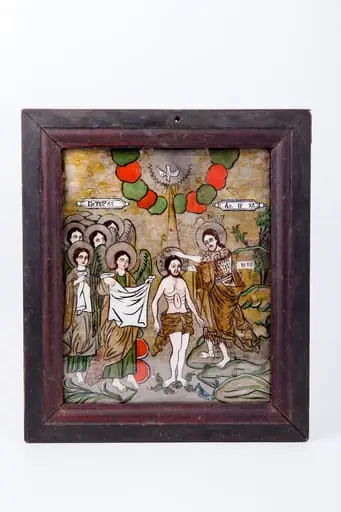 Domnul Iisus Hristos primește Botezul, în râul Iordanului, din partea Sfântului Mare Prooroc și Înaintemergător Ioan Botezătorul, care se află în stânga Mântuitorului. Mântuitorul este înfășurat cu o pânză de culoare brună-bronzie împrejurul șoldurilor și a coapselor. În dreapta Lui, este un grup de îngeri evlavioși, care Îl așteaptă cu două ștergare albe gata să înveșmânteze Trupul Domnului. Sfântul Ioan Botezătorul este îmbrăcat cu o mantie brună-bronzie și un himation alb-brun sau o haină din păr de cămilă. Cerurile de culoare brun-gri-aurie sunt deschise și izvorăște o rază de lumină, pe care se pogoară porumbelul, simbolul Sfântului Duh, pe creștetul Mântuitorului. Mandorla de nouri rotunzi, care permite deschiderea Cerurilor au o alternanță cromatică de roșu-vermillon și verde. Cromatica este specifică Țării Făgărașului: auriu, roșu vermillon, verde kaki, bej, gri, ocru, brun-nisipiu, alb, negru. Inscripția din româno-chirilică se traduce Botezul IC XC Iisus Hristos Ioan. Icoana este datată 1868 și este atribuită lui Savu Moga, din Arpașu de Sus, Țara Făgărașului.
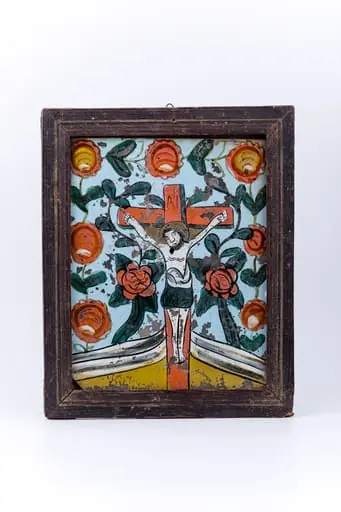 Mântuitorul Iisus Hristos, fiind răstignit pe Cruce, are în dreapta și în stânga câte o floare mare roșie vermillon, cu frunze gri-antracit, înlocuind stilizat și semantic pe ucenicul cel iubit, care a stat lipit de pieptul Învățătorului, la Cina cea de Taină, mai precis, pe Sfântul Apostol și Evanghelist Ioan Teologul, Evanghelistul Iubirii și pe Maica Domnului Îndurerată, Jalnică și Plângătoare. Mântuitorul Iisus Hristos are o țesătură gri, înspre negru-gri-antracit în jurul mijlocului și a coapselor. În registrul inferior, paralel cu Crucea sunt și lujere foarte înalte cu flori mari, elemente geometrizante și fitomorfe, care înlocuiesc prezența ucenicilor și martorilor la suferință. Fondul icoanei este cerul albastru bleu-ciel ceruleum senin, împodobit cu elemente stilizate florale. În registrul inferior este un câmp luminos de galben-chihlimbar. Întreaga compoziție iconografică este încadrată de un chenar fitomorf, format dintr-o ghirlandă bogată de ruje roșii vermillon, cu miezul galben - 7 ruje, cu frunze gri-albăstrii. Astfel imaginea iconografică este o preînchipuire a Grădinii Raiului. Cromatica este armonioasă: roșu vermillon, albastru bleu-ciel ceruleum, verde-brad forest și smarald, galben chihlimbar, ocru-muștar, alb, negru. Inscripția din româno-chirilică de pe Cruce se traduce INRI Iisus Nazarineanul Regele iudeilor. Icoana este din Nordul Transilvaniei, Nicula.
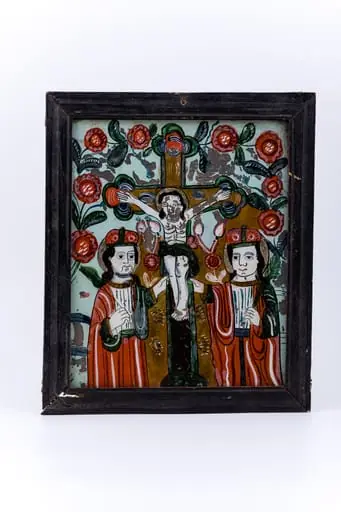 Mântuitorul Iisus Hristos, fiind răstignit pe Cruce, are în dreapta pe Sfântul Împărat Constantin cel Mare, în locul uceniculuil cel iubit, care a stat lipit de pieptul Învățătorului, la Cina cea de Taină, mai precis, în locul Sfântului Apostol și Evanghelist Ioan Teologul, Evanghelistul Iubirii și în stânga pe Sfânta Împărăteasă Elena, mama Sfântului Constantin, în locul Maicii Domnului Îndurerate, Jalnică și Plângătoare. Veșmintele Sfinților Împărați sunt sacosuri albe, cu dungi albastre-verzi și mantii roșii vermillon, cu mânecile largi și verzi. Mântuitorul Iisus Hristos Răstignit pe Cruce are o țesătură verde-forest în jurul mijlocului și a coapselor. Fondul icoanei este cerul albastru bleu-ciel înspre alburiu senin și deschis, în registrul superior și galben-chihlimbar, în spatele Crucii, un spațiu galben-solar, prefigurând Lumina Învierii Domnului Iisus Hristos. Întreaga tematică iconografică este încadrată de un chenar decorativ fitomorf, format dintr-o ghirlandă de bujori și trandafiri, 10 ruje. Cromatica este armonioasă: roșu vermillon, albastru bleu-ciel, albastru cobalt, gri antracit, galben-chihlimbar, verde forest, alb zinc, negru. Icoana este mai rară, datorită abordării tematicii iconografice. Icoana este din Nordul Transilvaniei, Nicula.
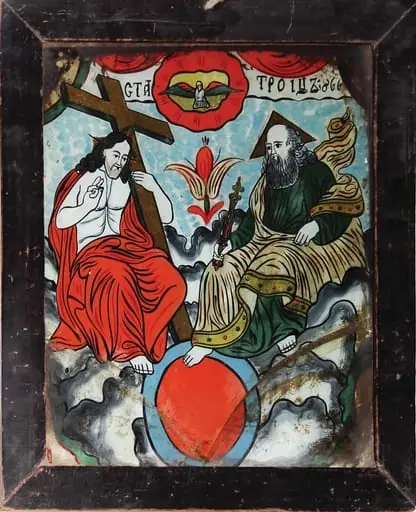 Sfânta Treime nou-testamentară
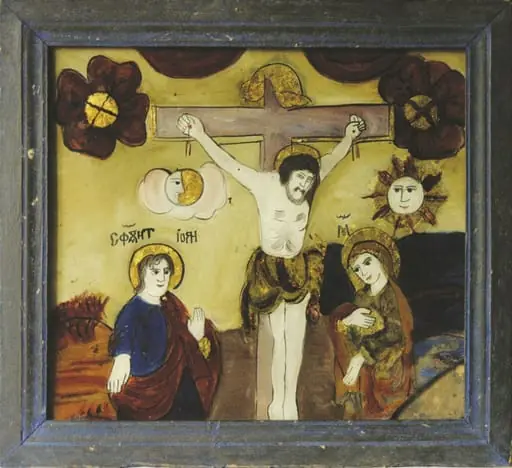 Răstignirea lui Iisus
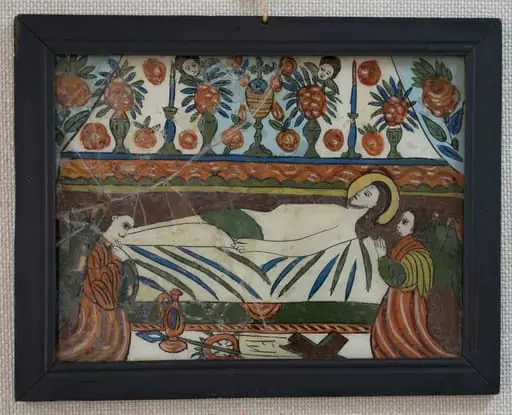 Icoana este pictată după un model central european, influența apuseană fiind evidentă. În prim plan, Isus redat din profil, întins pe un catafalc acoperit cu un giulgiu alb. Părul lung castaniu, ochii închiși, barba scurtă, redarea anatomiei diferită de specificul transilvan. Nimb simplu, umplut cu bronz auriu. Mijlocul este înfășurat cu un veșmânt verde, mâinile întinse pe lângă corp. În prim plan, la capetele catafalcului, câte un înger îngenuncheat, redat din profil. Îngerii au fețele diforme, veșminte roșii, aripi verzi. În spațiul dintre ei, în fața catafalcului se află o amforă, o lance, cununa de spini și o cruce cu inscriția INRI(probabil). În partea superioară a compoziției- planul doi, pe un postament decorat cu unda apei(iconarul a introdus motive familiare în redarea glacială apuseană), un potir cu o cruce, două lumânări în sfeșnice, intercalate cu vase cu flori, decor floral pe fond bleu/ alb; doi heruvimi hilari printre flori. În colțurile superioare- trandafiri roșii pe fond bleu. Compoziția echilibrată, naivă dar atent executată, desenul îngrijit, redarea chipurilor forțată, stângace, paleta cromatică bogată, culorile vii, intense, în dezacord cu tema. Rama, baghetată, profilată, realizată din patru șipci de brad îmbinate oblic la colțuri, de culoare neagră. Stratul pictural prezintă spart, pelicula de culoare în stare bună.