Artwork
Icoana îl reprezintă pe cuviosul Stelian în ipostaza consacrată: îmbrăcat în haine monahale, de factură athonită, ținînd în brațe, pe mâna dreaptă, un prunc înfășat în scutece, având aureolă(uneori pruncul apare cu însemnele lui Hrisos). Sfântul privește către prunc, mustățile și barba lungi, albe, chipul bine proporționat, ochii mari, expresivi, trăsăturile ușor vălurite, estompate.. Aureolele mari, după restaurare pictate cu galben, chenar roșu. Fond culoare verde crom, chenar îngust. Icoana a fost restaurată.
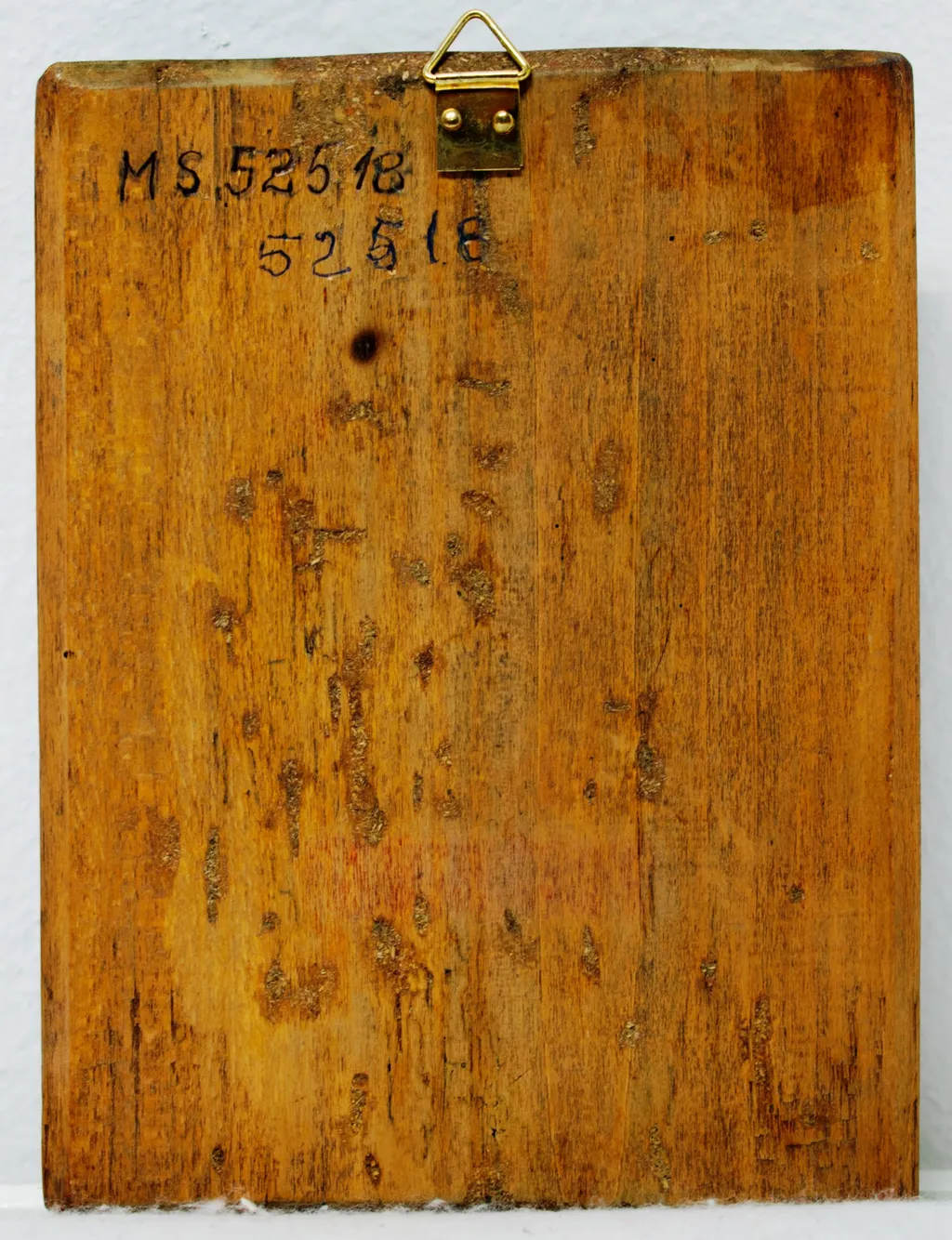
Icoana îl reprezintă pe cuviosul Stelian în ipostaza consacrată: îmbrăcat în haine monahale, de factură athonită, ținînd în brațe, pe mâna dreaptă, un prunc înfășat în scutece, având aureolă(uneori pruncul apare cu însemnele lui Hrisos). Sfântul privește către prunc, mustățile și barba lungi, albe, chipul bine proporționat, ochii mari, expresivi, trăsăturile ușor vălurite, estompate.. Aureolele mari, după restaurare pictate cu galben, chenar roșu. Fond culoare verde crom, chenar îngust. Icoana a fost restaurată. is a drawing by Unknown. It dates from 1850 and is held in the collection of the "Dimitrie Gusti" National Village Museum. This wooden panel serves as the reverse support for a religious icon depicting Saint Stelian, a venerated monastic figure.
About this work
Overview
This wooden panel serves as the reverse support for a religious icon depicting Saint Stelian, a venerated monastic figure.
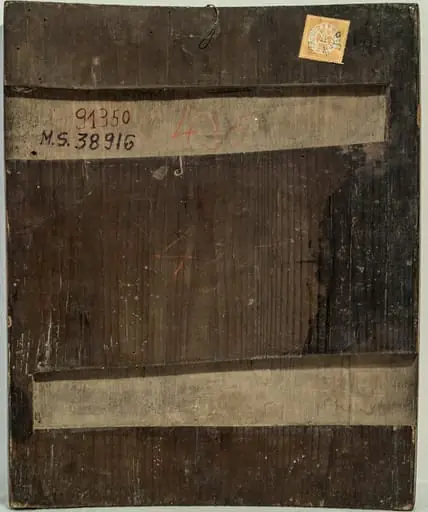
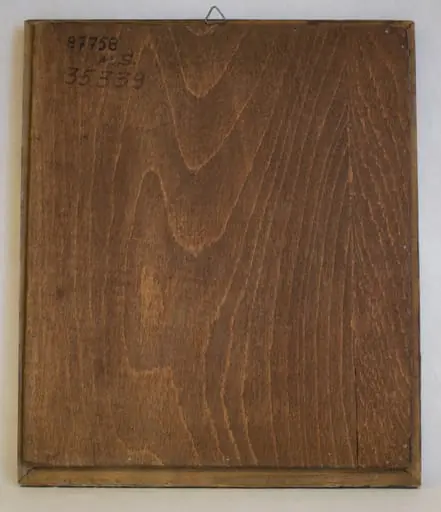
This wooden panel serves as the reverse support for a religious icon depicting Saint Stelian, a venerated monastic figure. The front surface, now missing, once bore a painted representation of the saint holding the Christ Child. The back retains traces of its original use: light brown wood with dark inclusions and a small metal fastener at the top, likely for securing the icon within a protective frame or case.
Subject & Meaning
The icon portrays Saint Stelian as a monastic elder, clad in Athonite robes, cradling the infant Christ, who is rendered with a halo and sometimes marked with symbols of divinity. The saint’s long white beard and expressive eyes convey spiritual authority and tenderness. His gaze toward the child underscores the theological theme of divine incarnation, emphasizing the saint’s role as witness and guardian of the mystery of Christ’s humanity.
Technique & Style
The original painting followed the Byzantine tradition, with stylized facial features, soft modeling of contours, and a restrained palette. Aureoles were rendered in gold and outlined in red, set against a green chromatic background. The figures exhibit delicate tonal transitions and serene proportions, typical of post-Byzantine iconography from monastic workshops. The restoration preserved these elements while reinforcing structural integrity.
History & Provenance
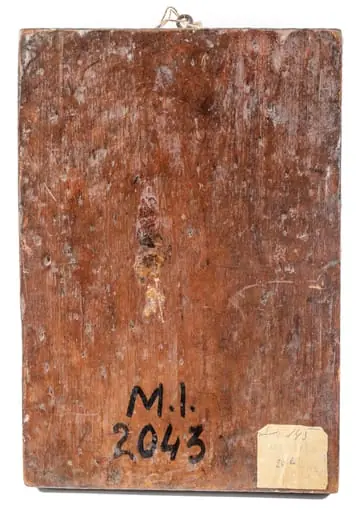
The icon underwent restoration, suggesting it was once in active liturgical use and later preserved as a cultural artifact. The numbers inked on the reverse likely served as inventory or workshop markings, though their precise function remains undocumented. Its presence in the Museum of Ethnography indicates it was collected as part of a broader effort to preserve religious material culture from Eastern European communities.
Context
Icons of Saint Stelian were common in Romanian Orthodox regions, particularly in Moldavia and Transylvania, where monastic traditions emphasized ascetic piety and the veneration of holy elders. The Athonite style of drapery and composition reflects influence from Mount Athos, a center of Orthodox iconography. Such icons were often displayed in home chapels or parish churches, serving as focal points for prayer and devotion.
Legacy
Though the painted surface is no longer visible, the wooden backing preserves evidence of the icon’s physical history and handling. Its survival offers insight into the material practices of religious art in Eastern Europe—how icons were constructed, stored, and maintained. The panel stands as a silent witness to centuries of devotion, now contextualized within a museum’s ethnographic mission.
Artist & collection
Museum
"Dimitrie Gusti" National Village Museum
Continue through works from the same source collection.
 Domestic Scene
 Giacomo and Cardinal Marco, investing Andrea, Abbot of San Zeno, with his Benefice
 The Nymph of Fontainebleau
 Portrait of a Woman
 Madonna and Child with Saints in the Enclosed Garden
 Venus and Minerva
 Family Group of Four on Sofa
 Wall painting from Room H of the Villa of P. Fannius Synistor at Boscoreale
 Icoa
Icoa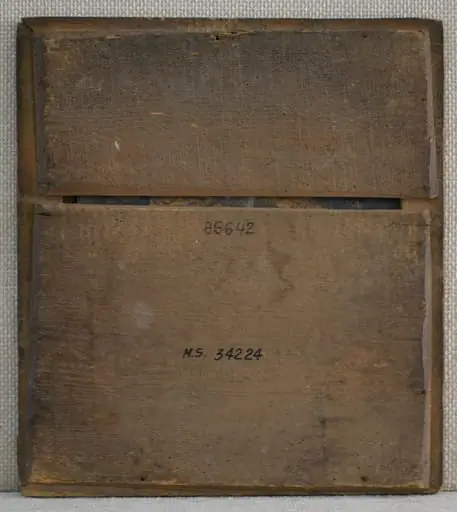 Icoana este pictată pe dosul unei bucăți de glajă de formă dreptunghiulară în ax vertical. Sfântul Nicolae este redat în prim plan, așezat pe un tron, ținînd Evanghelia închisă în mâna stângă în timp ce cu dreapta binecuvintează. Sfântul Nicolae este înveșmântat ca Mare Arhiereu, cu mitră înaltă, bipartită, omofor mare, verde, decorat cu cruci "patee", sacos roșu cărămiziu cu galon auriu cu motiv spiralat, stihar roșu. De mâna dreaptă îi atârnă bedernița, percepută ca decor al veșmântului. Chipul este sobru, barba albă,scurtă,la fel părul scurt, ondulat. Ochii sunt negri, bine definiți, arcadele evidențiate. Nimb auriu. Tronul, cu spătarul înalt, are marginea aurită realizată în trepte(surmontatea de câte o cruce) și decorată cu motiv spiralat. Spătarul este alb, decorat cu o rețea de linii negre dublate cu bleu, întretăiate. În colțurile de sus câte un serafim pe nori. Câmpul verde intens în partea de jos, până la nivelul jilțului, albastru de Prusia în registrul superior. Desenul este îngrijit, compoziția aglomerată, paleta cromatică variată, culorile tari, Inscripția cu negru în partea de sus, greu vizibilă. Rama, din lemn de brad băițuit, este alcătuită din patru șipci profilate pe o porțiune mică spre interior, îmbinate oblic la colțuri, decorată cu un motiv ușor ondulat, imitînd fibra lemnului, dispus oblic. Dos din scândurele subțiri de brad, dispuse orizonal și fixate în cuie.
 Icoambla
 Sfânta Paraschiva încoronată este reprezentată frontal, 3/4, Nimbul trasat cu roșu depășește linia chenarului și partea superioară a coroanei. Tehnica iluminării treptate cu elemente specifice: accentuarea zonei ochilor, tonurile de pământ ale umbrelor. Tunica decorată cu motive fitomorfe ample incizate în stratul de foiță. Mantie închisă în față, cu decor linar și bordură lată cu motive geometrice 3 șiruri de incizii în grund). Pe cap, umeri lăsat pe spate, un maforion de culoare deschisă. În mâna dreaptă, Sfânta ține o cruce mică, rusească, (6 brațe)în stânga un rotulus desfășurat cu inscripția scrisă în limba slavonă: Cred în unul Dumnezeu… alte inscripții: pe chenar de o parte și de alta a nimbului: Chipul Sf. Mucenițe Parascheva Vineri, în colțul stâng al icoanei ѾOН pe nimbul cruciger al lui Iisus, reprezentat ca pe sfântul Keramion. Cromatica: Chenar roșu cu două linii galbene și mărginit cu brun; fond - foița metalică decorată prin incizare, cu chenar multiplu din motive geometrice reteate. Tip Krashnuskha. Pe spate, un timbru al miliței RPR.
 Sfinții trei ierarhi: Vasilie cel Mare, Ioan Gură de Aur, Grigorie Teologul
 Icoari.
 Răstignirea lui Iisus Hristos plasată pe un câmp central sub formă de cruce, împarte spațiul pictural în patru casete dreptunghiulare, Iisus Hristos răstignit pe crucea cu 6 brațe (specifică ortodoxiei ruse), cu un veșmânt alb în jurul mijlocului, ochii închișiNimbul cu inscripțiile consacrate. La baza crucii, sugerat dealul Golgota și craniul lui Adam. Pe latura de sus un nor cu inscripția XC Cele 4 casete conțin următoarele scene: Stânga sus Maica Domnului cu Pruncul tipul Kazanskaia. Este reprezentată până la piept, nu se văd mâinile. Capul ușor înclinat spre Prunc. Maforion roșu, pe frunte și pe umeri stelele Fecioriei, albe, discrete.Iisus – Emanuel, binecuvintează cu dreapta, nimbul cruciger. Chiton albastru și himationgalben. Dreapta sus - Sf. Nicolae în veșminte de arhiereu, cărunt, cu barba rotundă capul descoperit. Nu se văd mâinile.. Înveșmântat cu sacos roșu cu drapaj galben, omofor lat, închis la culoare. Stânga jos - Sf. Gheorghe, oștean, călare pe un cal alb în poziție cambrată.Înfige, cu ambele mâini, sulița în gura balaurului, redat aici ca un șarpe negru, subțire. În oglindă, sfântul mucenic Dimitrie, în veșminte identice, călare pe un cal negru, cu o suliță în mâini. Fondul: brun pentru scena centrală, scenele de sus: brun roșcat, cu o bandă îngustă, aurită sus, niburile cu linie albă, scenele de jos: inferior bandă brună, pământul cu galben, cerul - verde închis, nimburile galbene cu linie discretă, albă pe margine. Chenarul marginal specific icoanelor tip krasnushka.Inscripții caligrafice cu negru. Inscripții cu llitere negre, caligrafice la scenele de sus, alb central. Caracter popular
 "Isea d
 Icoaerel
 Icoaori