Artwork
Judecata de Apoi
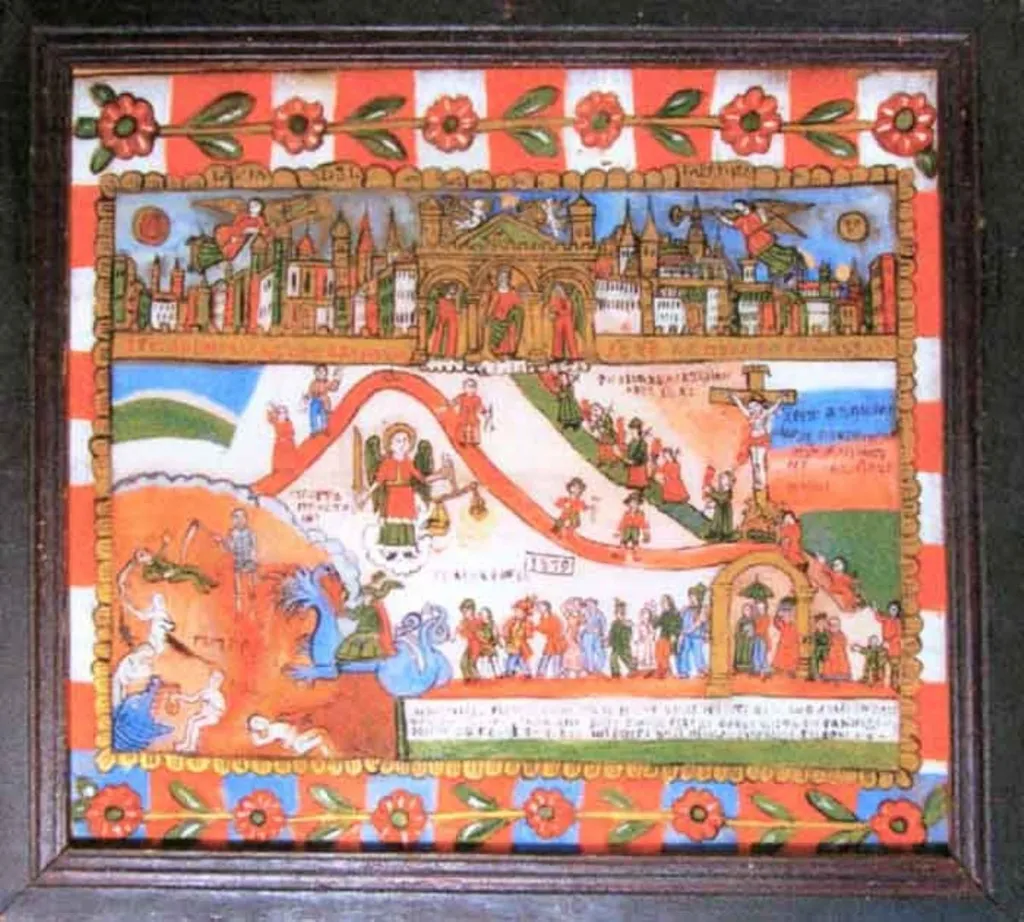
Judecata de Apoi is a drawing by the Impressionist artist Unknown. It dates from 1879 and is held in the collection of the Romanian Peasant Museum. This work is a colored drawing held by the Museum of Ethnography, composed with red, white, blue, and green pigments.
About this work
Overview
The central scene dominates the composition, featuring a group of figures beneath a large archway, surrounded by smaller surrounding episodes.
This work is a colored drawing held by the Museum of Ethnography, composed with red, white, blue, and green pigments. It presents multiple vignettes arranged within a decorative border of flora. The central scene dominates the composition, featuring a group of figures beneath a large archway, surrounded by smaller surrounding episodes. The background remains largely uncluttered, with subtle color accents enhancing spatial depth without overwhelming the detail.
Subject & Meaning
The central scene depicts a gathering of individuals in historical attire, some holding objects that suggest ritual or civic roles. Surrounding vignettes include architectural elements and floral motifs, possibly symbolizing community, tradition, or seasonal cycles. The arrangement implies a narrative sequence, though no single story is clearly defined. The imagery likely reflects cultural practices or communal events from a specific regional tradition, rendered with symbolic rather than literal precision.
Technique & Style
Executed in colored drawing, the work employs flat, unmodulated hues with minimal shading. Lines are deliberate and clear, defining figures and structures without illusionistic depth. The border of leaves and flowers frames the composition like a textile pattern, reinforcing its connection to folk or ceremonial art. The style prioritizes symbolic clarity over naturalism, aligning with traditions where visual storytelling serves cultural memory rather than optical realism.
History & Provenance
The piece resides in the Museum of Ethnography, indicating its classification as a cultural artifact rather than a fine art object. Its origin is not documented in the provided details, but its form and iconography suggest it was created within a local or regional tradition, possibly as part of a ceremonial object, manuscript, or decorative panel. Its preservation in an ethnographic collection implies it was collected for its anthropological significance.
Context
The imagery aligns with folk traditions in which communal rituals, festivals, or civic gatherings are visually recorded through symbolic representation. The archway may denote a threshold—between sacred and secular, or past and present—while the floral border echoes motifs found in embroidery or folk architecture. The work likely emerged from a community where visual symbols conveyed shared values, passed down through generations without written records.
Legacy
As a preserved example of vernacular visual culture, the drawing contributes to understanding how non-literate communities encoded social memory through imagery. Its presence in an ethnographic museum underscores its role as a record of lived tradition rather than artistic innovation. It remains a quiet testament to the ways ordinary people used color and form to affirm identity, continuity, and collective meaning.
Artist & collection

 Domestic Scene
 Giacomo and Cardinal Marco, investing Andrea, Abbot of San Zeno, with his Benefice
 The Nymph of Fontainebleau
 Portrait of a Woman
 Madonna and Child with Saints in the Enclosed Garden
 Venus and Minerva
 Family Group of Four on Sofa
 Wall painting from Room H of the Villa of P. Fannius Synistor at Boscoreale
 Înfricoșătoarea judecată de apoi
 Înficoșătoarea Judecată de Apoi
 Judecata de Apoi
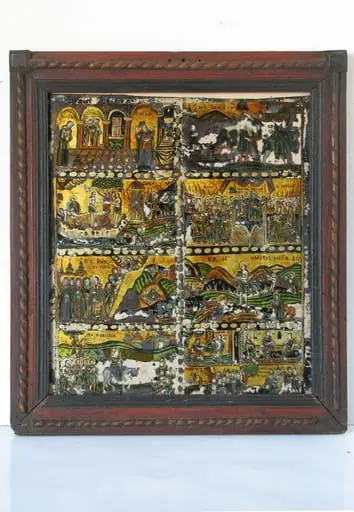 Prăznicar cu Sărbătorile Triodului
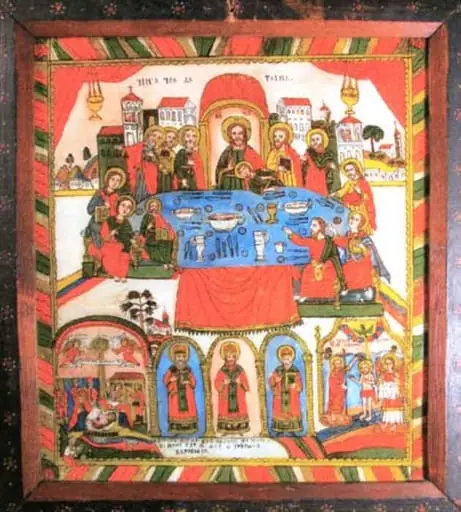 Cina cea de Taină
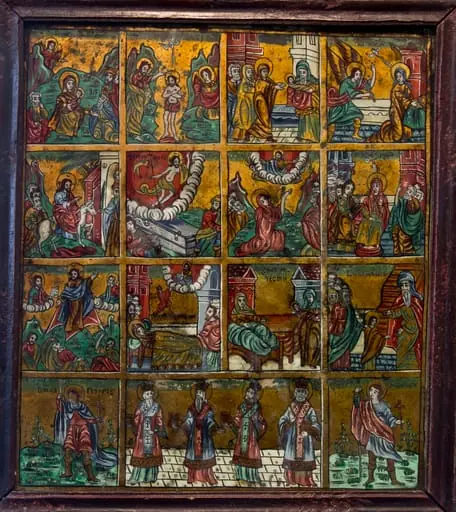 Prăznicar – Scene din viața lui Iisus
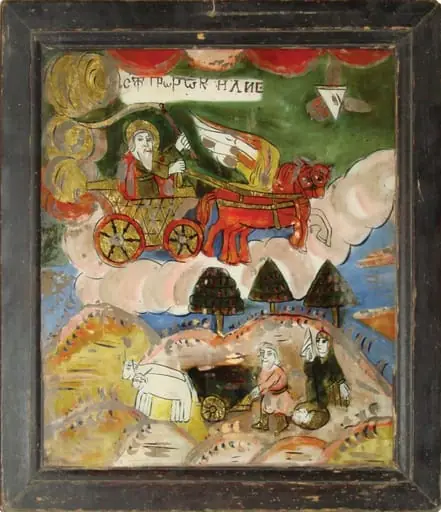 Sf. Prooroc Ilie
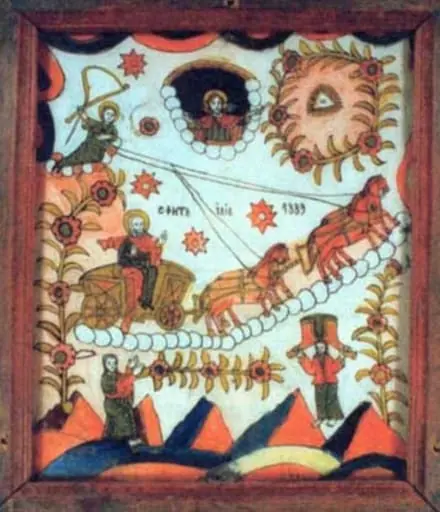 Sfântul Ilie
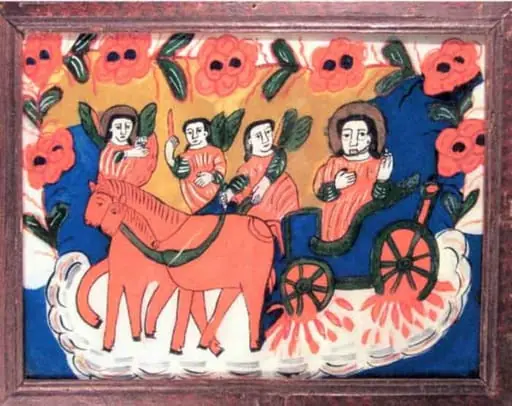 Sfântul Ilie
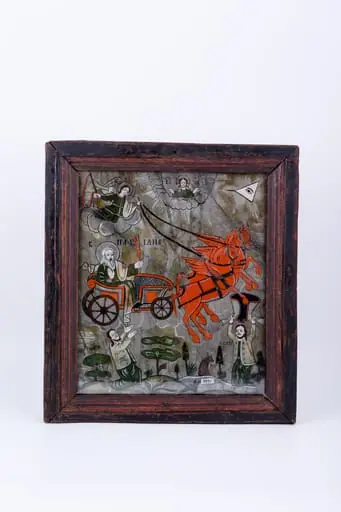 Icoana îl reprezintă pe Sfântul Mare Prooroc Ilie Tesviteanul, traversând Cerurile, în carul de foc, tras de doi cai roșii. Sfântul este îmbrăcat în straie brun-kaki și mantie brună-ocru și Îngerul din spate mână caii cu aripile roșii. Chipul Sfântului Ilie este unul ascetic, asemenea Sfântului Ioan Botezătorul. În registrul inferior sunt Sfântul Prooroc Elisei, ucenicul Sfântului Ilie, care prinde cojocul aruncat și un țăran plugar, care se ține de carul de foc al sfântului prooroc. Asemenea țăranului plugar, care ară pământul, așa și Sfântul Ilie Tesviteanul ară Cerurile cu carul de foc. În registrul superior este Dumnezeu-Tatăl, care binecuvântează și Îngerul care ține hățurile cailor. În colțul din dreapta este Ochiul Divin înscris în triunghiul Sfintei Treimi. Între registre există comunicare și interferență, atât semantică, cât și cromatică. Compoziția este amplă, dezvoltată pe registre și relații între personaje. Cromatica este armonioasă: roșu vermillon și sângeriu, verde kaki, verde mușchi-de-pădure, gri, nisipiu, ocru, bronziu, alb și negru. Inscripția din româno-chirilică se traduce IC XC Iisus Hristos Sf Proroc Ilie Elisei. Icoana aparține lui Savu Moga, din Arpașu de Sus, Țara Făgărașului. Icoana este datată 1859.