Artwork
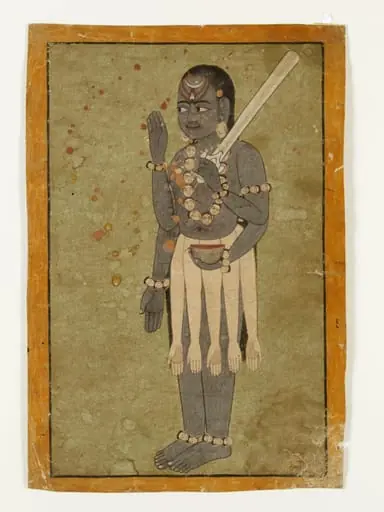
Khadgaroma, Son of Ravana
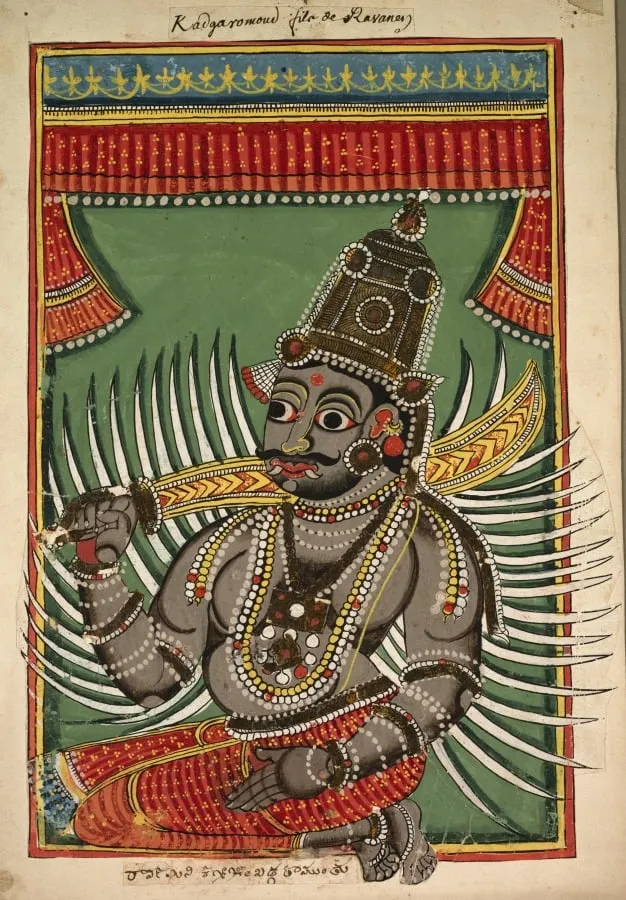
Khadgaroma, Son of Ravana is an unspecified painting by the Baroque artist Unknown. It dates from 1720 and is held in the collection of the Cleveland Museum of Art.
About this work
Overview
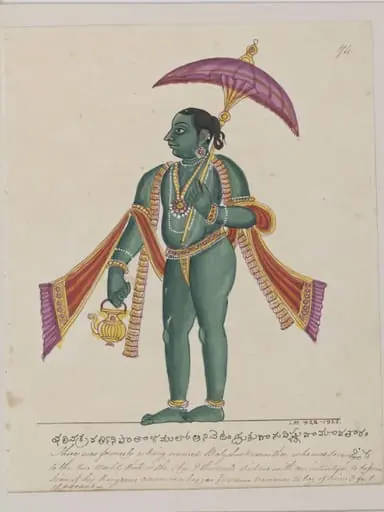
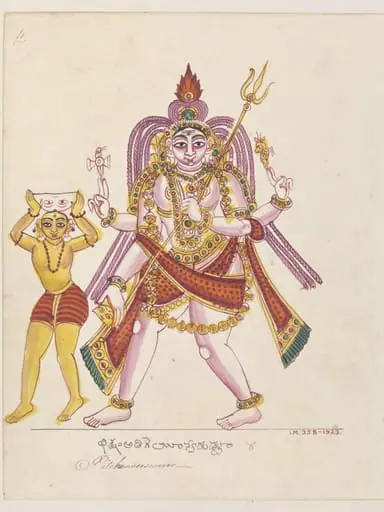
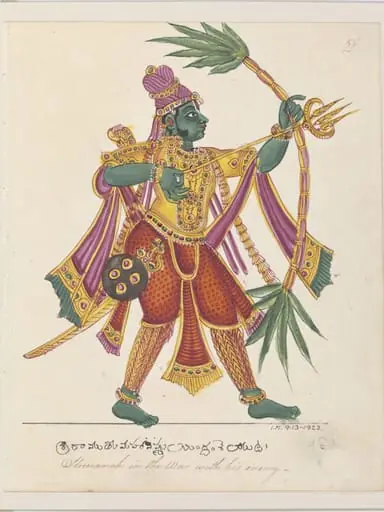
The work depicts a demonic figure whose body is encrusted with innumerable tiny blades, giving the impression that his skin itself is weaponry. He stands against an unadorned backdrop, his hair rendered as a jagged mass, and grips a broad, curved sword in his right hand, emphasizing his martial nature.
Subject & Meaning
The figure is identified as Khadgaroma, son of the mythic Ravana, a name that translates to “he whose body hair is swords.” The profusion of blades across his form visually reinforces this epithet, while the prominent sword underscores his preferred armament within the narrative tradition.
Technique & Style
Executed in a traditional southern Indian illustrative manner, the painting employs flat coloration and linear detailing to render the demon’s armor‑like flesh. The composition is straightforward, with the central figure isolated, allowing the intricate pattern of blades and the curving sword to dominate the visual field.
History & Provenance
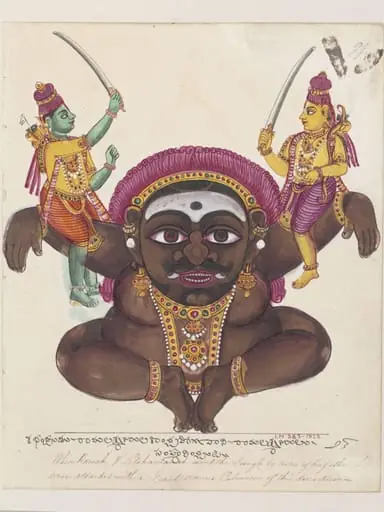
The lower margin bears an inscription in Telugu naming the demon; a portion of this text was pasted upside down, suggesting the later handler could not read the script. Above it, a French translation appears, indicating the piece passed through a French‑controlled region of southern India between 1692 and 1761.
Context
Originating from an illustrated storybook of Andhra Pradesh, the image reflects regional conventions for portraying supernatural beings. Such depictions often combine elaborate weaponry with stylized physiognomy to convey the character’s mythic attributes, aligning with broader South Indian visual narratives of gods and demons.
Artist & collection

 Domestic Scene
 Giacomo and Cardinal Marco, investing Andrea, Abbot of San Zeno, with his Benefice
 The Nymph of Fontainebleau
 Portrait of a Woman
 Madonna and Child with Saints in the Enclosed Garden
 Venus and Minerva
 Family Group of Four on Sofa
 Wall painting from Room H of the Villa of P. Fannius Synistor at Boscoreale