Artwork
Krishna
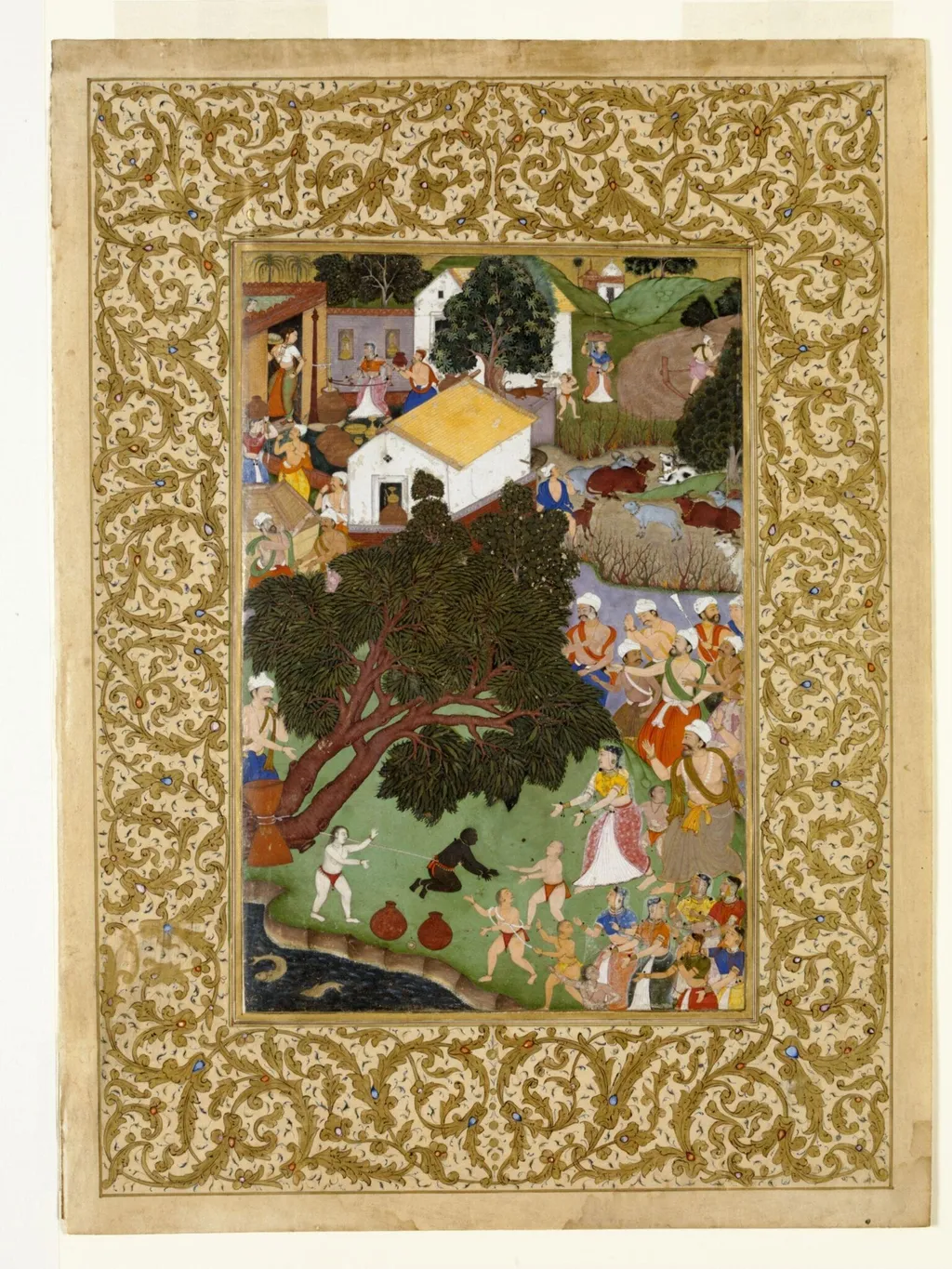
Krishna is a paint painting by the Mughal Painting artist Unknown. It dates from 1590 and is held in the collection of the Victoria and Albert Museum.
About this work
Overview
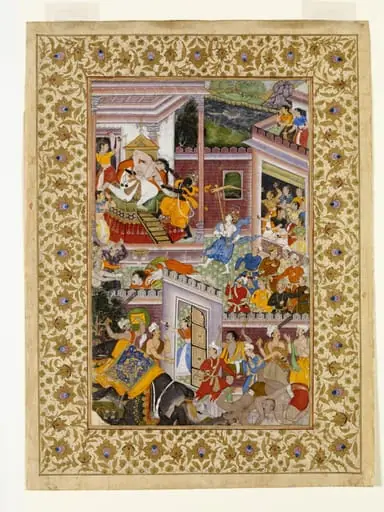
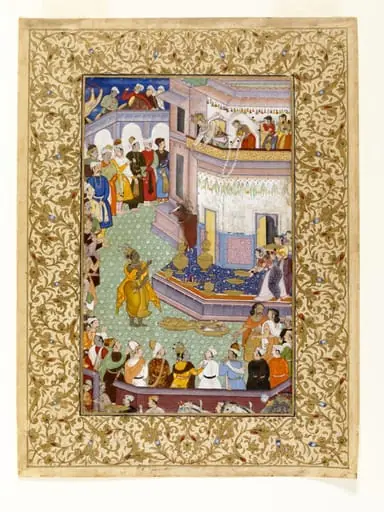
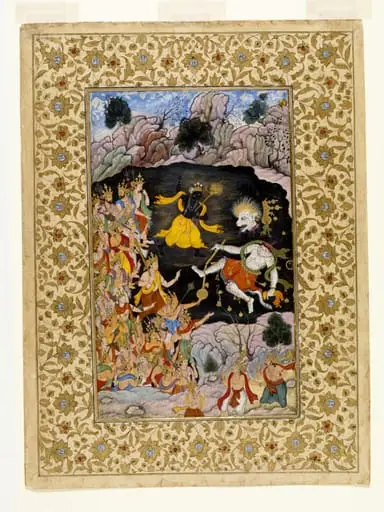
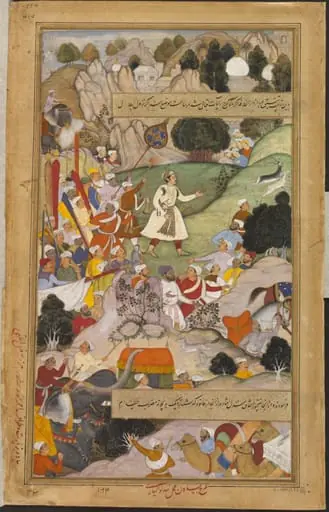
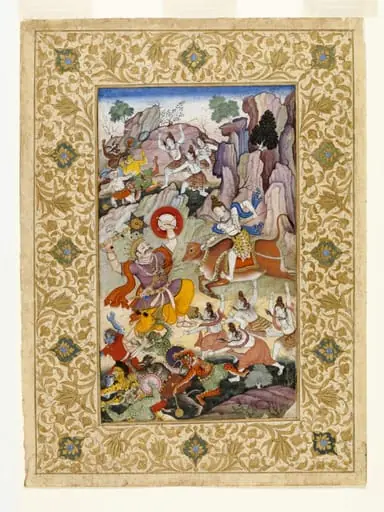
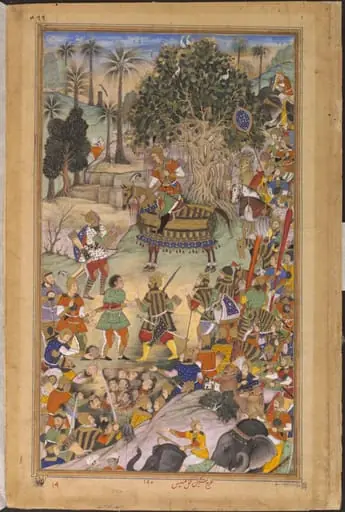
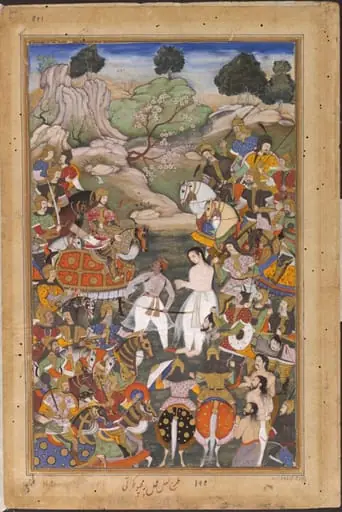
It illustrates a episode from the Harivamsa, a supplementary text to the Mahabharata, which was rendered as the Razmnama for Emperor Akbar’s court.
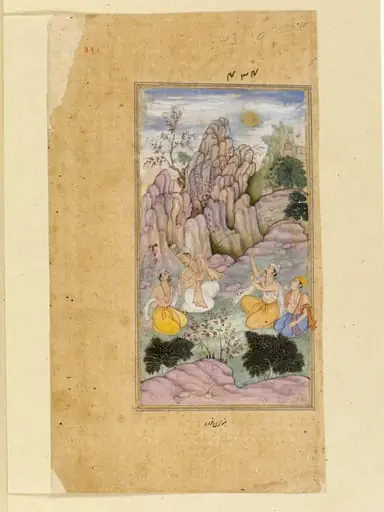
This painting was created in the Mughal royal atelier during the 1580s as part of a commissioned project to translate Hindu epics into Persian. It illustrates a episode from the Harivamsa, a supplementary text to the Mahabharata, which was rendered as the Razmnama for Emperor Akbar’s court. Though originally bound in a manuscript, its folios were later separated and remounted in an 18th-century album, likely in Lucknow, with ornate borders added for display.
Subject & Meaning
The scene depicts the infant Krishna, identified by his blue skin, breaking free from a tether tied by his foster-mother Yasoda. As he drags a heavy mortar, he uproots two trees, revealing them to be the cursed demigods Nalakuvera and Manigriva. Their liberation from the curse, triggered by Krishna’s divine action, underscores themes of grace and redemption. The surrounding villagers react with awe, while ordinary life continues, emphasizing the coexistence of the sacred and the mundane.
Technique & Style
The work reflects the refined Mughal miniature tradition, blending Persian precision with Indian narrative detail. Figures are rendered with delicate linework and subtle modeling, using layered pigments to suggest volume and depth. While not strictly chiaroscuro, the painting employs soft gradations of light and shadow to define form, particularly in the folds of garments and the contours of bodies, enhancing the scene’s quiet drama without overt theatricality.
History & Provenance
The painting originated in the imperial workshop around 1590 as part of a deluxe manuscript commissioned by Akbar. After the manuscript’s dispersal, its pages entered private collections. The Victoria and Albert Museum holds six folios from this volume, all later re-mounted with elaborate 18th-century Lucknow borders, suggesting their transition from codex pages to album art for elite connoisseurs seeking portable, collectible imagery.
Context
Akbar’s patronage of Persian translations of Hindu texts was part of a broader policy of cultural synthesis, aiming to bridge religious communities within his empire. The inclusion of Krishna’s stories in the Razmnama signaled imperial respect for Hindu traditions while asserting Mughal authority over their interpretation. This painting thus functions as both religious illustration and political statement, embedded in a courtly project of intellectual unification.
Legacy
The surviving folios from this manuscript represent a rare surviving example of Mughal illustrated Hindu literature. Their preservation and later recontextualization in albums reflect evolving tastes in collecting and display. As artifacts of cross-cultural exchange, they document how imperial courts mediated religious narratives through art, leaving a legacy of visual syncretism that continues to inform scholarly understanding of Mughal aesthetics and pluralism.
Artist & collection

 Domestic Scene
 Giacomo and Cardinal Marco, investing Andrea, Abbot of San Zeno, with his Benefice
 The Nymph of Fontainebleau
 Portrait of a Woman
 Madonna and Child with Saints in the Enclosed Garden
 Venus and Minerva
 Family Group of Four on Sofa
 Wall painting from Room H of the Villa of P. Fannius Synistor at Boscoreale